

Why can't i open a bank account? The answer is rarely your credit score. Most people get that wrong. Banks use a separate system to screen new accounts. It's called ChexSystems, and most people have never heard of it.
I run a credit repair company. One of the most common calls I get is from someone just been turned away at a bank. They think bad credit is the problem. It rarely is.
The numbers back this up. The 2023 FDIC National Survey of Unbanked and Underbanked Households found that 5.6 million U.S. households have no bank account. One in three cited fees or minimum balance issues as the main reason. Many others had past banking problems that blocked them from opening new accounts.
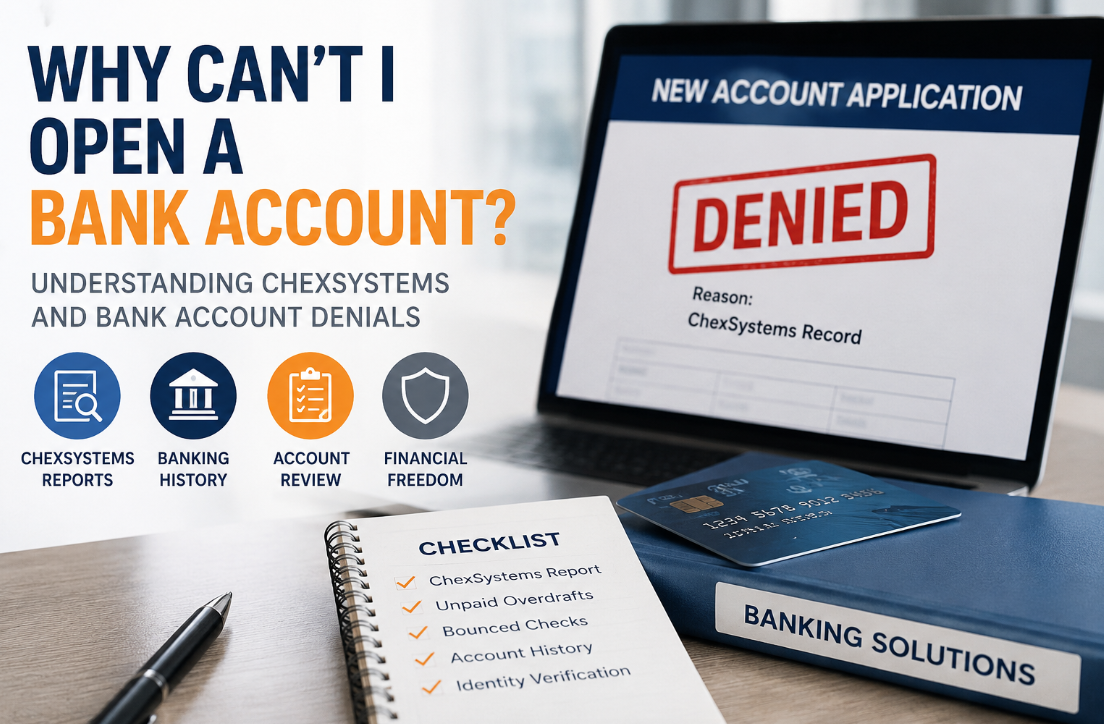
Why Can't I Open a Bank Account?
Banks deny account applications for a few clear reasons. The top reason is a negative record in ChexSystems.
ChexSystems is a consumer reporting agency. It tracks your checking and savings account history. When you apply for a new account, most banks check your ChexSystems report. If it shows unpaid overdrafts, bounced checks, or a forced account closure, the bank may deny you right away.
Other reasons you can't open a bank account include:
Errors on your application (wrong Social Security number or misspelled name)
Identity check failure (the bank can't confirm who you are)
Fraud activity linked to your name
Too many new account attempts in a short time
By law, if a bank denies you based on a consumer report, they must tell you. They must also give you the name of the agency. If a banker says "we can't help you today" without a reason, ask them to be specific.
What Is ChexSystems and Why Does It Matter?
ChexSystems is similar to a credit bureau. But it doesn't track loans or credit cards. It tracks how you manage bank accounts.
More than 80% of U.S. banks and credit unions use ChexSystems to review new applicants, according to the National Consumer Law Center. When a bank closes your account for misuse, they report it. That record stays on file for five years.
ChexSystems also gives you a score from 100 to 899. Higher is better. Scores below 600 flag you as a high-risk applicant. Most major banks will deny you at that range.
You have the right to a free copy of your report once every 12 months. The Fair Credit Reporting Act (FCRA) grants you this. Request it at ChexSystems.com or call 800-428-9623.
What Are the Specific Reasons Banks Refuse to Open an Account?
Here are the most common ChexSystems items that trigger a denial:
Unpaid overdraft fees. You spent more than your balance and never paid it back. One unpaid amount can block you at dozens of banks.
Bounced checks. Writing a check without enough funds creates a negative record. It gets worse if it happens more than once.
Forced account closure. The bank shut down your account due to misuse. This is one of the most damaging marks on a ChexSystems report.
Suspected fraud. Any fraud flag gets reported. It can follow you even if the fraud was not your fault.
Too many account applications. Opening and closing accounts too often signals instability to banks.
Last year, our team reviewed dozens of cases where clients could not open a bank account at three or more banks in a row. In nearly 80% of those cases, the root issue was one unpaid overdraft balance under $200.
Who Can Open a Bank Account?
Most U.S. citizens and permanent residents age 18 or older can open a bank account. You need to meet a few basic requirements.
Here is what banks ask for:
A government-issued photo ID (driver's license, state ID, or passport)
A Social Security number or an Individual Taxpayer Identification Number (ITIN)
Proof of address (utility bill, lease, or pay stub)
An opening deposit (some banks don't require one)
Minors under 18 can open accounts with a parent or guardian as a co-signer. Non-residents may qualify with a foreign passport, ITIN, and a U.S. address. Policies vary by bank.
The real barrier for most people is not age or citizenship. It's a ChexSystems flag. Even a valid ID won't override a negative banking record during the application process.
Why Did My Bank Refuse to Open My Account?
Three main things cause a bank to turn you away.
First, your ChexSystems or Early Warning Services (EWS) report has a negative item. EWS is a similar agency used by large banks like Wells Fargo and Bank of America. Either one can trigger a denial on its own.
Second, your application had a data mismatch. A typo in your Social Security number or an old address can trigger a fraud alert. Banks compare your details against government records. Any mismatch stops the process cold.
Third, the bank has an internal policy that blocks your application. This could be tied to your ZIP code, account history, or credit score. Banks have wide discretion here. They don't always have to explain why.
Always ask for the denial reason in writing. Federal law requires the bank to tell you if a consumer report played any role.
Most people who can't open a bank account are blocked by one of these three issues. Knowing which one applies to you is the first step to fixing it.
How Do I Check If ChexSystems Is Blocking Me?
Go to ChexSystems.com and request your free Consumer Disclosure report. You can also call 800-428-9623. You get one free report every 12 months. You also get a free copy anytime a bank denies you because of the report.
Read every section. Look for:
Accounts reported by banks you no longer use
Wrong personal details (wrong SSN digits or name spelling)
Fraud flags you don't recognize
Overdraft records on accounts you thought were closed
If you spot errors, dispute them with ChexSystems directly. They must investigate within 30 days. If they can't verify the item, they must remove it.
How Can I Fix My ChexSystems Report?
True negative items can't be removed for five years. But you can still act now.
Pay any unpaid balances. After paying, contact the bank that reported you. Ask them to request removal from ChexSystems. Get written proof of payment.
Dispute errors. If anything in your report is wrong, file a dispute with ChexSystems right away. Attach documents that support your case.
Dispute with the reporting bank. Go back to the bank that flagged you. Challenge the accuracy of what they submitted. The FCRA requires them to review it.
In our experience, clients who pay off small balances and request removal see their ChexSystems status updated within 60 to 90 days. That alone is enough to open a standard account at most banks.
What If I Still Can't Open a Bank Account?
You still have real options. Several accounts let you manage money without a clean ChexSystems record.
Second-chance checking accounts skip the ChexSystems check. Chime, Varo Bank, and Wells Fargo's Clear Access Banking all offer these. Some charge a small monthly fee. Some charge nothing.
Credit unions are worth a try before you give up on traditional banking. Many credit unions review each case on its own. Talking to a branch manager in person can sometimes override an automatic denial.
Prepaid debit cards work like a regular Visa or Mastercard. You load funds and spend from that balance. They work for most purchases. The downside is that they don't rebuild your banking history. Monthly fees run between $5 and $10.
Neither prepaid cards nor second-chance accounts will clear your ChexSystems record. They keep you functional while you fix the root problem.
Does a Denied Bank Account Hurt My Credit Score?
No. A ChexSystems or EWS check does not affect your credit score. ChexSystems is not connected to Experian, TransUnion, or Equifax.
That said, some banks do pull your credit report as part of the process. Ask the bank before you apply if they run a hard credit check. Multiple hard pulls in a short window can lower your score by a few points.
The bigger risk is indirect. Without a bank account, you rely on cash-checking services and prepaid cards. Those don't build any credit history. Over time, this limits your access to loans and credit products.
How Long Does ChexSystems Keep Negative Records?
ChexSystems keeps most negative records for five years from the date the bank first reported them. After five years, they drop off on their own.
Fraud records are the exception. Suspected or confirmed fraud may stay on your file longer. Some second-chance banks will also deny you if fraud appears in your report.
You can ask for early removal. Pay off the balance, then ask the reporting bank to withdraw the entry. Not every bank agrees. But many will for small, resolved debts.
If you are waiting out the five-year window, don't waste that time. Open a second-chance account and use it well. When your record clears, your next application for a standard account will be far stronger.
Being denied doesn't have to be permanent. Most people who can't open a bank account are one resolved item away from approval. Pull your ChexSystems report, fix what you can, and use a second-chance account in the meantime. The five-year clock is already running. Start the repair now so you don't have to wait the full five years to bank freely again.