
Can you really improve credit with ChatGPT? Yes, but not by asking AI to remove negative accounts or raise your credit score. ChatGPT can help you read credit reports, calculate credit utilization, organize disputed information, and draft letters. It cannot access your credit bureau records, correct account information, or force Experian, Equifax, or TransUnion to delete accurate negative items.
Consider someone with $4,200 in credit card balances and a combined $5,000 credit limit. Their credit utilization is 84%. ChatGPT can calculate that paying down $2,700 would bring utilization to 30%. At $450 per month, that takes six months, assuming no new charges or interest. The calculation gives the borrower a repayment target, but the payments themselves reduce the debt.
Credit report disputes require the same distinction. Under the Fair Credit Reporting Act (FCRA), consumers have the right to dispute inaccurate or incomplete information. ChatGPT can help organize the facts and draft a dispute letter, but credit bureaus and information furnishers investigate the claim. The Consumer Financial Protection Bureau (CFPB) confirms that consumers can dispute credit report errors for free. Accurate negative information generally cannot be removed simply because someone disputes it.
This guide examines what ChatGPT does well, where its answers become unreliable, and how to use it without exposing sensitive financial information.
You'll find a practical dispute letter prompt, credit utilization examples, and steps to verify AI-generated advice before contacting a credit bureau.
The goal isn't to let ChatGPT repair your credit. It's to use ChatGPT to make better decisions about the credit information you can verify and the actions you control.
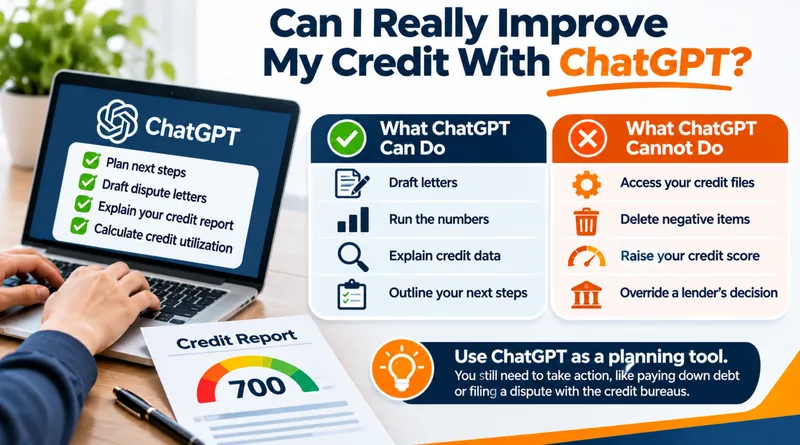
Can I Really Improve My Credit With ChatGPT?
You improve your credit with ChatGPT only when it helps you change what the credit bureaus report. It writes the letter. You find the error, send the dispute, and keep paying on time.
That gap trips people up. They paste in a problem, get a polished letter, and expect the score to move the next week.
The score moves when your reported data changes. myFICO states that payment history carries 35% of a FICO Score and amounts owed carry 30%.
ChatGPT helps with the paperwork around those numbers. It also gets credit rules wrong, and OpenAI states that it sometimes invents quotes and citations.
Here is what this guide covers:
- Four credit tasks ChatGPT handles well
- Where it gets credit wrong
- A dispute-letter prompt and a five-point check for the draft
- What never to paste into the chat
- Does ChatGPT improve your credit score?
- The good: tasks ChatGPT handles well
- The bad: where ChatGPT gets credit wrong
- How to draft a dispute letter with ChatGPT
- How to check a ChatGPT draft before you send it
- How to build a payoff plan
- What not to paste into ChatGPT
- The ugly: five mistakes that cost you
- ChatGPT or a credit repair company?
- How long results take
- FAQ
- ChatGPT drafts. You act. Only corrected or improved reported data moves a score.
- Disputes are free. The CFPB calls disputing errors a free legal right under the Fair Credit Reporting Act.
- Accurate negatives stay. The CFPB states that most negative information remains for seven years.
- Check every fact. Verify each law, number, and account detail against your reports.
Does ChatGPT Improve Your Credit Score?
ChatGPT improves your credit score indirectly. It drafts dispute letters, payoff plans, and call scripts, and those actions change your reported data. ChatGPT does not see your credit reports, file disputes, or remove accurate negative items.
A credit score is a calculation on your credit report. Change the report, and the score follows.
Two things change a report. You correct wrong data, or you change your behavior.
ChatGPT speeds up both. The work that moves the score still belongs to you.
The Good: Four Credit Tasks ChatGPT Handles Well
ChatGPT handles four credit tasks well: drafting dispute letters, building payoff plans, explaining report terms, and scripting calls with creditors. All four are writing or planning work. Each one still needs your facts and your final review.
Dispute letters
ChatGPT writes a clean first draft in under a minute. You supply the account, the error, and the correction.
The CFPB states that a dispute should explain the inaccuracy and include copies of supporting documents.
Payoff plans
Give ChatGPT your balances, limits, and monthly budget. It ranks the cards and sets a schedule.
Our credit utilization guide explains why balances weigh so heavily.
Report terms
Paste a redacted tradeline and ask what "charge-off" or "date of first delinquency" means. The plain-language answer saves you a search.
Confirm legal points at the CFPB. The tool sometimes states rules incorrectly.
Creditor calls
Ask for a short script to request an itemized statement or a payment arrangement. A script keeps the call specific.
Write down the date, the representative's name, and what they promised.
The Bad: Where ChatGPT Gets Credit Wrong
ChatGPT does not verify your credit report, file disputes, guarantee results, or remove accurate negative items. OpenAI states that the tool sounds convincing even when it gives incorrect information. Treat its output as a draft you check.
| Credit Task | ChatGPT | Who Does It |
|---|---|---|
| Pull your credit reports | No access | You, at AnnualCreditReport.com |
| Decide whether an item is wrong | Unreliable | You, comparing the report to your records |
| Send the dispute | Cannot send | You, to the bureau and the furnisher |
| Investigate the dispute | Not involved | The bureau and the furnisher |
| Remove accurate negatives | Cannot | No one, per the CFPB |
| Quote the law correctly | Sometimes wrong | You, checking the CFPB or the statute |
The CFPB states that you generally cannot have accurate negative information removed. Most of it stays for seven years.
A well-written letter does not change that.
How Do You Draft a Credit Dispute Letter With ChatGPT?
Redact personal details, describe one specific error, ask ChatGPT for a short letter, then fix every fact before you send. The CFPB states that you dispute with both the credit reporting company and the company that supplied the information.
Here's how to do it:
- Find the error. Compare your report to your statements. Look for a wrong balance, a late payment you made on time, or an account you never opened.
- Redact your details. Replace your name, address, and account numbers with placeholders.
- Paste the prompt below. Fill in the brackets.
- Rewrite the facts. Add your real details back in a document on your own device. Delete any law or case ChatGPT cites that you did not verify.
- Attach proof. Include copies of statements, receipts, and the marked-up report page. Never send originals.
- Send two disputes. Mail one to the bureau and one to the furnisher, by certified mail with a return receipt.
Write a short, plain-English letter disputing an error on my credit report under the Fair Credit Reporting Act. Address it to [Credit Bureau Name].
The error: the [Creditor Name] account ending [XXXX] shows a [wrong balance / late payment / account I do not recognize] reported as [what the report shows]. The correct information is [what is true]. I have attached [statement / receipt / confirmation].
Ask the bureau to investigate, correct or delete the inaccurate item, and send me the results in writing. Do not cite case law. Keep it under 200 words.
The prompt bans case law on purpose. A fake citation weakens your dispute.
How Do You Check a ChatGPT Draft Before You Send It?
Run five checks on every ChatGPT draft: facts, law, tone, proof, and promises. Fix any failure before you mail the letter. The check takes about ten minutes and prevents the errors that get disputes ignored.
| Check | What a Bad Draft Does | Your Fix |
|---|---|---|
| Facts | Changes your account number, date, or balance | Compare every figure to your report |
| Law | Cites statutes or cases you never gave it | Verify at the CFPB or delete the citation |
| Tone | Threatens lawsuits or uses legal jargon | Rewrite in two or three plain sentences |
| Proof | Mentions documents you have not attached | List only the copies you enclose |
| Promises | Demands deletion of an item that is accurate | Ask for investigation and correction of the error |
Run the check on a real draft, and save the before and after versions. You see exactly what the tool changed.
How Do You Build a Credit Card Payoff Plan With ChatGPT?
List each card's balance, limit, and APR, set your monthly extra payment, and ask ChatGPT to rank the cards and schedule payments. Then check the math yourself. A $4,200 balance on a $5,000 limit is 84% utilization, and a $450 extra monthly payment reaches 30% in six months.
Utilization is your balance divided by your limit.
A 30% target on a $5,000 limit equals $1,500. You pay down $2,700 ($4,200 minus $1,500), and at $450 a month that takes six months.
myFICO states that 30% is a guideline and that lower utilization is better. Pay by the due date every month while you do it, because payment history carries the most weight.
What Should You Not Paste Into ChatGPT?
Never paste your Social Security number, full account numbers, date of birth, or passwords into ChatGPT. Replace them with placeholders. OpenAI states that you control whether your chats improve its models, so review that setting before you share anything.
Use placeholders such as [NAME], [ADDRESS], and [ACCOUNT ENDING 1234].
Add the real details only after you copy the draft into a document on your own device. A pasted credit report is sensitive financial data. When in doubt, describe the problem in your own words.
The Ugly: Five Mistakes That Cost You
Five mistakes waste time or money: trusting invented laws, disputing accurate items, sending generic mass letters, skipping the furnisher, and paying anyone upfront to "run AI credit repair." Avoid all five.
- ✗Trusting a cited law or case. OpenAI states the tool sometimes invents citations. Check statutes at the CFPB or the U.S. Code.
- ✗Disputing everything. Dispute only items you show are wrong.
- ✗Sending one letter to every bureau. Each bureau shows different data, so match each letter to each report.
- ✗Skipping the furnisher. The CFPB states that you contact both the bureau and the company that supplied the information.
- ✗Paying upfront. The CFPB states that credit repair companies cannot request or receive payment until they complete the promised services.
Should You Use ChatGPT or a Credit Repair Company?
Use ChatGPT and your own time for one or two clear errors on one report. Hire a credit repair company when you face many disputes across three bureaus and several furnishers. Neither route guarantees a score increase or removes accurate information.
| Situation | Better Fit |
|---|---|
| One wrong balance on one report | You, with a ChatGPT draft |
| Several errors across all three bureaus | A credit repair company, or a long DIY process |
| Accurate late payments from years ago | Neither removes them. Build new on-time history |
| You lack time to track follow-ups | A credit repair company |
| Someone promises a specific score jump | Walk away |
The CFPB also states that you have three business days to cancel a credit repair contract at no charge.
How Long Does It Take to See Results?
Expect about 30 days for a dispute response and one to two reporting cycles for lower balances to appear. The CFPB states that furnishers generally have 30 days to investigate a dispute. A score change follows the corrected data, not the letter.
A second round of disputes adds another month.
A payoff plan shows up one billing cycle at a time, because each issuer reports balances on its own schedule. Our guide to credit score mistakes lists the habits that undo progress.
Think of ChatGPT as a fast assistant, not a credit expert. You stay responsible for every fact in the letter and every payment on the plan.
Proceed with caution, and verify before you send.
Not Sure What to Dispute?
ChatGPT writes the letter, but it cannot read your credit file. Start with the report itself. ASAP Credit Repair USA helps you review your three-bureau reports for inaccurate balances, payment statuses, and unfamiliar accounts, so you know what deserves a dispute.
Review Your Credit Report → Credit report corrections do not guarantee a score increase or the removal of accurate information.Frequently Asked Questions About Improving Credit With ChatGPT
Does ChatGPT fix bad credit?
No. ChatGPT drafts letters and plans, but it does not change your credit report. Your score improves when wrong data gets corrected or when your payment and balance habits change. Use ChatGPT to save time on the writing, then send the dispute and follow up yourself within 30 days.
Is ChatGPT able to write a credit dispute letter?
Yes. ChatGPT writes a clear first draft in under a minute when you describe the error and the correction. Rewrite the facts yourself, attach proof, and delete any law or case it cites that you did not verify. OpenAI states that the tool sometimes invents citations, so verify each one.
Is it safe to give ChatGPT my credit report?
Share as little as possible. Never paste your Social Security number, full account numbers, or date of birth. Use placeholders for names and accounts, and check your privacy settings first. OpenAI states that you control whether your chats are used to improve its models.
Will ChatGPT remove negative items from my credit report?
No. The CFPB states that you generally cannot have accurate negative information removed, and most of it stays for seven years. A letter works only when the item is wrong, outdated, or unverifiable. Dispute items you prove are inaccurate, and leave accurate ones alone.
Does ChatGPT know my credit score?
No. ChatGPT has no access to your credit file unless you type details in. Check your score through your bank, card issuer, or myFICO, and pull your full reports free at AnnualCreditReport.com. Then give ChatGPT only the redacted facts it needs for each task.
Is a ChatGPT dispute letter as good as a credit repair company's?
For one clear error, yes. The letter matters less than the proof you attach and the follow-up you do. For many errors across three bureaus, a company saves time on tracking. The CFPB states that disputing errors is free, and no company guarantees results or a specific score.
What should I ask ChatGPT about my credit?
Ask for tasks, not verdicts. Request a dispute letter draft, a payoff schedule from your balances, a plain-English definition of a report term, or a call script. Avoid asking whether an item is legally removable. Check each answer against your reports and the CFPB.
How long does a credit dispute take?
Plan on about 30 days. The CFPB states that furnishers generally have 30 days from receipt to investigate and respond. Send one dispute to the bureau and one to the furnisher, keep copies of everything, and note the dates you mailed them.
- DIY Credit Repair: Fix Your Credit Like a ProA step-by-step guide to disputing on your own.
- Dispute Credit Report Errors GuideHow to dispute a wrong balance or status.
- How to File a TransUnion DisputeBureau-specific dispute steps.
- Late Payments on Credit Report: Removal GuideWhat a late payment does and how it ages.
- Consumer Financial Protection Bureau — How do I dispute an error on my credit report?
- Consumer Financial Protection Bureau — Is it possible to remove accurate negative information from my credit report?
- Consumer Financial Protection Bureau — How can I tell a credit repair scam from a reputable credit counselor?
- OpenAI Help Center — Does ChatGPT tell the truth?
- OpenAI — ChatGPT privacy settings
- myFICO — What is in your credit score
- AnnualCreditReport.com — Free credit reports
- Google Search Central — Creating helpful, reliable, people-first content