

Indianapolis led the nation in credit score growth, but the financial picture for local households is more complicated than that ranking suggests.
Between Q1 2025 and Q1 2026, Indianapolis credit scores increased 3.03%, the largest gain of any U.S. city studied by WalletHub. At the same time, nearly 1 in 5 Indiana residents has medical debt in collections, while Marion County recorded more than 25,000 eviction filings in 2024.
Those numbers show two sides of the same city. More residents may be keeping balances lower and payments current, while others are still dealing with medical collections, unpaid rent, and housing-related debt that can damage an individual credit file.
“A citywide increase does not mean every credit report in Indianapolis improved,” says Joe Mahlow, owner of ASAP Credit Repair USA. “When we review a report, we look at what is happening account by account. One collection or inaccurate balance can tell a very different story from the citywide trend.”
So, why did Indianapolis have the largest credit score increase in the U.S.? The latest data points to real progress, but medical debt, evictions, and collection accounts show where credit pressure remains.
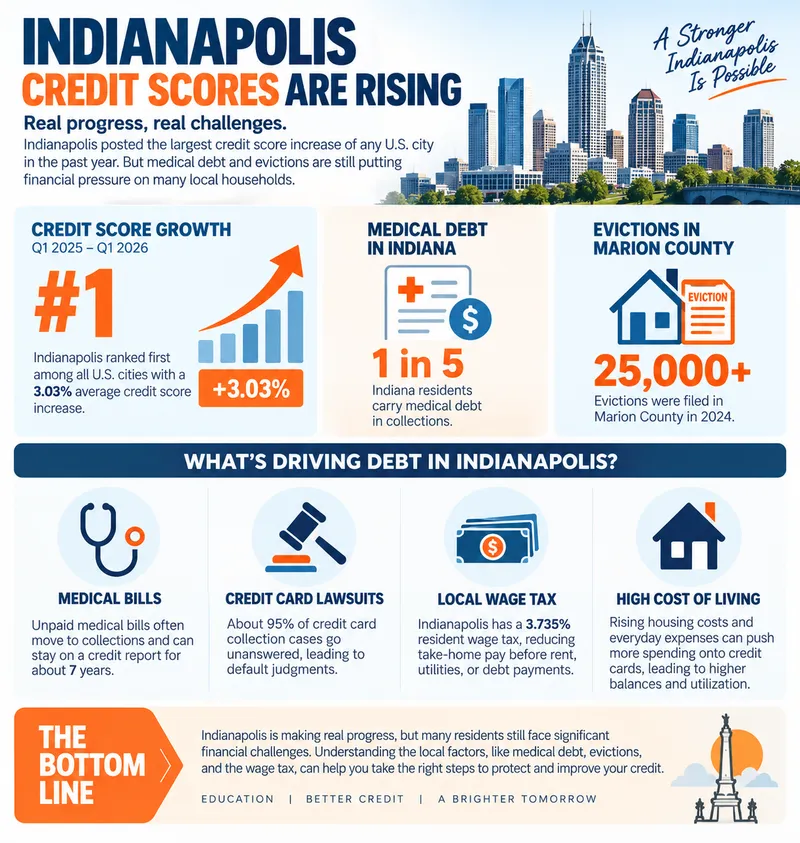
Why Did Indianapolis Have the Largest Credit Score Increase in the U.S.?
Indianapolis posted the largest credit score increase of any city in the United States over the past year, and that single fact sits next to a much harder one: nearly one in five Indiana residents carries medical debt in collections, and Marion County filed more than 25,000 evictions in 2024 alone. Both things are true about Indianapolis at the same time. This article pulls together the most current credit score, debt, and housing data for Indianapolis, what is driving the city's score growth, and where the underlying financial pressure is still showing up.
Why Did Indianapolis Have the Largest Credit Score Increase in the U.S.?
Indianapolis's average credit score rose 3.03 percent between Q1 2025 and Q1 2026, the largest increase of any U.S. city, according to WalletHub. That is more than a full percentage point ahead of Chula Vista, California, the second-place city at 1.91 percent, and no other city studied posted growth above 3 percent.
WalletHub's editorial team attributes broad score improvements like this to residents staying current on payments and keeping credit card utilization below 30 percent, the same two factors that carry the most weight in any FICO or VantageScore calculation. Indianapolis simply outpaced every other major U.S. city on that combination over the past year.
What Is the Average Credit Score in Indianapolis?
Indiana's statewide average credit score is 713 on the FICO scale, ranking 15th among all 50 states and sitting just below the national FICO average of 717. Indianapolis, as the state's largest city, was also the single biggest driver of credit score improvement nationwide in the most recent WalletHub study.
| Metric | Figure | Source |
|---|---|---|
| Indiana average credit score (FICO) | 713 (15th of 50 states) | Experian FICO state data |
| National average credit score (FICO) | 717 | Experian FICO national data |
| Indianapolis credit score growth | +3.03% (1st of all U.S. cities) | WalletHub, Q1 2025-Q1 2026 |
| Indiana residents with medical debt in collections | ~20% (1 in 5) | Johns Hopkins Bloomberg School of Public Health |
How Common Is Medical Debt in Indianapolis?
Nearly one in five Indiana residents has medical debt in collections, according to a Johns Hopkins Bloomberg School of Public Health study reported by WRTV. Adults carrying medical debt were four times more likely to experience housing instability the following year, at 24 percent, compared to 6 percent for adults without medical debt.
Medical debt in Indianapolis is significant enough that a coordinated relief effort recently addressed it directly. United Way of Central Indiana and United Neighborhood Centers of Indianapolis erased nearly $234 million in medical debt for 108,699 Marion County residents, roughly one in nine county residents, by purchasing that debt from collections agencies at a steep discount, as reported by Axios Indianapolis.
Adults without medical debt reported housing instability at close to background levels the following year.
Adults carrying healthcare debt were four times as likely to face housing instability within a year.
See If Medical Debt Is Hiding on Your Indianapolis Credit Report
A free 3-bureau review shows exactly what Equifax, Experian, and TransUnion currently report, including medical collections that may already be past their reporting eligibility.
Claim My Free Credit Analysis Now → Secure · 2 minutes · No credit card requiredHow Bad Are Evictions in Indianapolis Right Now?
Marion County, which contains Indianapolis, saw over 116,000 eviction filings between January 2021 and September 2025, including more than 25,000 in 2024 alone, according to the Fair Housing Center of Central Indiana. Indianapolis ranks sixth highest among 27 major U.S. cities tracked by Eviction Lab for its eviction filing rate.
| Eviction Metric | Marion County Figure |
|---|---|
| Total filings, Jan. 2021-Sept. 2025 | 116,489 |
| Filings in 2024 alone | 25,000+ |
| 2024 filing rate | 14.6 per 100 renter households |
| 2025 filing rate | 14.2 per 100 renter households |
| National ranking among 27 tracked cities | 6th highest |
| Highest-filing township (Warren) | 16 per 100 renter households |
A decade ago, Indianapolis ranked second nationally for total evictions, behind only New York City despite having roughly a tenth of its population. Filing volume has come down slightly since then, but Marion County still recorded more eviction filings in the past year than the entire state of Minnesota, a state with more than five times its population.
Does an Eviction Show Up Directly on a Credit Report in Indianapolis?
An eviction filing itself does not appear as a line item on a credit report. What does appear is the financial fallout, unpaid rent sent to collections or a court judgment for money owed, both of which can significantly lower a score and remain on a credit report for up to seven years.
This is one of the more misunderstood parts of an eviction's financial impact, covered in more detail in how eviction records actually impact a credit score. The court case is public record and shows up in tenant screening searches, but the credit report damage comes specifically from what happens to the unpaid balance afterward, not the eviction filing itself.
- ✓ Pull a full credit report to see whether an unpaid balance from an eviction was sent to collections
- ✓ Dispute any collection amount that does not match what was actually owed
- ✓ Check for medical debt in collections separately, since it is one of the most common co-occurring issues on Indianapolis files
- ✓ Ask about pay-for-delete arrangements on old collection accounts where appropriate
- ✓ Expect meaningful credit repair progress within 3 to 6 months with consistent dispute activity
Indianapolis leading the nation in credit score growth and Marion County leading in eviction filings are not contradictory facts. Citywide averages move on aggregate payment behavior, while individual households are still working through the medical debt and housing-related collections that drag a single credit file down.
Indianapolis genuinely earned its number one national ranking for credit score growth, and that reflects real progress for a lot of residents. At the same time, medical debt touches roughly one in five Indiana households, and Marion County's eviction filing rate remains among the highest in the country. Both data sets are current, and both are useful, since the same credit report that shows a rising score can also be hiding a collections account worth disputing.
Why did Indianapolis have the largest credit score increase in the U.S.?
Indianapolis's average credit score rose 3.03 percent between Q1 2025 and Q1 2026, the largest increase of any U.S. city, according to WalletHub. That is more than a full percentage point ahead of Chula Vista, California, the second-place city at 1.91 percent, and no other city studied posted growth above 3 percent.
What is the average credit score in Indianapolis?
Indiana's statewide average credit score is 713 on the FICO scale, ranking 15th among all 50 states and sitting just below the national FICO average of 717. Indianapolis, as the state's largest city, was also the single biggest driver of credit score improvement nationwide in the most recent WalletHub study.
How common is medical debt in Indianapolis?
Nearly one in five Indiana residents has medical debt in collections, according to a Johns Hopkins Bloomberg School of Public Health study reported by WRTV. Adults carrying medical debt were four times more likely to experience housing instability the following year, at 24 percent, compared to 6 percent for adults without medical debt.
How bad are evictions in Indianapolis right now?
Marion County, which contains Indianapolis, saw over 116,000 eviction filings between January 2021 and September 2025, including more than 25,000 in 2024 alone, according to the Fair Housing Center of Central Indiana. Indianapolis ranks sixth highest among 27 major U.S. cities tracked by Eviction Lab for its eviction filing rate.
Does an eviction show up directly on a credit report in Indianapolis?
An eviction filing itself does not appear as a line item on a credit report. What does appear is the financial fallout, unpaid rent sent to collections or a court judgment for money owed, both of which can significantly lower a score and remain on a credit report for up to seven years.
Turn Indianapolis's Momentum Into Your Own Score Gains
A free 3-bureau audit shows exactly what is helping or hurting your score right now, so you can build on Indianapolis's national-leading progress instead of guessing at it.
Claim My Free Credit Analysis Now → Secure · 2 minutes · No credit card required-
How Eviction Records Impact Your Credit Score Explains why the eviction filing itself is not the credit report problem, and what actually drags a score down afterward.
-
How Medical Debt Can Impact Your Credit Score Covers how much a medical collection can cost a score and recent changes to medical debt reporting rules.
-
How Long Does Credit Repair Take? Setting Expectations Sets realistic timelines for dispute rounds and meaningful score improvement based on what is being corrected.
-
How to Go From 500 to 700 Credit Score Fast A phased plan for rebuilding a damaged score, starting with utilization and inaccurate report entries.
-
WalletHub: Indianapolis Had the Largest Credit Score Increase Coverage of the WalletHub study ranking Indianapolis first nationally for year-over-year credit score growth.
-
WRTV: Medical Debt and Housing Instability in Indiana Investigative reporting on the Johns Hopkins study linking medical debt to housing instability among Indiana residents.
-
FHCCI: Eviction Filings in Marion County Townships and Neighborhoods The full 2026 Fair Housing Center of Central Indiana report on eviction filing volume and rates across Marion County.