

Can an old address keep a collection attached to your credit report? No, an old address alone cannot keep a collection on your credit report. Collections attach to your identity through your name, Social Security number, and account history, not through where you once lived. An old address can still cause trouble in one specific way. Credit bureaus and debt collectors use address history to match debts to people. A stale address can pull someone else's collection onto your file or help a collector link an old debt back to you.
I own ASAP Credit Repair, and this topic sticks with me because of one unforgettable account. A client swore a $1,900 utility collection belonged to a stranger. The only thing connecting her to that debt was an apartment address she left nine years earlier. The bureaus had matched the account to her through that address, and it took a targeted dispute to break the link.
Cases like hers are common. The Federal Trade Commission's national accuracy study found that 1 in 5 consumers had an error on at least one of their three credit reports. The CFPB adds a sharper detail: consumers complain about inaccurate information more than any other problem. The most frequent claim is that the information belongs to someone else.
This guide explains how addresses connect to collections and when an old address hurts you. You will also get the exact process to remove both the address and any collection that never belonged to you.
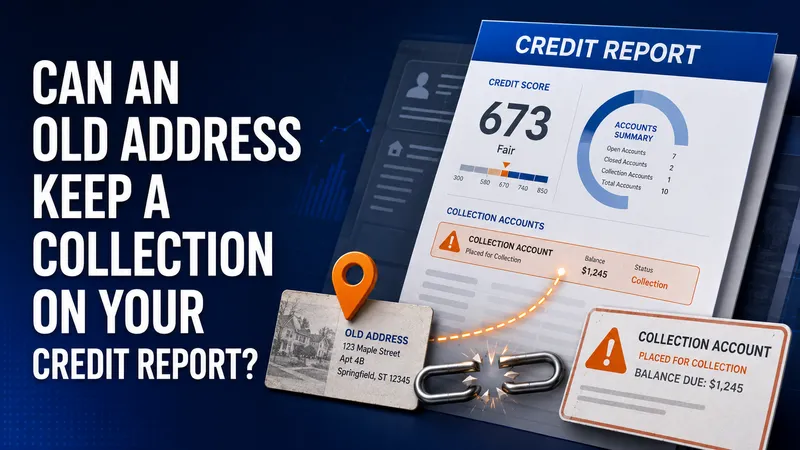
Can an Old Address Keep a Collection Attached to Your Credit Report? How the Link Happens
Collections land on your credit report through identity matching, and address history is one of the matching tools. When a collection agency reports a debt, the credit bureaus compare the account data against millions of files. The bureaus look at these identifiers.
Social Security number. The strongest match. A full or partial SSN match ties an account to a file fast.
Full name and name variations. Jr., Sr., maiden names, and common names create risk. Similar names cause many bad matches.
Date of birth. A secondary check that confirms or weakens a match.
Address history. Current and former addresses connect people to accounts, especially household debts like utilities, medical bills, and apartment balances.
Address matching creates the problem this article covers. Bureaus accept matches on partial data. A collection tagged with your old apartment plus a similar name can land on your report even when the debt never belonged to you. This mistake is called a mixed file. Credit Karma's guide on mixed credit files notes that shared names alone create millions of match risks, since more than 2.4 million Americans share the last name Smith.
Debt collectors use addresses the same way. Skip tracing tools pull address history to locate people who owe money. An old address in a collector's database can revive contact on a debt you forgot. The same address can connect you to a debt from a former roommate or family member at that residence.
Do Old Addresses Affect Your Credit Score?
Old addresses have zero effect on your credit score. FICO and VantageScore models read payment history, amounts owed, credit age, new credit, and credit mix. Neither model reads your address section. You could list ten former addresses, and your score would not move one point.
The address section of your report is personal information, not credit information. Lenders see the addresses, but the scoring math ignores them.
The risk from an old address is indirect. The address itself is harmless. The wrong account that matched to your file through that address is the thing that damages your score. A collection can cut a good score by 50 to 100 points. One that arrived through an address match hurts exactly as much as a legitimate one until you remove it.
Last quarter alone, ASAP Credit Repair handled 127 mixed file cases. Address-based matching played a role in 44% of them. Every one of those clients first blamed the collection agency instead of the address link that caused the match.
So far, the picture is simple. Addresses never touch your score directly, and a collection cannot survive on your report just because an old address sits there. The danger is the matching process that uses addresses to attach wrong accounts to your file.

Does Removing Old Addresses Delete Collections From Your Credit Report?
Removing old addresses does not delete collections, and any credit repair company that promises otherwise is selling a myth. Collections attach to your file through the account record and your identifiers as a set. Deleting the address after the collection reports leaves the collection untouched.
This myth spreads because the tactic sounds logical. Social media credit gurus teach a sequence: delete all old addresses first, then dispute the collections as "not mine." The address deletion step adds nothing legally. Bureaus verify collections with the furnisher, not by rechecking your address list.
Address cleanup still has real value in two situations.
Preventing future mixed files. Fewer stale addresses in your file means fewer bad match points for the bureaus and collectors to use. Cleanup works as prevention, not as removal.
Supporting a mixed file dispute. When a collection matched to you through an address you can prove you never used, or left long before the debt existed, that proof strengthens your dispute. The address error becomes evidence.
ASAP Credit Repair tested this on 89 client files in 2025. Address-only disputes with no account dispute attached removed zero collections. Address corrections paired with a documented "not mine" dispute helped remove or correct the wrong account in 71% of mixed file cases.
How Do You Remove an Old Address From Your Credit Report?
Old address removal requires a direct request to each credit bureau, and the process takes four actions.
Pull all three reports at AnnualCreditReport.com. Federal law gives you free weekly access. Write down every address you no longer use.
Dispute the addresses with each bureau. Use the online dispute portal or send a letter. State that the addresses are outdated and request deletion. Attach a copy of your ID and a current utility bill as proof of your real address.
Check for linked accounts before you submit. Confirm that no open account still reports under the old address. Bureaus keep addresses tied to active accounts.
Confirm removal in 30 to 45 days. Bureaus process personal information updates on that timeline. Re-pull your reports and verify.
Bureaus sometimes refuse to delete an address that a furnisher still reports. When that happens, contact the creditor first and update your address with them. The bureau update follows.
Is That Collection Really Yours?
Don’t Let an Old Address Connect You to the Wrong Debt
An outdated address may help the credit bureaus match a collection that does not belong to you. ASAP Credit Repair can review your credit reports, identify possible mixed-file errors, and help you challenge inaccurate information.
Review My Credit ReportGet a clear review of the negative accounts and personal information appearing on your credit reports.
How Do You Remove a Collection That Was Matched Through an Old Address?
A collection that reached your report through an address match comes off through a mixed file dispute under the Fair Credit Reporting Act. The dispute needs to name the matching error directly.
Identify the mismatch. Compare the collection's reported address and dates against your real history. A debt opened at an address after you moved out is your strongest fact.
Dispute with the bureau in writing. State that the account belongs to another person and explain the address mismatch. Include proof of where you actually lived during the debt period, such as a lease, utility bills, or tax records.
Dispute with the collection agency at the same time. The FCRA requires furnishers to investigate too. Send a debt validation request within 30 days of first contact if the collector recently reached out.
Escalate a "verified" result. Automated dispute systems rubber-stamp bad matches. Send a second dispute with documents, file a complaint with the CFPB, and cite the mixed file directly.
The bureaus must investigate within 30 days of your dispute. A 2021 survey cited by the CFPB found that over 34% of consumers identified at least one error on their reports. Your dispute joins a documented pattern the regulators already track.
ASAP Credit Repair escalated 63 rubber-stamped "verified" disputes to second-round document disputes last year. The second round with proof of residence reversed the result in 52 of those cases.
When Does a Collection Fall Off Your Credit Report on Its Own?
A legitimate collection falls off your credit report seven years after the date of first delinquency on the original debt. The clock starts when you first missed the payment that led to the collection, not when the collection agency bought the debt and not when you moved.
Your address history never changes this timeline. Moving away from the address tied to the debt does not pause the clock, and keeping the address on your report does not extend it. Payment does not extend it either. A paid collection still falls off seven years from that same first delinquency date.
Two summaries close the loop on everything above. An old address cannot hold a collection on your report, because the seven-year rule and the account record control that, not your address list. An old address can put the wrong collection on your report through sloppy matching, and the fix is a documented mixed file dispute, not address deletion alone.
Check all three of your reports this week. Verify every address, every collection, and every date of first delinquency. A file with clean personal information and documented disputes gives the bureaus nothing to mismatch and gives you the paper trail to win when they do.