
Purchase APR is one of the most important numbers on your credit card agreement, yet many Americans pay little attention to it until interest charges begin appearing on their statements. A card offering cash back, travel rewards, or a generous credit limit can quickly become expensive when the balance carries over from one month to the next.
The cost of borrowing has become harder to ignore. According to the Federal Reserve, the average interest rate on credit card accounts assessed interest reached 22.83% in August 2024, compared with 16.43% in August 2019. At a 24% purchase APR, carrying a $5,000 balance for 30 days could generate approximately $99 in interest, assuming the balance stays constant and interest accrues daily without compounding.
Consider someone who charges $2,500 for an emergency car repair. They make the minimum payment each month, believing they're keeping the account in good standing. While that protects against a late payment, it doesn't stop purchase interest from accumulating. The longer the balance remains unpaid, the more expensive the original purchase becomes.
Purchase APR determines the annualized interest rate applied to eligible credit card purchases when interest is charged. However, having a high APR doesn't automatically mean you'll pay interest. Many cards offer a grace period that allows you to avoid purchase interest by paying your statement balance in full by the due date.
This guide explains how purchase APR works, how credit card issuers calculate interest, when the grace period applies, and what you can do to avoid paying more than the original purchase price.
What Is Purchase APR? How Credit Card Interest Really Works
Purchase APR is the annual interest rate a card issuer applies to the eligible purchase balance on your credit card. It sounds simple until the statement arrives and a $75 payment barely moves a $3,000 balance.
The Federal Reserve's G.19 release of October 7, 2026 puts the average rate at 22.15% on accounts assessed interest and 20.94% across all accounts, both for the second quarter of 2026. At 22.15%, interest alone takes roughly $55 a month from a $3,000 balance.
Purchase APR does not charge interest on every purchase. Your card's grace-period terms and your payment behavior decide when interest starts, and a cardholder who pays the full statement balance by the due date owes no interest on new purchases.
This guide shows how daily interest is calculated, how to compare rates, how a 0% introductory offer differs from deferred interest, and how to cut the cost of carrying a balance. It also covers where your rate appears on a statement and why it changes.
By the end of the next two sections, you will calculate your own daily interest on any balance and know the one mistake that turns a no-interest purchase into a daily charge.
What Is Purchase APR?
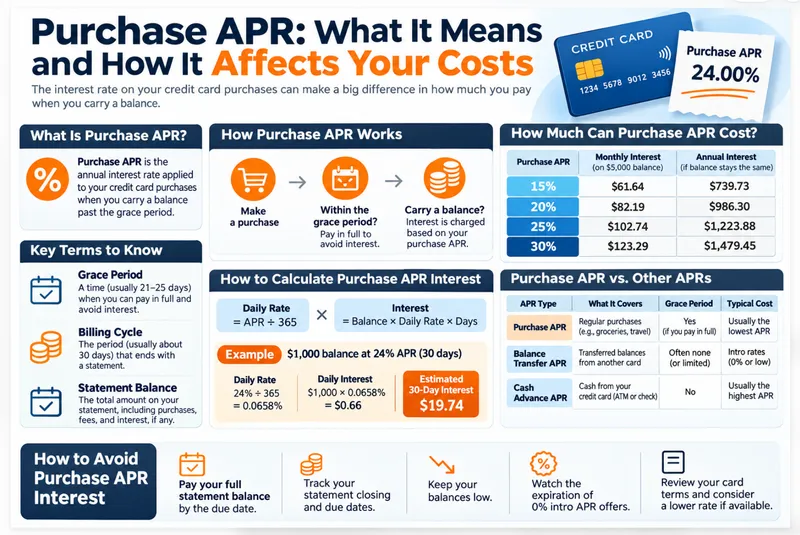
Purchase APR is the annual percentage rate a card issuer applies to the unpaid balance from purchases made with the card. Interest accrues daily on that balance. A grace period lets you avoid interest on new purchases when you pay the full statement balance by the due date.
| Term | What It Means |
|---|---|
| Annual percentage rate (APR) | The yearly cost of borrowing, expressed as a percentage. The CFPB calls it the standard way to compare loan costs. |
| Purchase balance | What you owe from purchases, as opposed to cash advances or transfers |
| Interest charge | The dollar amount added to your account for borrowing that balance |
| Billing cycle | The period, usually about 30 days, covered by one statement |
| Grace period | The time between the end of a billing cycle and your payment due date, when new purchases carry no interest if you pay in full |
| Outstanding balance | The amount you still owe after payments, which keeps accruing interest when unpaid |
Here is a $1,000 example. You buy $1,000 of furniture on a card with a 24% purchase APR.
Pay the full statement balance by the due date and the interest is $0. Carry the whole $1,000 for 30 days and the interest is about $19.73, as the calculation section shows.
Purchase APR differs from the rates on other transactions. A cash advance or a balance transfer carries its own APR, and one card account holds several rates at once. The comparison table later in this guide sets them side by side.
How Does Purchase APR Work?
Your issuer divides the annual rate by 365 to get a daily periodic rate, then applies it to your balance each day. Most issuers use your average daily balance for the billing cycle. The monthly interest charge is the sum of those daily amounts.
The CFPB explains that interest accrues daily, and that the sooner you pay down a balance, the less interest you pay. A 24% APR is not 24% a month. For a 30-day cycle, it works out to about 1.97% of the balance.
Average daily balance matters when your balance changes during the cycle. Suppose you carry $1,000 for 10 days and $1,500 for 20 days in a 30-day cycle. Your average daily balance is $1,333.33, and at 24% the simplified interest is about $26.30.
When Does Purchase APR Start Charging Interest?
Interest starts on a purchase the day you lose your grace period, or the day you make the purchase if you already carry a balance. These are the conditions that control it:
- ✓Grace period active: new purchases carry no interest while you pay the full statement balance by the due date every month
- ✓Unpaid balance carried over: you owe interest on the unpaid amount, and interest starts on new purchases from the day each one is made, according to the CFPB
- ✓Inconsistent payment: the CFPB warns that paying in full some months and not others costs you the grace period for the month you skip and the month after
- ✓No grace period offered: the CFPB notes that issuers are not required to offer one, though most do on purchases
- ✓Restoring the grace period: the conditions sit in your cardholder agreement, so read that document or call the issuer
Regulation Z limits how issuers charge after a lost grace period. Under 12 CFR 1026.54, an issuer generally cannot charge interest on balances from days before the most recent billing cycle, and cannot use two-cycle average daily balance billing.
Does Purchase APR Apply If You Pay in Full?
Not on new purchases, if your card has a grace period and you pay the full statement balance by the due date. Paying only the minimum is a different act: it keeps the account current, but it does not preserve the grace period, and the unpaid balance accrues interest daily.
How to Calculate Purchase APR Interest
Divide the purchase APR by 365 to get the daily periodic rate, then multiply by your balance. Multiply the daily interest by the days in the cycle for an estimate. Actual statement charges differ with payment timing, new transactions, compounding, and the issuer's balance method.
Daily interest = Balance × Daily periodic rate
Billing-cycle interest (constant balance) = Balance × (APR ÷ 365) × Days
Purchase APR Example: $1,000 at 24%
| Step | Calculation | Result |
|---|---|---|
| Daily periodic rate | 24% ÷ 365 | 0.0658% per day |
| Daily interest | $1,000 × 0.000657534 | About $0.66 |
| 30-day interest | $1,000 × (0.24 ÷ 365) × 30 | About $19.73 |
How Much Interest Does Purchase APR Add to $5,000?
| Purchase APR | Estimated Daily Interest | Estimated 30-Day Interest |
|---|---|---|
| 15% | $2.05 | $61.64 |
| 20% | $2.74 | $82.19 |
| 25% | $3.42 | $102.74 |
| 30% | $4.11 | $123.29 |
The gap between 15% and 30% is $61.65 every 30 days on this balance. Over a full year of an unpaid balance, that gap is about $750 before compounding.
What Is a Good Purchase APR?
A good purchase APR is competitive against current card offers and fits your credit profile. No universal threshold exists. Compare your rate to the Federal Reserve's published averages and to the pricing tables of cards you qualify for.
The Federal Reserve's G.19 release of October 7, 2026 reports 22.15% for accounts assessed interest and 20.94% for all accounts in the second quarter of 2026. A 24% rate sits 1.85 points above the first figure. That comparison tells you where you stand today, not what you qualify for.
Two applicants for the same card receive different APRs. Issuers price by creditworthiness, their own pricing tiers, and underwriting factors such as income and existing debt. A variable rate also moves with its reference index, so the same offer prices differently in different months.
To compare real offers, read each card's pricing table before you apply. That table lists the purchase APR as a range or a single rate, and it is the document that binds the issuer.
What Is an Introductory Purchase APR?
An introductory purchase APR is a temporary low rate, often 0%, that applies to purchases for a set period after you open the card. When the period ends, the regular purchase APR applies to any remaining balance. Check the length, the eligible purchases, and the rate that follows.
How Does a 0% Introductory Purchase APR Work?
- ✓Promotional duration: the offer states the number of months
- ✓Eligible purchases: some offers cover only purchases made in the first months
- ✓Required payments: you still owe the minimum payment every month
- ✓Late payments: the CFPB warns that a payment more than 60 days late lets the issuer raise your rate on all balances
- ✓Expiration: the regular purchase APR applies to what remains, and Regulation Z requires the issuer to disclose that later rate in advance
A hypothetical example: you put a $2,400 purchase on a card with a 12-month 0% introductory period. Divide $2,400 by 12 and you owe $200 a month in principal to clear it before the offer ends. The figure excludes fees and other transactions, and the card's minimum payment is often lower than $200, so the minimum alone leaves a balance when the promotion expires.
Is 0% Purchase APR the Same as Deferred Interest?
| Feature | 0% Introductory APR | Deferred Interest |
|---|---|---|
| Interest during the promotion | None | Tracked in the background, not charged yet |
| If a balance remains at the end | The regular purchase APR applies to the remaining balance going forward | Interest is charged from the original purchase date, per the CFPB |
| Main risk | A higher rate on what is left | A large retroactive interest charge |
| Check before you buy | The post-promotion APR | The exact payoff date and whether minimums clear the balance |
The CFPB states that with a deferred-interest plan, an unpaid balance at the end triggers interest for each month, going back to the purchase date. It adds that your minimum payments probably will not pay off the balance in time.
Purchase APR vs. Balance Transfer APR vs. Cash Advance APR
One card account holds a separate APR for each type of balance. Purchases usually have a grace period, cash advances usually do not, and balance transfers often carry a transfer fee. Your statement lists each balance category with its own rate.
| APR Type | Transaction Covered | Grace-Period Treatment | Additional Fees | Main Borrowing Risk |
|---|---|---|---|---|
| Purchase APR | Items and services bought with the card | Usually has a grace period if you pay in full | None on the purchase itself | Daily interest on any balance you carry |
| Balance transfer APR | A debt moved from another account | Set by the card agreement | A transfer fee in many offers | The promotional rate ends and the regular rate follows |
| Cash advance APR | Cash withdrawals and card checks | Generally none. Interest starts the day of the transaction. | Substantial fees, flat or a percentage, plus ATM fees | A higher rate with no interest-free window |
The CFPB explains that when you pay more than the minimum, the issuer generally applies the excess to the highest-rate balance first. That rule protects you from having extra payments absorbed by a low-rate promotional balance while a cash advance accrues at a higher rate.
Where Do You Find Your Purchase APR?
Your purchase APR appears in the interest charge calculation section of your monthly statement, listed beside the purchase balance. The original rate also appears in the pricing table, commonly called the Schumer box, that came with your application or account-opening materials.
- Open the current billing statement. Use the most recent one, not your account-opening paperwork.
- Find the interest charge calculation section. The CFPB notes that statements list each balance category and its APR.
- Locate the purchase balance and its APR. Read across the row to the interest charged for the cycle.
- Check the rate type. A (v) beside the rate usually marks a variable rate. A promotional rate lists an end date.
| Type of Balance | APR | Balance Subject to Interest Rate | Interest Charge |
|---|---|---|---|
| Purchases | 24.99% (v) | $1,200.00 | $24.65 |
| Cash advances | 29.99% (v) | $300.00 | $7.39 |
The original disclosure and your current APR differ for a few reasons. A variable rate moves with its index, a promotional rate expires, and an issuer sends advance notice before changing terms on new purchases. Regulation Z requires the pricing table on credit card applications and solicitations (12 CFR 1026.60).
Why Did My Purchase APR Increase?
A purchase APR rises when a promotional rate expires, when the index behind a variable rate goes up, when you fall more than 60 days behind, or when the issuer gives 45 days' notice of a higher rate on new purchases. Federal rules protect most existing balances.
The CARD Act and Regulation Z (12 CFR 1026.55) set the limits. The CFPB states that a card company is not permitted to increase your rate on existing purchases, with specific exceptions.
- ✓Promotional rate expires: allowed when the promotion lasted at least six months and the later rate was disclosed in advance
- ✓Variable rate follows its index: an increase tied to a publicly available index, such as the U.S. prime rate, is allowed
- ✓Payment more than 60 days late: the issuer sends a notice first, and six consecutive on-time minimum payments after that restore the earlier rate on prior balances
- ✓Advance notice for new purchases: issuers generally give 45 days' notice before raising the rate on new transactions, and generally not during the first year of an account
- ✓A workout or hardship arrangement ends: the earlier rate returns when the arrangement ends
After a rate increase that followed the 45-day notice, the CFPB says the issuer generally must reevaluate your rate at least every six months. The CFPB adds that if you believe an increase was a mistake, contact your issuer.
How to Avoid Paying Purchase APR Interest
Pay the full statement balance by the due date every month. Interest on new purchases stays at zero as long as your card has a grace period and you keep it. If you carry a balance, pay more than the minimum.
- Pay the full statement balance by the due date. This keeps the grace period and holds new-purchase interest at $0.
- Track your closing date and due date. The CFPB says issuers must deliver the bill at least 21 days before payment is due, so the window exists. Use it.
- Stop adding purchases to a carried balance. With no grace period, each new purchase accrues interest from the day you make it.
- Pay more than the minimum. Each extra dollar cuts the balance that earns daily interest. On a 24% card, $100 extra saves about $1.97 in 30 days.
- Calendar the promotional expiration date. Clear the balance before the standard rate or deferred interest applies.
- Ask for a lower rate. Call your issuer and ask, or compare lower-cost repayment options. Issuers decide each request, and none is guaranteed.
Does Purchase APR Affect Your Credit Score?
No. Purchase APR itself is not a FICO scoring factor. It affects your score only through unpaid balances, which raise credit utilization, and through missed payments, which hurt payment history.
Here is a hypothetical example. A cardholder owes $3,000 at 24% and pays $75 a month. The first month's interest is about $59.18, so only about $15.82 reduces the balance, and the reported balance stays high.
The score effect comes from that high balance and, if payments slip, from late-payment reporting. Lowering the APR does not raise a score automatically. It slows interest, which lets the same payment reduce the balance faster.
Should You Pay Off High-APR Credit Cards First?
Paying the highest-APR card first, the debt avalanche method, generally minimizes total interest when payment amounts stay the same. The snowball method pays the smallest balance first and builds momentum. Paying only minimums costs the most.
| Method | How It Works | Interest Effect |
|---|---|---|
| Debt avalanche | Extra payments go to the highest-APR card | Lowest total interest, other conditions equal |
| Debt snowball | Extra payments go to the smallest balance | Higher total interest than avalanche, faster early wins |
| Minimums only | No extra payments | Highest cost, slowest payoff |
Here is a simple example. Card A carries $3,000 at 28% and Card B carries $3,000 at 18%. Over 30 days, Card A accrues about $69.04 in interest and Card B about $44.38.
Each extra $100 paid to Card A cuts about $2.30 of 30-day interest. The same $100 on Card B cuts about $1.48. Send the extra to Card A and keep Card B current with its minimum.
What If Your Credit Report Contains Errors Affecting Credit Card Approval?
A high purchase APR is a contractual borrowing cost, and a credit report error is inaccurate information about your history. Wrong late payments, incorrect balances, mixed accounts, and identity theft entries change what lenders evaluate. Disputing an accurate APR charge does not correct a report.
Lenders weigh the information on your report when they set approval and pricing. An inaccurate late payment or a wrong balance feeds into that decision, so the report deserves a check before your next application. Our guides on why a correct report still gets denied and how to dispute credit report errors walk through the steps.
Check Your Credit Report Before Your Next Credit Card Application
If your credit reports contain inaccurate balances, payment histories, or accounts, ASAP Credit Repair USA helps you review the information and identify appropriate dispute steps. We do not guarantee lower APRs, higher scores, or credit card approval.
Get My Credit Report → Secure · 2 minutes · No credit card requiredFrequently Asked Questions About Purchase APR
What does purchase APR mean on a credit card?
Purchase APR is the annual interest rate your card issuer applies to the unpaid balance from purchases. Interest accrues daily at one 365th of that rate. If you pay the full statement balance by the due date and your card has a grace period, new purchases carry no interest.
Is 24% purchase APR high?
It sits 1.85 points above the Federal Reserve's second-quarter 2026 average of 22.15% for accounts assessed interest. No universal threshold defines high, so compare your rate to current offers for your credit profile. On a $3,000 balance, 24% adds about $59 every 30 days.
Do you pay purchase APR every month?
Only when you carry a balance. If your card has a grace period and you pay the full statement balance by the due date, new purchases carry no interest that month. If you pay less than the full statement balance, interest accrues daily on the unpaid amount, and new purchases accrue from the day you make them.
What happens if you pay your credit card in full?
You owe no interest on new purchases for that cycle when your card has a grace period and you pay the full statement balance by the due date. The CFPB warns that skipping a full payment costs you the grace period for that month and the next.
Is purchase APR the same as interest rate?
They are close but not identical. The CFPB describes APR as the standard way to compare borrowing costs, built from the interest rate and fees over a year. On credit cards, the purchase APR is the rate used to figure daily interest on your purchase balance, and it is the figure your statement lists.
How do you calculate purchase APR?
Your issuer sets the APR, and you calculate interest from it. Divide the APR by 365, multiply by your balance for daily interest, then multiply by the days in the cycle. At 24%, a $1,000 balance adds about $19.73 over 30 days.
What is a 0% introductory purchase APR?
It is a temporary 0% rate on purchases for a set number of months. When the period ends, the regular purchase APR applies to any remaining balance. A $2,400 purchase over 12 months requires $200 a month to clear in time.
Does purchase APR apply to cash advances?
No, cash advances carry their own APR, which the CFPB says is commonly higher than the purchase rate. They generally have no grace period, so interest starts the day you withdraw, and fees are often substantial. ATM fees add to the cost.
Why did my purchase APR increase?
Common causes are an expired promotional rate, a rise in the index behind a variable rate, a payment more than 60 days late, or a rate change on new purchases after 45 days' notice. Federal rules generally protect existing balances. Your statement and the notice from your issuer state which reason applies.
Does purchase APR affect your credit score?
Not directly, because FICO does not score your APR. Interest raises unpaid balances, which lifts credit utilization, and missed payments damage payment history. According to myFICO, amounts owed carry 30% of a FICO score and payment history carries 35%, so lowering your APR does not raise your score automatically.
What is the difference between purchase APR and regular APR?
Purchase APR is the rate on purchases. Issuers use "regular APR" differently, so your cardholder agreement defines it for your account. Cash advances and balance transfers carry separate rates, so one card account lists several APRs on the same statement.
How do you avoid purchase APR interest?
Pay the full statement balance by the due date every month, so your grace period stays active. Avoid adding purchases to a carried balance, because they accrue interest from the day you make them. If you carry debt, pay more than the minimum and clear promotional balances before they expire.
Your purchase APR is a daily cost, and the statement shows exactly what it charged. Pay in full to avoid it, and pay above the minimum when you carry a balance to shrink it.
-
Why Was My Credit Limit Increase Denied? Why They Say No How issuers weigh balances and payment history.
-
Top Reasons Your Credit Card Application Was Denied Even With Good Credit What issuers review besides your score.
-
Credit Report Correct but Denied? 7 Reasons Why What lenders weigh beyond the accuracy of your report.
-
How to File a TransUnion Dispute & Fix Credit Report Errors The dispute steps once you spot an inaccurate entry.
- Federal Reserve Board — G.19 Consumer Credit, credit card interest rates, second quarter 2026 (release of October 7, 2026)
- Consumer Financial Protection Bureau — How does my credit card company calculate the amount of interest I owe?
- Consumer Financial Protection Bureau — What is a grace period for a credit card?
- Consumer Financial Protection Bureau — Credit cards key terms
- Consumer Financial Protection Bureau — Deferred interest promotions
- Consumer Financial Protection Bureau — Cash advances
- Consumer Financial Protection Bureau — Credit card interest rate increases
- Regulation Z — 12 CFR 1026.54, limitations on the imposition of finance charges
- Regulation Z — 12 CFR 1026.55, limitations on increasing annual percentage rates, fees, and charges
- Regulation Z — 12 CFR 1026.60, credit and charge card applications and solicitations
- myFICO — What is in your credit score