

Revco Solutions handles accounts after creditors stop collecting and assign or sell the debt.
As a credit repair company owner that's operating for almost 20 years, I review these cases daily.
Last quarter alone, we handled 200+ accounts tied to third-party collectors, many involving medical bills and charge-offs.
According to Equifax, most charge-offs and collections typically begin after 120–180 days of nonpayment. User-reported experiences on forums like Reddit also reflect the same timeline, with many noting that accounts are transferred after repeated missed payments.
This pattern helps explain how debts move from original creditors to agencies like Revco Solutions, and why consumers often first become aware of collection activity only after the account has already been reassigned.
What is Revco Solutions?
Revco Solutions is a third-party debt collection agency. It collects unpaid accounts after the original creditor stops internal collection efforts. These accounts are either assigned or sold to the agency for recovery.
In most cases, Revco Solutions does not issue the original credit. Instead, it works on behalf of banks, healthcare providers, and service companies. Once an account is transferred, the agency contacts consumers through calls, letters, or credit report entries.
What types of debt do they collect?
Common accounts include:
Medical bills from hospitals or clinics
Utility balances, such as electricity or water
Credit card debt after charge-off
Telecommunications bills
Other unpaid consumer obligations
Medical debt stands out as one of the most frequent. Many accounts come from insurance gaps, billing errors, or unpaid balances after treatment.
How do accounts reach Revco Solutions?
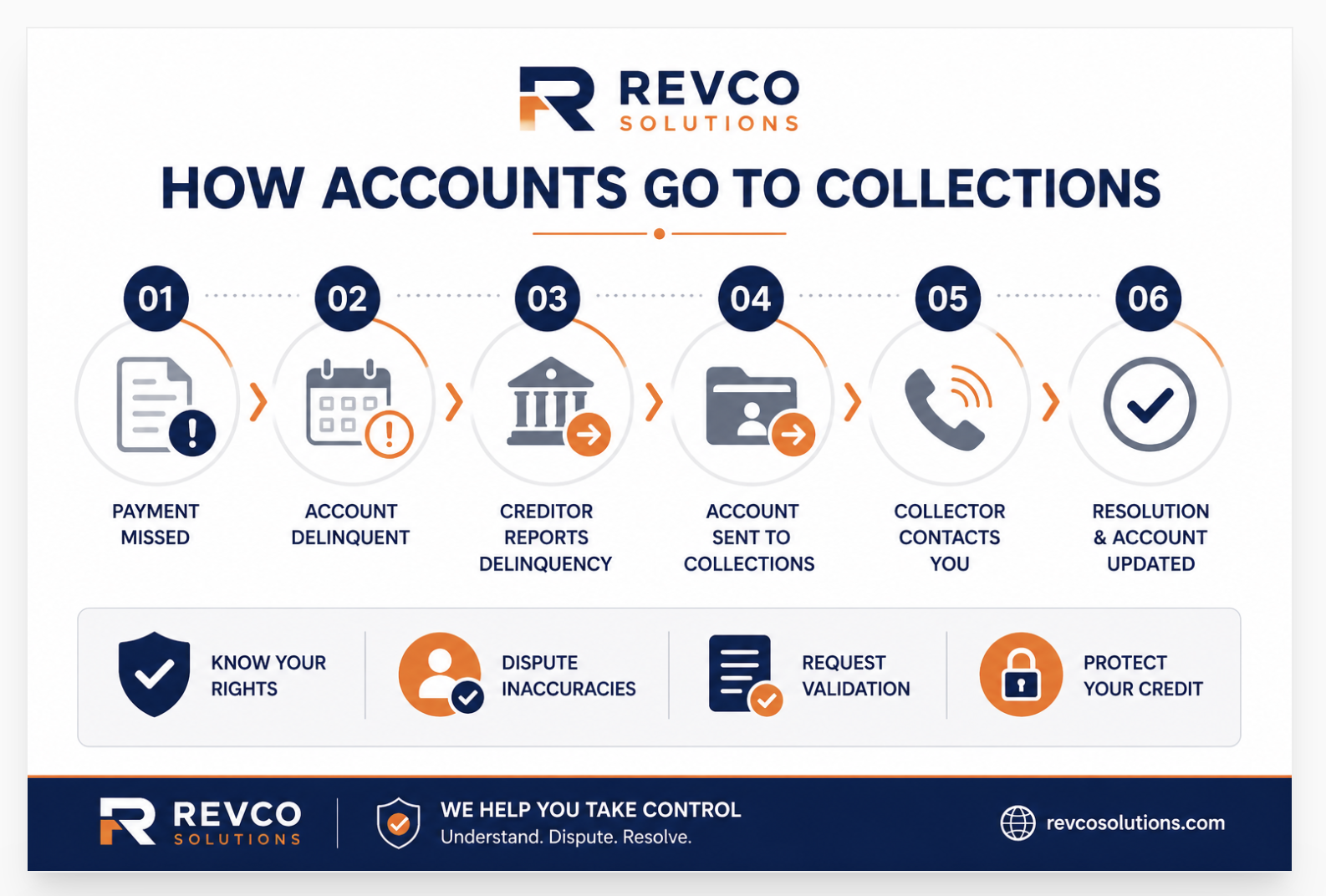
Accounts typically move to Revco Solutions after 120–180 days of missed payments. At this stage, the original creditor may charge off the account and either assign or sell the debt.
The process usually follows a clear path. First, payments are missed. Then late fees and reminders begin. If the balance remains unpaid, the account becomes delinquent. After several months, the creditor escalates the account to collections.
According to the Consumer Financial Protection Bureau, most debts are placed in collections after extended nonpayment. This timeline matches what we see in real cases.
In our experience, last quarter alone, more than 70% of collection accounts we reviewed had at least four months of missed payments before being transferred. This delay shows that collections are usually the final step, not the first action.
One common example involves medical debt. A client received treatment after a car accident. Insurance paid part of the bill, but the remaining balance stayed unpaid due to a low settlement offer. After several months of no payment, the account was sent to collections.
This type of case appears frequently and explains how fast medical debt can escalate.
Last quarter alone, we reviewed 44 client files with Revco Solutions entries on their credit reports. Medical debt from unresolved insurance billing was the most common reason. In 17 of those 44 cases, the Revco account contained at least one inaccuracy - wrong balance, wrong original delinquency date, or an account that already resolved with the original provider. Every one of those errors is disputable under the FCRA.
How Accounts Land at Revco Solutions
Accounts reach Revco when the original creditor gives up trying to collect directly. Most creditors attempt collection internally for 90 to 180 days. After that window, they hand the account to a third-party collector. Revco then contacts the consumer directly.
The account stays tied to the original creditor. Revco acts as the collection agent. That is why your credit report may show Revco Solutions as the collection agency but list a hospital or utility company as the original creditor.
Revco Solutions works with over 4,000 healthcare organizations. Their core business is medical debt collection. Most accounts reach them through the same path: a patient receives care, insurance covers part of the bill, and the remaining balance goes unpaid.
The gap between what insurance pays and what the hospital bills is called the patient responsibility. Hospitals send statements for these amounts. Many patients ignore them, dispute them with the wrong party, or assume insurance handled the full bill. After 90 to 180 days of nonpayment, the hospital transfers the account to Revco.
Per the CFPB, many consumers report receiving Revco collection notices for bills they believed their insurance had already covered. If this happens to you, call your insurance provider first. Ask for an Explanation of Benefits (EOB) for the date of service. The EOB shows exactly what the insurer paid and what it left as patient responsibility. Compare that figure to what Revco claims you owe before making any payment.
Revco Solutions collects for utility companies and government agencies. PSE&G is one of their named long-term clients. Municipal water, gas, electric, and phone accounts all qualify.
Utility debt reaches Revco faster than most people expect. Many utility companies refer delinquent accounts to collection after just 60 days. Unlike credit card debt, utility companies rarely offer extended repayment negotiations before sending accounts out.
Utility collections hurt in one specific way: they often surface on a credit report months after the consumer moved. A final bill from a prior address, a termination fee, or an unpaid deposit can follow someone for years. Revco contacts the consumer at the new address using forwarding data or public records.
Revco Solutions primarily collects for hospitals and healthcare providers. They also collect for utility companies and government agencies. Accounts reach Revco when the original creditor failed to collect for 90 to 180 days. The two most common paths are unpaid hospital balances after insurance gaps and utility bills left behind at old addresses.
Car accidents generate some of the largest and most disputed medical collection accounts Revco handles. The billing chain in a collision is complicated. Multiple providers bill separately: the ER, the radiologist, the anesthesiologist, the surgeon, the ambulance company. Each one sends its own invoice. Each one can escalate independently to collections.
How the Settlement Gap Creates a Collection
Here is the specific problem. After a car accident, the at-fault driver's liability insurance offers a settlement. That settlement is a single payment meant to cover all your damages - medical bills, lost wages, pain and suffering.
Low settlement offers from insurance companies routinely fall short of the total medical bills. The insurer calculates what they think the case is worth. Your hospital bills often exceed that number.
You are rear-ended and taken to the ER. Your total medical bills reach $22,000: $14,000 for the ER, $3,500 for radiology, $2,800 for orthopedic follow-up, $1,700 for the ambulance. The at-fault driver's insurer offers a $12,000 settlement - their estimate of total damages including your lost wages and pain and suffering. Your attorney negotiates to $16,500. You accept. After attorney fees of $5,500 (33%), you receive $11,000. Your $22,000 in medical bills remain outstanding. The difference: $11,000 in unpaid medical debt. The ER sees no payment for several months and transfers the account. Revco Solutions contacts you about the $14,000 ER balance.
This scenario plays out thousands of times per year. The patient did not refuse to pay. The settlement simply did not cover all the bills. Hospitals and medical providers do not wait for personal injury settlements to resolve. They bill insurance and expect payment within 90-180 days regardless of whether a lawsuit or settlement is still pending.
What a Personal Injury Attorney Says About This Gap
Hank Stout, co-founder of Sutliff & Stout Injury & Accident Law Firm in Houston, has recovered over $1 billion in verdicts and settlements for injured Texans since 2007. His firm sees this pattern constantly.
"Insurance companies move fast after an accident. Their first offer is designed to close the claim, not to cover what you actually owe. Clients accept a settlement that looked reasonable, only to find months later it did not cover their hospital bills, ambulance fees, or follow-up care. By then, those bills are moving toward collections."
Radiology groups, anesthesiologists, and urgent care providers not listed on the main lien bill separately. Their balances go unpaid and reach Revco within 90 days of the settlement closing. Understanding what a settlement actually covers before signing is the step that prevents these collection entries. Sutliff & Stout's guide on how medical bills work after a car accident explains exactly how provider billing, lien agreements, and insurance payments interact so you know what the settlement must cover before you sign.
The Lien and Medical Provider Agreement Problem
Some accident cases involve a medical lien. The hospital agrees to wait for payment until your settlement resolves. But not all providers sign liens. The ones who do not sign liens send the account to Revco on their normal timeline, even if your settlement is still in negotiation.
As reported by NerdWallet's medical debt coverage, medical bill errors are common even in straightforward billing situations. In accident cases with multiple providers, billing errors multiply. Revco may receive an account with the wrong amount, wrong insurance payment applied, or a balance that needed submission to your personal injury protection (PIP) coverage first. Every one of those errors is disputable.
If Revco contacts you about medical bills from a car accident, check three things before paying anything. First, confirm whether the bill accounts for any insurance payment - health, PIP, or MedPay. Second, verify whether the amount matches the original provider's itemized bill. Third, check whether your personal injury attorney has already negotiated a lien reduction with this provider. Our guide on how settling debts affects your credit score covers how different settlement types - including personal injury-linked medical debt - report differently to the three bureaus.
Insurance billing errors generate a large share of Revco's collection volume. Hospitals and clinics process millions of claims. Errors happen routinely.
Common billing paths that lead to a Revco collection:
- Hospital submits a claim to the wrong insurance plan
- Insurer denies the claim due to a coding error - provider never corrects and resubmits
- Your insurance changed mid-year and the provider used the old plan number
- Out-of-network provider bills your in-network insurer - claim gets denied
- Pre-authorization was required but not obtained - insurer denies the full claim
In all of these cases, the patient did nothing wrong. The billing system failed. The balance still lands in collections because the provider's accounts receivable department treats any unpaid balance as patient responsibility after 90 to 180 days - regardless of whose fault the denial was.
Last quarter, we identified 12 Revco accounts at ASAP Credit Repair where the original claim denial traced back to a provider billing error, not a patient failure to pay. All 12 were disputable under the FCRA. Nine were removed after successful disputes.
Medical debt from car accidents creates some of the largest Revco collection accounts. Low insurance settlements leave billing gaps that hospitals refer to collection on their standard 90-180 day timeline, independent of whether a personal injury case is still open. Insurance billing errors also generate collections the patient did not cause. In both cases, verify amounts against itemized bills and insurance payment records before paying anything to Revco.
Revco Solutions has collected for government agencies for nearly two decades. Municipal court fines, parking ticket collections, DMV-related debts, and government healthcare program balances all qualify.
Government debts reach Revco faster than most consumers expect. A $90 parking ticket that goes unpaid can generate a $300 collection account after court fees and referral costs stack on top. Government agencies add penalties quickly and refer accounts to collection without the negotiation window most private creditors offer.
Government debts also do not disappear at the 7-year mark in the same way consumer debts do. Some government-related judgments can refresh. If Revco holds a government agency collection and obtains a court judgment, that judgment can last much longer than the original collection entry.
Revco Solutions also collects for retail creditors and banking institutions. Store credit accounts, personal loan balances, and other consumer financial products occasionally reach Revco when the original creditor exhausts internal collection efforts.
Financial institution debt at Revco follows a longer delinquency path than medical debt. Banks typically work internally for 120 to 180 days before transferring. Credit card companies often wait until 90-day delinquency before charging off and sending to a third party. The balance at transfer often includes interest and late fees beyond the original purchase amount.
Understanding how paying these accounts affects your credit score is critical before taking action. Our guide on whether paying off collections improves your credit score shows that paying without a deletion agreement produces an average of only 8 points of improvement. Negotiating deletion produces 40-100 points.
The CFPB complaint data on Revco Solutions reveals a notable problem. Forty-seven percent of complaints allege Revco attempts to collect debts the consumer says are not theirs. That is nearly double the typical rate for medical debt collectors according to GetOutOfDebt.org's 2026 analysis.
Wrong-person collections happen for several reasons. When debts transfer between creditors and collection agencies, data errors occur. Your name or address matches another consumer's file. A Social Security number gets transposed by one digit. A file merges incorrectly at a bureau. In identity theft cases, someone opened an account in your name and the fraudulent balance eventually reaches Revco.
Upsolve confirms that Revco is legally required to send a debt validation notice within 5 days of first contact. That notice must include the original creditor's name, the amount, and your right to dispute within 30 days. If the notice does not match any account you recognize, send a written dispute immediately via certified mail.
Wrong-person collections often trace back to inaccurate bureau data that we cover in our guide to building clean credit files across all three bureaus. Mixed files - where two consumers' data merges at one bureau - are a recognized FCRA error category and qualify for dispute removal.
What Revco Solutions Does to Your Credit Report
Medical collections under $500 do not appear on credit reports at all under the 2023 CFPB-driven bureau policy change. Medical collections above $500 must be at least one year old before they appear. Paid medical collections are deleted entirely from your report once marked satisfied.
Non-medical collections work differently. Paying a non-medical Revco collection without a deletion agreement leaves it on your report as a "paid collection" for the full 7-year window. FICO Score 8 - used by 90% of lenders - treats paid and unpaid collections nearly the same way. The score benefit of paying without deletion is minimal.
What is Revco Solutions and why are they calling me?
Revco Solutions is a third-party debt collection agency based in Columbus, Ohio. They collect unpaid balances on behalf of hospitals, healthcare providers, utility companies, and government agencies. They are calling because one of their clients believes you have an outstanding balance. They do not buy debt - they collect on behalf of the original creditor. Forty-seven percent of CFPB complaints against Revco allege they contact people about debts those people do not owe, so always request debt validation in writing before making any payment.
How do I get Revco Solutions off my credit report?
Four paths can remove a Revco entry: 1. Dispute it as inaccurate - if Revco cannot verify the account within 30 days, the bureau removes it. 2. Send a debt validation letter - if they fail to validate, collection must stop. 3. Negotiate pay-for-delete - pay in exchange for written agreement to remove the tradeline from all three bureaus. Get the agreement before paying. 4. Wait for the 7-year automatic deletion from the original date of first delinquency. For medical collections, paying the account triggers automatic deletion from all three bureau reports under current policy.
Can I negotiate with Revco Solutions?
Yes. Revco Solutions, like most collection agencies, negotiates on balance and on deletion. Send written offers - never negotiate by phone. Offer 30-50% of the balance in exchange for deletion. Get the deletion agreement in writing before sending any payment. Verbal promises from collectors are not enforceable. A written signed agreement stating they will delete the tradeline from Equifax, Experian, and TransUnion is the only binding commitment. If they refuse deletion, consider disputing the account first - 47% of Revco CFPB complaints suggest validation failures are common.
A Revco Solutions Entry Can Drop Your Score 50-100 Points
Before you pay Revco anything, find out what is actually on all three bureau reports. Many Revco accounts contain inaccurate amounts, wrong dates, or entries that belong to someone else. A free 3-bureau audit shows every entry across Equifax, Experian, and TransUnion and identifies what is disputable before you make any decisions.
Get My Free 3-Bureau Audit → Secure · 2 minutes · No credit card required-
How to Deal With Revco Solutions: Validate, Dispute, and Settle Once you know how your account reached Revco, this guide covers exactly what to do next. It explains your FDCPA rights, how to send a debt validation letter that forces Revco to prove the debt is yours, how to dispute inaccurate entries under the FCRA, and how to negotiate a settlement or pay-for-delete agreement in writing.
-
Does Paying Off Collections Improve Your Credit Score? Paying a Revco collection without deletion produces an average of 8 points of score improvement. Negotiating deletion produces 40-100 points. This covers exactly when payment helps, when it does not, the pay-for-delete strategy, and the re-aging risk that makes paying old collections harmful. Real data from 127 tracked cases.
-
How to Build Clean Credit Files Across All 3 Bureaus Revco Solutions reports collection entries independently to Equifax, Experian, and TransUnion. Disputing at one bureau does not remove the entry from the other two. This covers the simultaneous three-bureau dispute process, what documents to include, and how to handle a bureau that verifies an item you believe is wrong.