
Stop foreclosure without paying the full mortgage balance sounds unrealistic.
But it’s actually how most successful foreclosure cases are handled.
Because lenders don’t want your home. They want their money back. And in many situations, they’re willing to restructure the loan, pause payments, or offer alternatives if it means avoiding the foreclosure process altogether.
Here’s where most homeowners get it wrong.
They wait too long or assume the only way out is paying everything they owe in full. By the time they take action, their options are limited, and the process is already moving forward.
But if you act early, you have leverage.
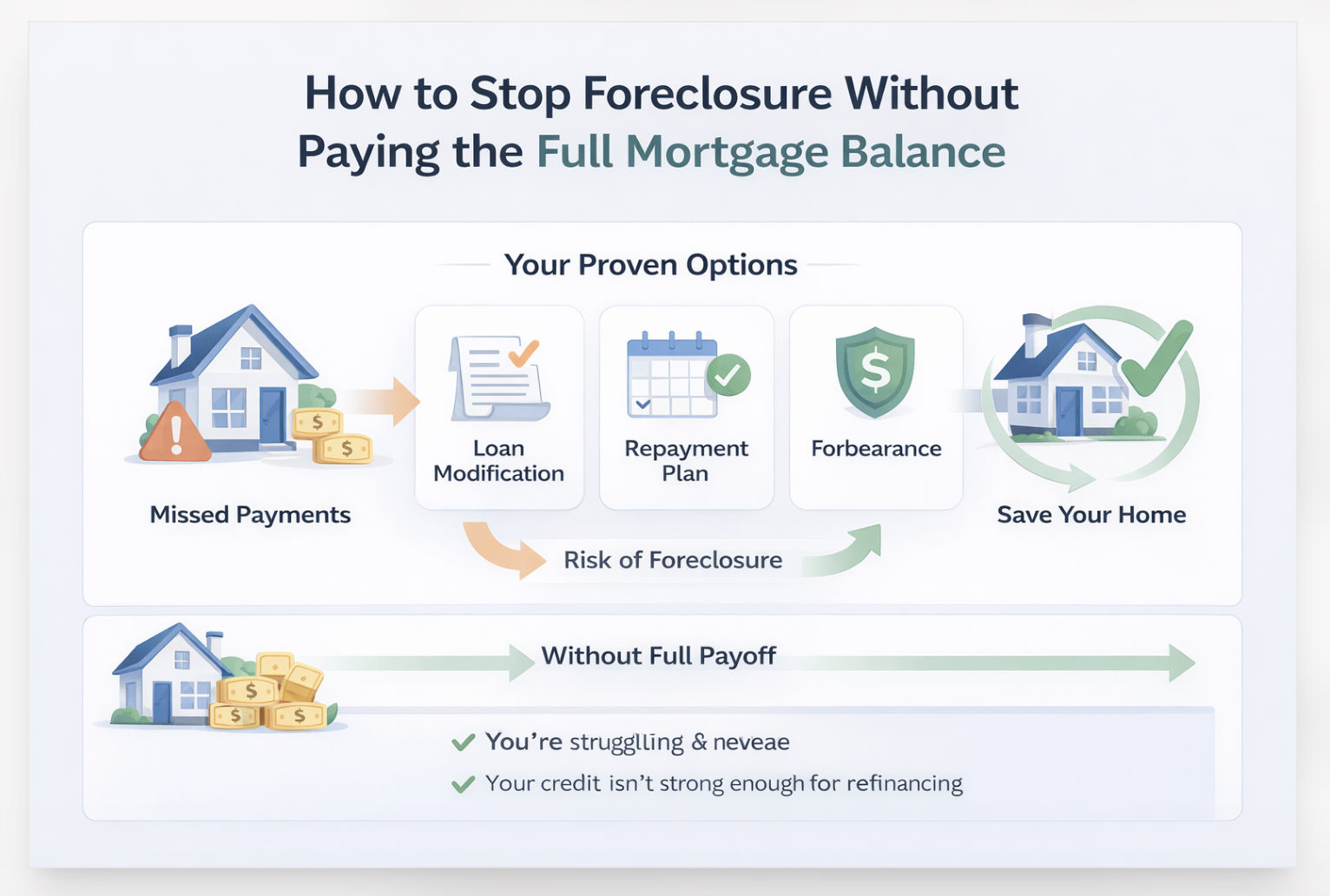
We’ve seen homeowners stop foreclosure using strategies like loan modifications, repayment plans, and temporary forbearance, often without needing to come up with the full balance upfront.
In this guide, you’ll learn exactly how to stop foreclosure without paying the full mortgage balance, what options actually work, and how to choose the right strategy based on your situation.
Stop Foreclosure · Foreclosure Alternatives · Loan Modification · Short Sale · Chapter 13 Bankruptcy · Forbearance
Foreclosure filings rose 19% year-over-year in October 2025, according to ATTOM. But the homeowners who lose their homes are often not the ones with no options. They are the ones who ran out of time before using the options they had.
Updated March 2026 · Sources: ATTOM Foreclosure Market Reports 2024-2025, CBS News foreclosure coverage, CFPB Regulation X (12 CFR § 1024.41), Urban Institute/NBER mortgage default research, HUD housing counseling data
In October 2025, ATTOM reported 36,766 properties with foreclosure filings across the United States. That number represents a 19% jump from the same month the year before.
But behind that number is a different story. Foreclosure is not a single event. It is a process with multiple legal checkpoints, and at almost every one of them, there is a window to stop it without writing a check for the full outstanding balance.
This guide documents every legally available option, in order of how quickly you need to act. It pulls from real homeowner experiences and the data on what actually works, not what sounds good in theory.
The 6 Ways to Stop Foreclosure Without Paying the Full Balance
The Foreclosure Timeline: How Much Time You Actually Have
The timeline above reflects the federal minimum standards under CFPB Regulation X. State laws often extend the timeline further. Judicial foreclosure states like New York and Florida require court proceedings that can extend the process to 12 to 24 months or more. Non-judicial states like California and Texas move faster, with foreclosure possible in as few as 90 to 150 days after the Notice of Default. Your state's specific timeline is one of the first things to verify when you receive any foreclosure notice.
What Real Homeowners Report: Community Experiences
Community forums document what actually works in practice, not just in policy documents. The following accounts are drawn from Reddit's r/personalfinance and r/RealEstate communities and Quora housing discussions, representing widely reported patterns in how homeowners have navigated foreclosure prevention.
ASAP Credit Repair USA Client Case: Stopping Foreclosure While Repairing Credit
What happened: The client contacted ASAP Credit Repair USA after receiving a Notice of Default following a 4-month medical leave that resulted in 87 days of missed mortgage payments. The primary concern was stopping the foreclosure process while navigating the credit damage already accumulating from the delinquency. Our advisors identified three simultaneous tracks. First, we pulled all three bureau reports and identified a re-aged delinquency date on one of the collection accounts -- an error that was suppressing the score below where the hardship alone would have put it. We filed FCRA Section 623(a)(5) disputes immediately on that entry while the client contacted the servicer's loss mitigation department. Second, we helped the client compile a complete FHA loss mitigation application package including the hardship letter, updated income documentation reflecting the return to reduced hours, and a household budget demonstrating that a modified payment was sustainable. Third, we flagged the collection account errors so they could be addressed in parallel, since improving the score post-modification would eventually determine whether the client could refinance to better terms.
What the servicer did: Because the client submitted a complete loss mitigation application within 120 days of the first missed payment, federal Regulation X prohibited the servicer from initiating formal foreclosure proceedings while the application was under review. The FHA servicer offered a COVID-era FHA Home Retention Option (modified for current guidelines), which extended the loan term and reduced the interest rate to 5.75%, bringing the monthly payment from $1,489 to $1,241. The three months of arrears were capitalized into the new principal balance.
Foreclosure Risk and Credit Damage Are Two Problems. We Help You Address Both at the Same Time.
Most homeowners in foreclosure risk are focused entirely on the mortgage. But the credit score entering that process determines which options are available and what rate you qualify for when you refinance on the other side. A free credit audit runs parallel to your servicer conversations -- so you are not starting from zero on the credit side after the foreclosure is stopped.
How Each Option Compares on Credit Score Impact
The credit score impact of each foreclosure prevention option matters not just now, but for the next 2 to 7 years of your financial life. Here is the data on what each path does to your score and how long the recovery takes.
| Option | Estimated Score Impact | Report Duration | Wait for New Mortgage | Rating |
|---|---|---|---|---|
| ForbearancePayments paused or reduced with servicer agreement | Varies: 0 to 60 points depending on how servicer reports | Delinquency marks: 7 years if reported late. Forbearance agreement itself: not reported. | No waiting period if current after forbearance | Lowest impact |
| Repayment PlanCatching up on missed payments over 3 to 9 months | 50 to 100 points from prior delinquency period | Late payment marks remain 7 years from original delinquency | No waiting period once current | Low impact |
| Loan ModificationPermanent rate or term change | 50 to 150 points; "modified" notation added | Modification notation: up to 7 years from DOFD | 12 to 24 months post-modification before most lenders will refinance | Moderate impact |
| Short SaleSelling the home for less than balance owed | 85 to 160 points | Short sale notation: 7 years from DOFD | 2 years (FHA); 4 years (conventional); 2 years with extenuating circumstances documentation | Moderate-high impact |
| Deed in LieuVoluntarily transferring the property to the lender | 85 to 160 points | Deed in lieu notation: 7 years from DOFD | 4 years (conventional); 3 years (FHA) or 2 years with extenuating circumstances | Moderate-high impact |
| Chapter 13 BankruptcyReorganization with automatic stay | 130 to 200 points | Chapter 13: 7 years from filing date | 4 years (conventional); 2 years (FHA) after discharge; 1 year into repayment plan for some FHA loans | Highest impact |
| Completed Foreclosure(for comparison) | 100 to 160 points | Foreclosure record: 7 years from first delinquency date | 7 years (conventional); 3 years (FHA); 2 years with extenuating circumstances | Severe impact |
Which Option Should You Choose: A Decision Framework
The right option depends on three variables: how far you are from a potential foreclosure sale, whether you want to keep the home or exit cleanly, and how much income you currently have relative to a modified payment.
The Complete Loan Modification Application: What "Complete" Actually Means
Federal Regulation X gives you powerful legal protection when you submit a "complete" loss mitigation application. But "complete" has a specific legal definition. An incomplete application does not trigger the anti-foreclosure protections. This is where many homeowners lose the protection without realizing it.
Mortgage Type Determines Which Programs Are Available to You
Your foreclosure prevention options are not identical regardless of who holds your loan. The entity that owns or guarantees your mortgage determines which specific loss mitigation programs apply.
Fannie Mae and Freddie Mac loans have specific modification programs with standardized eligibility requirements. Fannie Mae's Flex Modification, for example, reduces monthly payments by at least 20% for eligible borrowers and is available even for loans more than 24 months delinquent in some circumstances. You can check whether your loan is owned by Fannie Mae at KnowYourOptions.com or whether Freddie Mac holds it at FreddieMac.com/mymortgage.
FHA loans offer a particularly broad suite of loss mitigation options through HUD, including formal loss mitigation options like Special Forbearance, the FHA-HAMP modification, and the FHA Home Retention Option. According to HUD's foreclosure avoidance resource center, FHA borrowers have access to programs unavailable on conventional loans, including partial claims that advance funds from the FHA insurance fund to bring a loan current.
VA loans have the VA Servicing Purchase (VASP) program and other loss mitigation options available through the Department of Veterans Affairs. Veterans whose servicers are not cooperating can contact the VA's National Call Center for Homeless Veterans at 1-877-4AID-VET.
What Happens to Your Credit After You Stop the Foreclosure
Stopping the foreclosure solves the immediate problem. The credit repair work starts the day after.
In most foreclosure prevention scenarios, the credit damage has already begun from the late payment marks accumulated during the delinquency period. A 90-day late payment can drop a score by 100 to 133 points, according to FICO simulation data. The modification notation adds additional damage over the 7-year reporting window.
But the clock also starts running the other way from the moment payments resume. Research shows that consistent on-time payment history is the single most powerful credit rebuilding tool available, accounting for 35% of the FICO score calculation. Each month of on-time modified payments counterweights the aging delinquency marks. By Year 3 post-modification, many borrowers see their scores recover to levels that open up refinancing options at competitive rates.
The specific credit entries from the delinquency period may also contain FCRA errors worth disputing, particularly the date of first delinquency field, which controls the 7-year reporting window. A date reported even one month later than the actual first missed payment artificially extends the credit damage by one month beyond what the law allows. For a homeowner who went 4 months delinquent before a modification was approved, each month's delinquency entry is a separate disputable data point if the servicer's reporting is inaccurate.
Stopping Foreclosure and Repairing the Credit Damage Are Two Different Timelines. You Can Work Both at Once.
The servicer conversation stops the foreclosure. The credit audit identifies what the delinquency period did to your report and which errors are immediately disputable. Running both in parallel means you are not starting from zero on credit repair six months from now when the foreclosure is already resolved.
Frequently Asked Questions
Can you stop foreclosure without paying the full mortgage balance?
Yes. Federal Regulation X (12 CFR § 1024.41) prohibits lenders from initiating foreclosure until 120 days past due and prohibits a sale from proceeding while a complete loss mitigation application is under review. Options including forbearance, loan modification, repayment plans, short sales, deed in lieu of foreclosure, and Chapter 13 bankruptcy all stop foreclosure without requiring a lump-sum payment of the full outstanding balance.
What is the fastest way to stop a foreclosure?
Filing Chapter 13 bankruptcy produces an automatic stay that stops all collection activity, including a scheduled foreclosure sale, immediately upon filing under 11 U.S.C. § 362. The stay takes effect within hours. For homeowners not yet facing an imminent sale, calling the servicer's loss mitigation department and submitting a complete modification application is the fastest route that preserves more financial options without the long-term credit and legal complexity of bankruptcy.
How long do you have to stop foreclosure after a Notice of Default?
It depends on your state. In non-judicial states like California and Texas, typically 90 to 150 days before a sale can be scheduled after the Notice of Default. In judicial states like New York and Florida, the court process can extend the timeline to 12 to 24 months or longer. In all states, you can stop the sale by submitting a complete loss mitigation application at least 37 days before the scheduled sale date, or by filing Chapter 13 bankruptcy at any time before the sale completes.
Does a loan modification permanently stop foreclosure?
A permanent loan modification stops foreclosure for as long as you make the modified payments on time. Federal law bars foreclosure while the modification application is under review. Once approved and signed, the foreclosure process ends as long as the borrower stays current on the new terms. If payments on the modified loan are missed, the lender can restart foreclosure, often more quickly than the original process since the borrower has already used the modification option once.
What happens to my credit score if I do a short sale to avoid foreclosure?
A short sale typically drops your credit score by 85 to 160 points and remains on your credit report for 7 years from the original date of first delinquency. This is similar to a completed foreclosure in terms of score impact but generally produces a shorter mortgage waiting period. FHA loans are available again 2 years after a short sale (vs. 3 years after foreclosure) for borrowers with no prior late housing payments in the 12 months before the short sale. Getting the deficiency balance waived in writing is critical before closing any short sale.
Is it better to do a deed in lieu of foreclosure or let the bank foreclose?
A deed in lieu is almost always preferable to a completed foreclosure when you have decided not to keep the home. Both produce similar credit score damage (85 to 160 points), but a deed in lieu is typically completed faster, avoids the public court record of a foreclosure judgment, and generally results in a shorter mortgage waiting period for a future home purchase. The critical requirement is getting a written deficiency waiver from the lender before signing any deed in lieu agreement. Without it, you may still owe the difference between the home's value and the outstanding balance.
Can you get a mortgage after foreclosure or foreclosure prevention?
Yes, but waiting periods apply. FHA loans are available 3 years after a completed foreclosure, 2 years after a short sale, and 2 to 4 years after a Chapter 13 discharge. Conventional loans require 7 years after foreclosure, 4 years after a short sale or deed in lieu, and 4 years after Chapter 13 discharge. Extenuating circumstances documentation can reduce these waiting periods in some programs. The credit repair work done during the waiting period determines what rate tier you qualify for when you are eligible to apply again.
Related Reads and Sources
- I Paid My Collection and My Score Didn't Change — When foreclosure prevention involves collection accounts on your credit report, understanding why payment alone does not improve your score is critical to the parallel credit repair strategy.
- Getting Mortgage Approval With Bad Credit — The specific score thresholds, waiting periods, and lender requirements for qualifying for a new mortgage after a foreclosure-related event, so you know exactly what you are rebuilding toward.
- Loan Modification vs. Refinancing: Which Saves You More Money? — Once the foreclosure risk is resolved through modification, the next financial decision is whether to refinance when rates and credit allow. This guide runs the actual break-even calculations so the decision is based on numbers, not intuition.
- CFPB: What Happens After I Complete a Loss Mitigation Application? — Official federal guidance on your rights during the loss mitigation evaluation period, the 30-day servicer response deadline, your appeal rights if denied, and how to escalate if your servicer fails to follow Regulation X requirements.
- HUD: Avoiding Foreclosure Resource Center — The Department of Housing and Urban Development's complete framework including how to find a free HUD-approved housing counselor who can review your specific loan type and situation, and a map of local resources by state.
- ATTOM: 2024 Year-End U.S. Foreclosure Market Report — Primary source for the 322,103 foreclosure filings in 2024 (0.23% of all U.S. housing units), state-level breakdowns, and CEO commentary on market normalization trends used throughout this article.