

Travel hacks can save money, but bad travel habits can create debt that lasts longer than the trip. The best travel hacks lower costs while protecting savings, credit cards, and monthly cash flow.
Many people book travel with rewards cards, buy-now-pay-later plans, or last-minute deals. Some of those choices help. Some become expensive later.
We see that. Travel debt is common after peak holiday seasons and summer travel months. The trip ends, but the balance stays. What's worse? It can easily become a collection account that will destroy your credit rating.
Consumer surveys often show that many travelers use credit cards to fund vacations. Online forums also show a common pattern: people regret overspending more than they regret skipping luxury upgrades. That matters because smart travel is not only about cheaper flights. It is about returning home without financial stress.
From our experience helping consumers rebuild credit, the strongest travel plan is simple: spend less upfront, avoid interest, and keep emergency funds intact. A vacation should refresh you, not damage your budget for six months.
This guide covers 8 travel hacks you can enjoy without hurting your finances.
Let's understand what works in real life, and what mistakes cost travelers the most.
8 Travel Hacks To Save Money
Did you know that roughly 1 in 3 Americans goes into debt just to travel? It’s a surprising statistic. Especially when vacations are supposed to be about relaxation, not financial stress.
Between flights, hotels, food, and activities, costs can add up quickly, often leaving people paying off their “getaway” long after they’ve returned home.
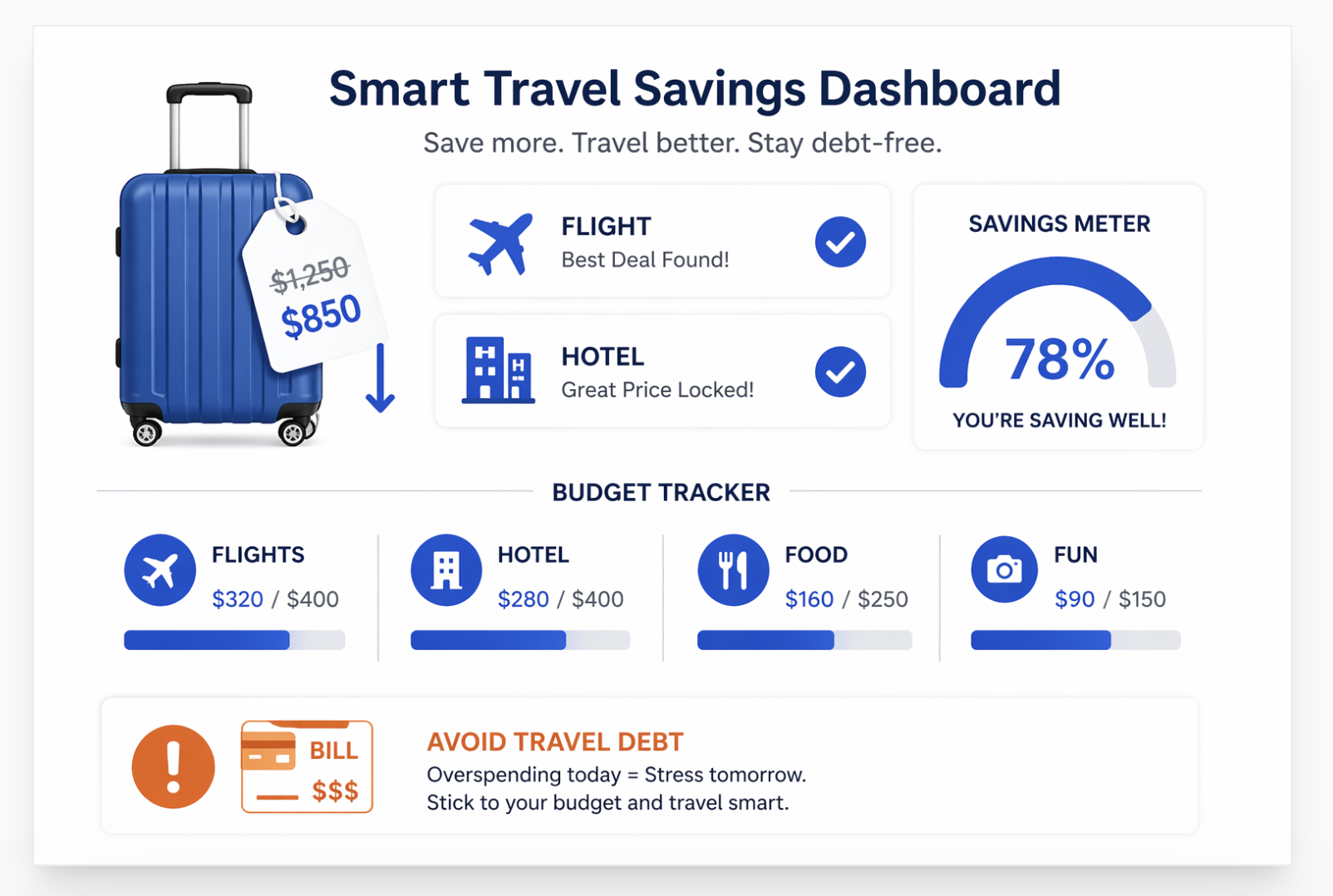
We see travel debt on credit reports regularly. A client came to us with a 591 score partly because of a vacation taken on a high-limit card two years earlier - the balance grew with interest until it hit 78% utilization. The trip was real. The debt stuck around long after. These hacks are about keeping the trip and skipping the damage.
This is the highest-value travel hack available in 2026. Done right, it turns regular spending into free flights.
Here is how it works. You sign up for a travel rewards card. You earn points on every purchase. You redeem those points for flights, hotel stays, and upgrades.
A Chase Sapphire Preferred sign-up bonus alone - 60,000 points - is worth about $750 in travel through their portal. That covers a round-trip domestic flight for most routes.
The critical rule: you must pay the card off in full every month. Travel points earn you roughly 1-3 cents per dollar spent. Credit card interest at 21-24% APR erases that value entirely in one billing cycle if you carry a balance.
Only 32% of 2026 summer travelers plan to use points for travel, while 48% say rewards programs feel too complicated. It is not complicated. Spend on the card. Pay it off. Redeem for flights. That is the whole system.
Airline pricing is not random. It follows patterns. Most people book whenever it is convenient. That is usually the most expensive time.
Here is what the data shows:
- Domestic flights are cheapest when booked 3-6 weeks out for budget routes, 6-8 weeks for popular routes
- International flights hit lowest prices 2-4 months before departure
- Tuesday and Wednesday searches often surface lower fares - airlines release sale seats mid-week
- Flying Tuesday, Wednesday, or Saturday is cheaper than Friday and Sunday by 15-25%
Use Google Flights. Set a price alert for your route. The alert emails you when fares drop. You do not have to watch prices manually every day.
Also check the departure airport. Driving 60-90 minutes to a secondary airport can save $100-$300 per ticket. On a family trip, that math adds up fast.
Peak season means peak prices. Flights, hotels, tours, and restaurant prices all rise during the busiest weeks.
Shoulder season is the 2-6 weeks before and after peak. The weather is usually still good. The crowds are gone. Prices drop across the board.
Examples:
- Europe in May or September instead of July-August: hotel prices 30-40% lower, shorter lines
- Caribbean in April or November instead of December-March: hotels 40-50% cheaper, still warm
- Hawaii in late August or early September: flights and hotels drop 20-30% from summer peak
At ASAP Credit Repair, we have had clients come to us after maxing cards on peak-season international trips. The debt from one expensive week sometimes takes two years to pay down. Shoulder season removes that risk entirely.
Checked baggage fees are pure travel tax. Most airlines charge $35-$75 each way per bag. On a round trip, that is $70-$150 per person for a single checked bag.
A family of four checking bags spends $280-$600 extra. That is a night or two at a hotel.
Packing carry-on only is a skill. It takes one trip to learn. After that, it is automatic.
- Use a 40L backpack - fits in most overhead bins
- Pack clothes you can mix and match (neutrals, layers)
- Wear your heaviest items on travel days
- Buy toiletries at the destination if needed - often cheaper abroad
Also: if you have a travel credit card with airport lounge access, you can refresh and recharge during layovers at no extra cost. Cards like Chase Sapphire Reserve and American Express Platinum include lounge access in the annual fee.
Hotels hate empty rooms. They would rather fill them at 40% off than leave them empty.
Two strategies work well here.
Last-minute booking: Apps like HotelTonight pull unsold inventory from hotels the day-of or up to 7 days before. Discounts run 20-60% on the same rooms that were full price a week earlier. This works best in cities with lots of hotel supply. Riskier in small markets or during major events.
Book direct: Call the hotel and ask for their best rate. Hotels often match or beat OTA prices to avoid the 15-25% commission they pay Expedia and Booking.com. Direct booking also means room upgrades, early check-in, and loyalty points that do not exist through third-party sites.
For hotel points: most hotel chains (Marriott, Hilton, Hyatt) have free loyalty programs. Nights booked direct earn points. Points convert to free nights. Even one free night per trip adds up to hundreds of dollars saved per year.
Most standard credit cards charge a 3% foreign transaction fee on every purchase made outside the US. On a $3,000 international trip, that is $90 in fees added automatically - just for using your card.
Travel cards like Chase Sapphire Preferred, Capital One Venture, and Charles Schwab Debit charge zero foreign transaction fees. You swipe. You pay in local currency. No fee added.
Also: do not use airport currency exchange booths. The spread on exchange rates is typically 5-15% above mid-market rate. Use a no-fee card or withdraw local currency from an ATM connected to your bank network.
The Charles Schwab debit card goes further - it reimburses all ATM fees worldwide at the end of each month. You can withdraw cash anywhere without planning which ATMs to use. It is the best cash option for international travel.
Restaurant prices double or triple within two blocks of major tourist attractions. The closer you are to the Eiffel Tower, the Vatican, or Times Square, the more you pay for worse food.
Walk away. Two blocks in any direction and prices drop. Four blocks and you are in local territory.
How to find local spots:
- Google Maps: search the type of food you want and filter by reviews in the local language, not English
- Walk toward residential streets - the restaurants that locals use do not need tourist foot traffic
- Markets and food halls: every city has one. Fresh, cheap, no-markup dining
- Lunch menus: many European restaurants offer prix-fixe lunch menus for 50-60% less than dinner prices
Food is often the fastest-growing budget item on a trip. It is also the easiest to control. One restaurant swap per day on a 7-day trip can save $15-$40 per day per person. On a couple's trip, that is $210-$560 saved on food alone.
This is the hack that saves the most money over a lifetime. It is also the one most people skip.
One in ten Americans used BNPL (buy now, pay later) to fund travel in 2025. Of all BNPL users, 41% paid late at least once. A missed BNPL payment can carry an effective APR of 28-49%. That trip to Miami becomes dramatically more expensive when it is still being paid off six months later.
Here is the real number: 35% of 2025 summer travelers who charged their vacation to a credit card still had not paid off the balance by 2026. At 21-24% APR, a $2,500 travel balance carried for 12 months costs $525-$600 in interest. You paid for the trip twice.
At ASAP Credit Repair, we have reviewed hundreds of credit reports where travel spending shows up as the turning point. A credit card that was 20% utilized before a vacation is at 75% after. Utilization jumps 55 points. Score drops 40-70 points. That drop can cost thousands of dollars when the person then applies for a car loan or mortgage at a higher rate.
The rule: If the trip is not funded before you book it, it is not funded. Save in a dedicated travel account. Book when the money is there. Use a credit card for purchase protection and points - then pay it off the same month it hits.
Understanding how carrying revolving debt affects your credit score is something we cover in detail on the blog. Our piece on what happens to your credit score when you do not manage debt shows exactly how a single high-balance event - like a vacation on a credit card - can take 12-18 months of clean behavior to recover from.
The Travel-Credit Connection: What Most People Miss
We have seen this pattern at ASAP Credit Repair many times. A client with a 680 score books a $3,000 trip on a card with a $5,000 limit. Utilization jumps from 15% to 75%. Score drops to 620. Six months later, they apply for a car loan and get quoted a rate that is 4% higher than they would have received at 680. Over a 5-year loan, that is $2,000-$4,000 in extra interest from one vacation.
The smart travel approach protects both your trip and your score:
- Save the travel budget in a separate account before booking
- Charge the trip to a travel card for points and protection
- Pay the balance in full the month it posts
- Keep utilization below 30% at all times - below 10% before any major loan application
If you are planning a big purchase - a home, a car, a refinance - within the next 6-12 months, keep travel spending conservative. Your credit score during that window is worth more than the points you earn on any trip. Our article on credit repair for first-time home buyers covers exactly how lenders look at utilization in the months before a mortgage application.
Frequently Asked Questions
What are the best travel hacks to save money in 2026?
The top eight: use credit card points for flights and hotels, book flights on Tuesdays or Wednesdays and set Google Flights alerts, travel shoulder season (before or after peak), pack carry-on only to avoid baggage fees, book hotels last-minute through HotelTonight or direct, use a no-foreign-transaction-fee card abroad, eat two blocks from tourist areas, and never charge travel you have not already saved for. The last one saves the most money over time.
How do I travel without going into debt?
Save first, book after. Open a dedicated travel savings account. Set up automatic deposits weekly. Book the trip only when the funds are there. Use a travel card for the purchase - for points and purchase protection - then pay the balance in full the same month it posts. Never book travel on a card you are already carrying a balance on. 35% of 2025 summer travelers are still paying off those trips in 2026. At 21-24% APR, the trip cost them significantly more than the original price.
Do travel credit cards hurt your credit score?
Opening a travel card causes one hard inquiry - a 5-10 point drop lasting up to 12 months. Long-term, the card can help your score by increasing available credit (reducing utilization) and adding positive payment history. The score damage comes from carrying a balance. A travel card paid in full monthly is a net positive for most credit profiles within 6-12 months of opening. A travel card with a high balance is a score negative that can last years.
Is BNPL a good way to pay for travel?
No. 10% of Americans used BNPL for travel in 2025. 41% of all BNPL users paid late at least once. Missed BNPL payments can carry effective APRs of 28-49%. BNPL loans stack invisibly - they do not appear on credit reports, so you can take on multiple travel installment plans without any lender seeing your full debt load. When one payment is missed, the fees exceed what most travel rewards cards charge. Save for the trip. Book it when the money exists.
What is the cheapest day to book a flight?
Tuesdays and Wednesdays are historically the cheapest days to search and book flights. Airlines release new sale fares early in the week. Flying on Tuesdays, Wednesdays, and Saturdays is typically cheaper than Friday and Sunday departures by 10-25%. Use Google Flights and set a price alert for your specific route. The alert does the monitoring for you and notifies you when prices drop - no need to check daily.
Travel Spending Should Not Cost You Your Credit Score
If a past trip spiked your utilization or left behind a missed payment, those marks stay on your report for 7 years. A free 3-bureau audit shows exactly what is reporting across Equifax, Experian, and TransUnion - and identifies any inaccurate entries that are still dragging your score down.
Get My Free 3-Bureau Audit → Secure · 2 minutes · No credit card required-
10 Best Ways Proven to Build Credit Fast in 2026 Before your next trip, a higher credit score means better travel card options, lower APRs, and a stronger financial position if you carry any balance. This covers the 10 fastest methods to improve your score - from reducing utilization in one billing cycle to removing inaccurate entries in 30 days - ranked by speed and average impact from 300+ client cases.
-
Does Paying Off Collections Improve Your Credit Score? The Truth Travel debt that goes to collections is handled differently than most people expect. Paying a collection without a deletion agreement produces an average of 8 points of score improvement - nowhere near what most expect. This covers exactly when payment helps, when it hurts, and the pay-for-delete strategy that produces 40-100 point gains instead. Real client data from 127 tracked cases.
-
Can I Buy a House in Laurel MD With a 580 Credit Score? Travel debt that spiked your utilization or left a missed payment can push your score below the thresholds that matter for a home loan. In Laurel, MD, the line between FHA and conventional financing is 620. The line between conventional and Maryland Mortgage Program access is 640. This covers what each threshold opens, what it costs, and how to move your score across the thresholds that change your loan product.