

Travel planning for credit score protection starts the moment you decide where you are going. Most travelers think about hotels, flights, and packing lists. Few think about what a two-week trip can do to their credit score. The damage can come from fraud, hard inquiries, high balances, or missed payments while you are away. All of it is preventable.
I run a credit repair company. One of the most unforgettable cases I ever worked on involved a couple who returned from a three-week trip to Southeast Asia. Their credit scores had dropped over 40 points each. Not because of anything they did wrong on purpose. Their credit card number was skimmed at a restaurant in Bangkok. By the time they were home, three new accounts had been opened in their names. Resolving it took four months and a lot of paperwork.
The Federal Trade Commission reported 503,450 credit card fraud cases in just the first three quarters of 2025. That is a 54% increase over the same period in 2024 (Motley Fool via FTC). Travelers are not the only victims. But travel creates conditions that make fraud easier: new locations, public Wi-Fi, unfamiliar card terminals, and a relaxed routine. Protecting your credit before you leave is far easier than repairing it when you return.
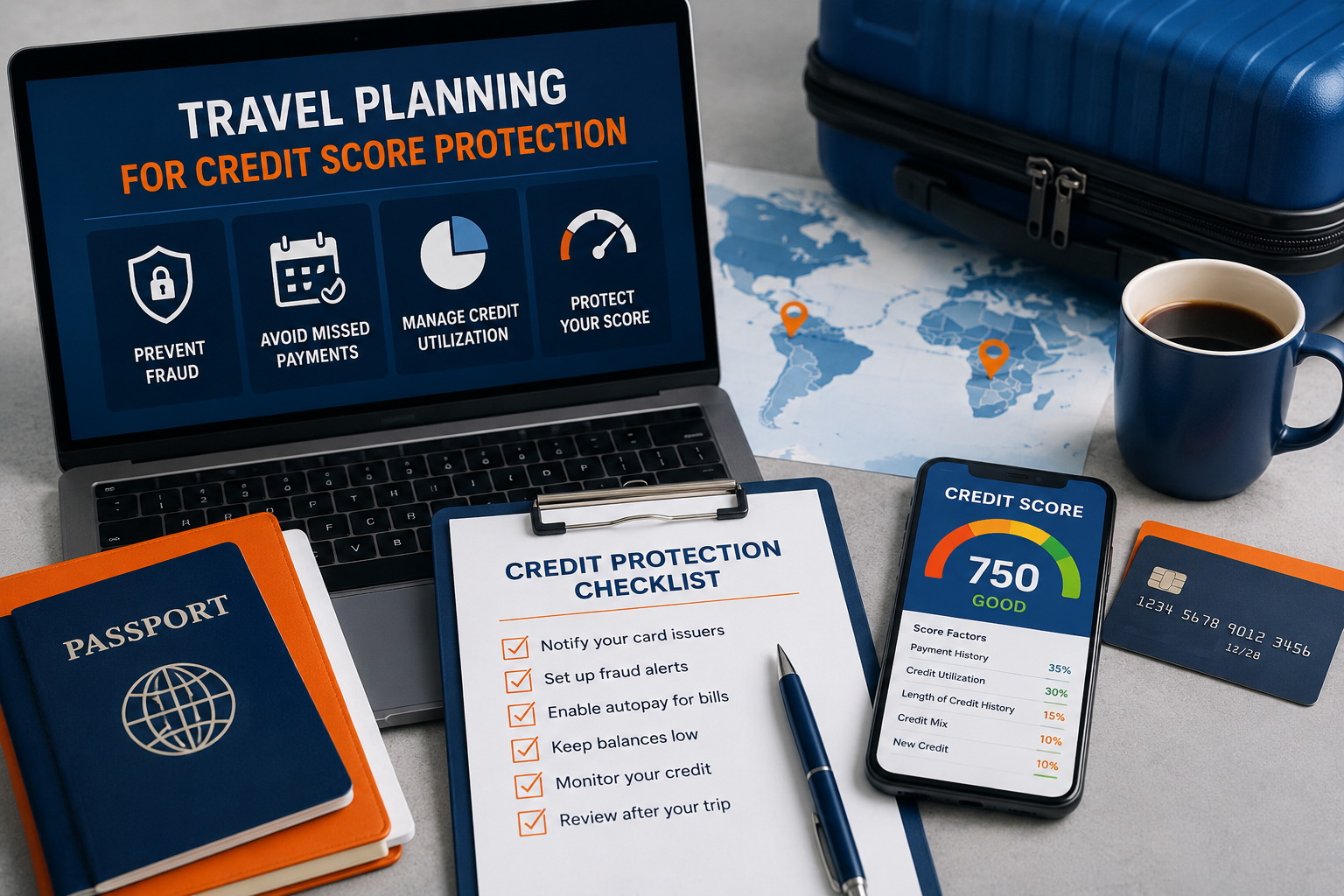
How Travel Affects Your Credit Score
Travel does not automatically hurt your credit score. But several common travel behaviors can.
Your credit score responds to five factors: payment history (35%), credit utilization (30%), credit history length (15%), credit mix (10%), and new inquiries (10%). Travel can trigger problems in all five if you are not careful.
Spending more than usual on a trip pushes up your balance. A higher balance on your card raises your utilization ratio. If you carry that balance into the statement closing date, your score drops. Your issuer reports the balance to the credit bureaus at the statement date, not at the payment date. So even a balance you plan to pay off can hurt your score if you wait too long.
Missing a payment because you were traveling is one of the most common credit score drops we see. A 30-day late payment can reduce your score by 60 to 110 points. One payment missed during vacation recovery can undo months of rebuilding work.
What Happens When You Apply for a Travel Credit Card
Applying for a travel card triggers a hard inquiry. Hard inquiries drop your score by about 4 to 5 points and stay on your report for two years, though the score impact fades after about 12 months (Cybernews). One inquiry is not a major problem. Several applications in a short window send a different signal to lenders.
Space travel card applications at least six months apart. This keeps your inquiry count low and protects the average age of your accounts. Both factors feed directly into your score.
How Spending Abroad Changes Your Credit Utilization
Credit utilization is the ratio of your balance to your credit limit. Lenders want to see it below 30%. A long trip with daily hotel, food, and activity charges can push a single card above that threshold fast.
The fix is simple: either spread spending across two cards with different issuers or pay down your balance mid-trip before the statement date. Both strategies keep utilization manageable and protect your score while you travel.
Travel Planning Steps for Credit Score Protection Before You Leave
The week before your trip is the most valuable window for credit score protection. These steps take less than an hour and can prevent weeks of damage control.
Notify Your Card Issuers Before You Travel
Most credit card companies will flag foreign transactions as suspicious if they do not know you are traveling. A flagged transaction leads to a frozen card. A frozen card abroad means a declined payment and a stressful phone call to sort it out. Call your card issuer or update your travel dates in their app before you leave.
This notification also activates fraud monitoring tailored to your travel dates. Any charge outside your known itinerary triggers an alert rather than an approval.
Decide Whether to Apply for a Travel Credit Card
If you travel more than twice a year internationally, a no-foreign-transaction-fee card saves money on every purchase. But apply for that card at least 90 to 120 days before your trip. This gives the new account time to age slightly before travel. It also means the hard inquiry from the application will not appear fresh on your file when you return and need to apply for something else.
Do not apply for a new travel card in the two to four weeks before your trip. A fresh hard inquiry plus increased spending on a new card looks risky to other lenders reviewing your file.
Set Up Real-Time Credit Alerts Before You Go
Real-time alerts from your card issuers and a credit monitoring service give you immediate notification of any suspicious activity. Experian, Equifax, and TransUnion all allow you to set up email or text alerts for new accounts opened in your name, address changes, and hard inquiries.
Set these up before you leave. You will not be checking your mail or logging into banking apps daily while traveling. Alerts bring the information to you.
Set All Bills to Autopay
This is the most important pre-trip credit protection step. Set every credit card to autopay the minimum balance before you leave. You are not required to pay the full balance, just enough to prevent a late mark. When you return, you can pay the remainder.
In our office, last quarter, we reviewed 22 client files where a travel-period missed payment caused a score drop of 60 or more points. In 19 of those 22 cases, the client had simply forgotten to pay because they were on vacation. Autopay eliminates this.
Travel Planning for Credit Score Protection
The habits you carry into a trip are just as important as the preparation before it.
Use Credit Cards Instead of Debit Cards Abroad
Credit cards offer better fraud protection than debit cards. If a fraudster charges your credit card, the disputed amount stays with the card issuer while the case resolves. You are not out of pocket. If a fraudster drains your debit card, the cash is gone from your bank account while you wait for a dispute resolution.
Visa and Mastercard both offer zero fraud liability on credit cards. Use credit for every purchase abroad. Carry minimal cash. Skip the debit card for foreign point-of-sale transactions.
Avoid Public Wi-Fi for Banking
Public Wi-Fi at airports, hotels, and cafes is one of the most common vectors for financial credential theft. A person connected to the same network can intercept your login data if you access your bank or card accounts without a VPN.
Use your phone's mobile data connection for any financial login abroad. If you must use public Wi-Fi, enable a VPN first. This one habit prevents the kind of credential theft that leads to new fraudulent accounts opened in your name.
What to Do If Your Card Gets Stolen While Traveling
Report it immediately. Do not wait until you return home. Call your issuer the same day. Most card issuers can express mail a replacement to your hotel within two to three business days.
When you report the theft, ask your issuer two things: whether any fraudulent charges have already been posted, and whether they have seen any new account applications attached to your card number. Fraudsters sometimes use stolen card data to apply for new credit, not just to make purchases. A new fraudulent account on your credit file harms your score even if you did not make the purchases.
What to Do After You Return to Protect Your Credit Score
The week after a trip is when most credit damage goes undetected.
Pull Your Credit Report Within a Week of Returning
Go to AnnualCreditReport.com and pull your report from all three bureaus. Look specifically for accounts you do not recognize, addresses you have never lived at, and inquiries from lenders you never contacted. Any of these signals means your information was used while you were away.
Dispute unfamiliar items immediately. The sooner you file a dispute, the faster the bureau investigates. Waiting months allows fraudulent accounts to age and accumulate negative payment history on your file.
Pay Your Travel Card Balance Before the Statement Closes
Your card issuer reports your balance to the credit bureaus at the statement closing date. If you spent heavily during your trip, that balance is what gets reported, even if you intend to pay it off. A high reported balance raises your utilization ratio and lowers your score temporarily.
Pay down your travel card balance as soon as you return, before the statement date. Even a partial payment that brings the balance below 30% of your limit will reduce the score impact.
Review Autopay and Reset Alerts
After your trip, confirm that all autopay settings are still active. Some travelers temporarily disable autopay before a trip to manage cash flow. Forgetting to re-enable it is a common post-travel mistake. Check all recurring payment settings and confirm your credit monitoring alerts are still turned on.
Does a Travel Credit Card Application Hurt Your Score?
Yes, but only slightly and temporarily. Each new travel card application generates one hard inquiry. That inquiry drops your score by about 4 to 5 points on average. The impact fades after 12 months and disappears from your report completely after two years.
The more important factor is how many applications you submit in a short time. Applying for three travel cards in two months generates three hard inquiries and opens three new accounts, lowering your average account age. The combined effect is more significant than any single application.
Apply for one travel card at a time. Wait at least six months between applications. Use pre-qualification tools before applying. Most major issuers now offer soft-pull pre-qualification that shows you your approval odds without touching your score.
Is Your Credit Ready for Your Next Trip?
Travel-related fraud, missed payments, and high credit card balances can damage your score fast. Get a professional credit review before your next vacation and travel with confidence.
Get Your Free Credit AnalysisDiscover potential risks, identify errors, and learn how to protect your credit score before, during, and after travel.
How to Monitor Your Credit While Traveling
Monitoring your credit while abroad is easier than it used to be. Experian, Equifax, and TransUnion all support U.S.-based report access from overseas. Credit Karma offers free real-time score updates and fraud alerts.
Set up monitoring before you leave so alerts reach you in real time. If you are on a long trip (more than two weeks), do a mid-trip credit check. Log in from a secure connection and look for anything new. A new account or an unexpected inquiry mid-trip means someone is using your information right now, while you can still act immediately.
Identity theft reports filed between January and September 2025 already exceeded the full-year total from all of 2024, with credit card fraud growing at a quarterly average of 167,817 reports. Travel creates an opportunity for that fraud. Preparation closes that opportunity before it opens.
The clients who come to us with travel-related credit damage almost always share the same pattern: they did not set up alerts, they skipped the post-trip credit check, and they were not watching their utilization during the trip. All three gaps are easy to close. Close them before you pack your bags.