
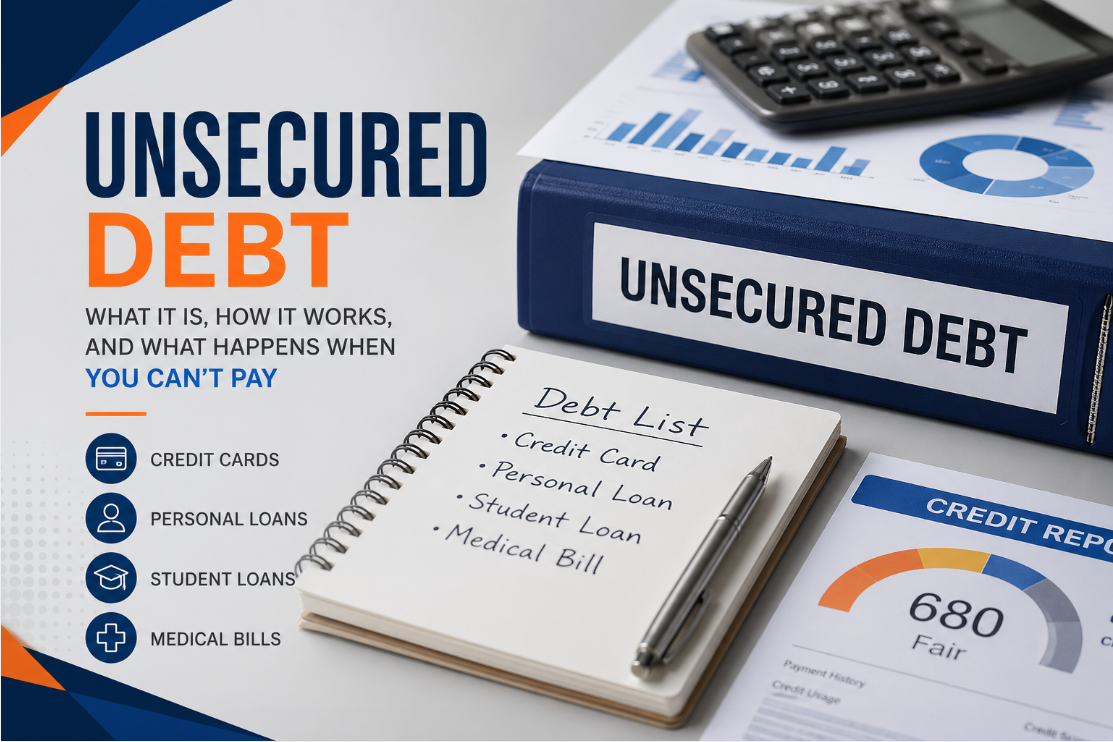
Unsecured Debt Definition: What It Is, How It Works, and What Happens When You Can't Pay is something every borrower should understand before taking on credit card debt, personal loans, or medical bills. Unlike secured debt, unsecured debt is not backed by collateral, which changes how lenders approve it, price it, and collect it when payments stop.
Running a credit repair company, I see the damage unsecured debt causes when it spirals. One case that stays with me is a client who came in with $34,000 across six credit cards, two personal loans, and a medical bill from an ER visit. She had no idea which accounts were already in collections and which were still with the original creditors.
That distinction matters enormously, and understanding it starts with knowing what unsecured debt actually means.
Americans now carry $1.277 trillion in credit card debt alone, according to the Federal Reserve Bank of New York's Q4 2025 Household Debt and Credit Report.
That is the highest balance recorded since the Fed began tracking this data in 1999. Nearly 47% of American cardholders carry a balance from month to month, according to Bankrate's 2026 Credit Card Debt Report. Unsecured debt is not a niche financial concept. It is the daily financial reality for tens of millions of people.
Unsecured Debt Definition
Unsecured debt is a financial obligation not backed by collateral. The borrower's promise to repay, combined with their creditworthiness, is the only thing the lender holds.
This differs from secured debt in one fundamental way: if you default on a secured loan, the lender can take a specific asset. A mortgage lender can foreclose on your home. An auto lender can repossess your car.
With unsecured debt, the lender has no specific asset to claim. They must go through the legal system to collect.
Because lenders take on more risk with unsecured debt, they charge higher interest rates to compensate. The average credit card APR in 2024 was 22.76%, according to Federal Reserve data.
Compare that to the average 30-year mortgage rate, which hovered between 6% and 7% during the same period. The absence of collateral directly drives that gap in cost.
Types of Unsecured Debt
Most consumer debt people encounter day-to-day is unsecured. The main types are:
Credit cards are the most common form of unsecured debt in the U.S.
They are revolving debt, meaning you can borrow, repay, and borrow again up to your credit limit. The average individual credit card balance was $6,523 as of Q3 2025, according to TransUnion.
Personal loans are fixed-term, fixed-payment loans used for debt consolidation, home improvements, medical costs, or emergency expenses.
Lenders approve them based on your credit score and income. Americans pay an average of $475 per month toward personal loan payments, according to LendingTree data.
Student loans are unsecured in most cases, both federal and private.
The federal government does not require collateral for student loans. Outstanding student loan debt stood at $1.62 trillion in Q4 2024, per the New York Fed.
Medical bills are unsecured because no collateral is involved in receiving healthcare. As of 2022, 13% of Americans, over 43 million people, had medical debt in collections, according to the Urban Institute.
Buy Now, Pay Later (BNPL) plans are a newer form of unsecured debt. Nearly 49% of consumers have used BNPL, according to a LendingTree survey. Reporting to credit bureaus is inconsistent across BNPL providers, which creates blind spots in credit profiles.
Unsecured personal lines of credit work like credit cards but often come with lower interest rates and are used for larger, ongoing expenses.
Unsecured Debt vs. Secured Debt: What's the Real Difference?
The difference comes down to one word: collateral.
Secured debt ties the loan to a specific asset. Examples include mortgages, auto loans, home equity lines of credit, and secured credit cards. If you stop paying, the lender takes the asset. The lender's risk is lower, so the interest rate is lower.
Unsecured debt has no asset attached. If you stop paying, the lender cannot take anything immediately. They must report the debt to credit bureaus, send it to collections, and potentially file a lawsuit to recover the money. The lender's risk is higher, so the interest rate is higher.
One practical point: some debt types can be either secured or unsecured. A secured credit card requires a cash deposit as collateral, typically for people building or rebuilding credit.
A secured personal loan may use a savings account or a vehicle title. Once you build enough credit history, you can often transition to unsecured versions of these products.
How Unsecured Debt Affects Your Credit Score
Unsecured debt touches your credit score in multiple ways, more so than most people realize.
Payment history accounts for 35% of your FICO score. Every missed payment on an unsecured account, whether a credit card or personal loan, gets reported to the credit bureaus after 30 days. One 30-day late payment can drop a score by 60 to 110 points, depending on your credit profile.
Credit utilization accounts for 30% of your score. This is the ratio of your revolving balances to your total credit limits. Unsecured credit cards and personal lines of credit directly drive this number. Keeping utilization below 30% is the standard guidance. Above 30%, scores start dropping. Above 50%, the impact becomes serious.
New credit inquiries happen every time you apply for a new unsecured product. Each hard inquiry can temporarily reduce your score by a few points.
At our credit repair company, this quarter, we handled over 40 cases where unsecured debt in collections was the primary driver of credit score drops. In nearly all of them, the collection account appeared months or even years after the original account was closed, catching clients off guard.
What Happens When You Default on Unsecured Debt
Defaulting on unsecured debt triggers a sequence of escalating consequences. Unlike secured debt, no asset gets seized immediately, but the financial and legal fallout can be just as serious.
The timeline typically looks like this:
30 days late: The lender reports the missed payment to credit bureaus. Your score drops.
60 to 90 days late: Late fees accumulate. The interest rate may increase. The lender's internal collections department starts contacting you.
90 to 180 days late: Many credit card accounts reach "charge-off" status. The lender writes the debt off as a loss on their books. A charge-off is one of the most damaging marks possible on a credit report and stays there for 7 years.
After charge-off: The lender either assigns the debt to an internal collections team or sells it to a third-party debt collection agency.
Collections and lawsuit: The collection agency attempts to collect. If unsuccessful, the creditor or agency may file a civil lawsuit. Unsecured creditors must sue and win a court judgment before they can garnish wages or levy a bank account.
A charge-off or collection account can drop a credit score by 100 to 150 points. That damage stays on your credit report for 7 years from the date of first delinquency. For people with good to excellent credit, the drop is even more severe because there is further to fall.
Can Unsecured Creditors Garnish Your Wages?
Yes, but only after winning a court judgment. This is a key difference from secured debt.
A mortgage lender can foreclose without suing you first. An unsecured creditor, such as a credit card company or personal loan lender, must file a lawsuit, serve you with papers, win the case, and then obtain a court order before any wage garnishment or bank levy can happen.
Federal law limits wage garnishment to 25% of disposable earnings or the amount your weekly wages exceed 30 times the federal minimum wage, whichever is lower. State laws vary and sometimes provide stronger protections.
If you receive a lawsuit summons, do not ignore it. Failing to respond results in a default judgment automatically in the creditor's favor. At that point, the creditor gains full legal authority to garnish wages, levy bank accounts, or place liens on property. Responding to the lawsuit preserves your right to dispute the debt or negotiate terms, even if you cannot pay in full.
How to Manage and Reduce Unsecured Debt
Several strategies exist for reducing unsecured debt, and the right one depends on your total balance, income, and credit score.
Debt avalanche: Pay minimum payments on all accounts. Put every extra dollar toward the account with the highest interest rate. This method saves the most money over time.
Debt snowball: Pay minimum payments on all accounts. Put every extra dollar toward the smallest balance. This method builds momentum through early wins and works well for people who need motivation.
Debt consolidation: Combine multiple unsecured debts into one loan, ideally at a lower interest rate. A personal loan used for debt consolidation can reduce monthly payments and simplify repayment. This works best if your credit score is good enough to qualify for a competitive rate.
Debt settlement: Negotiate with creditors to accept less than the full balance. This works for accounts already in default or collections. Settled accounts are reported as "settled for less than full balance," which is better than an active collection but still a negative mark. Any forgiven amount over $600 may be reported as taxable income on a Form 1099-C.
Bankruptcy: Chapter 7 bankruptcy can discharge most unsecured debts entirely, including credit cards, personal loans, and medical bills. The process takes roughly 3 to 4 months. The trade-off is a bankruptcy notation that stays on your credit report for 10 years (Chapter 7) or 7 years (Chapter 13). About 123,000 consumers had a bankruptcy notation added to their credit reports in Q4 2024, according to the New York Fed.
The median Chapter 7 filer lists approximately $25,000 to $30,000 in total unsecured debt, with credit cards making up 60% to 70% of that total, according to the American Bankruptcy Institute.
Is Unsecured Debt Dischargeable in Bankruptcy?
Most unsecured debt is dischargeable in Chapter 7 bankruptcy. This includes credit card balances, personal loan balances, medical bills, utility arrears, and most private judgments.
Not all unsecured debt qualifies for discharge. Federal student loans, most tax debts, child support, alimony, and court fines are not dischargeable in most cases. Private student loans have limited discharge options, though courts have granted discharge in cases of proven undue hardship.
If you are considering bankruptcy to manage unsecured debt, consult with a bankruptcy attorney before filing. The means test determines Chapter 7 eligibility based on income, and the outcome affects which chapter you qualify for.
What to Do Right Now If Unsecured Debt Is Becoming Unmanageable
Unsecured Debt Hurting Your Credit?
Credit cards, personal loans, medical bills, and collections can damage your credit fast. See what is reporting on your credit file and find out what steps may help you start repairing the damage.
Get Your Credit Report ReviewKnow what is hurting your score before unsecured debt turns into bigger credit problems.
List every unsecured account, the current balance, the interest rate, and whether it is current or past due
Call each creditor before missing a payment to ask about hardship programs, many of which offer temporary rate reductions or deferred payments
Request your free credit report at AnnualCreditReport.com to confirm which accounts are in collections
Contact a nonprofit credit counseling agency, such as the NFCC (National Foundation for Credit Counseling), for a free budget review and debt management plan options
If accounts are already in collections, confirm the debt is valid before making any payment paying can reset the statute of limitations in some states
Unsecured debt rarely resolves itself. Interest compounds, fees accumulate, and creditors escalate. Taking action before accounts charge off preserves your options and costs significantly less than rebuilding credit after a default.