

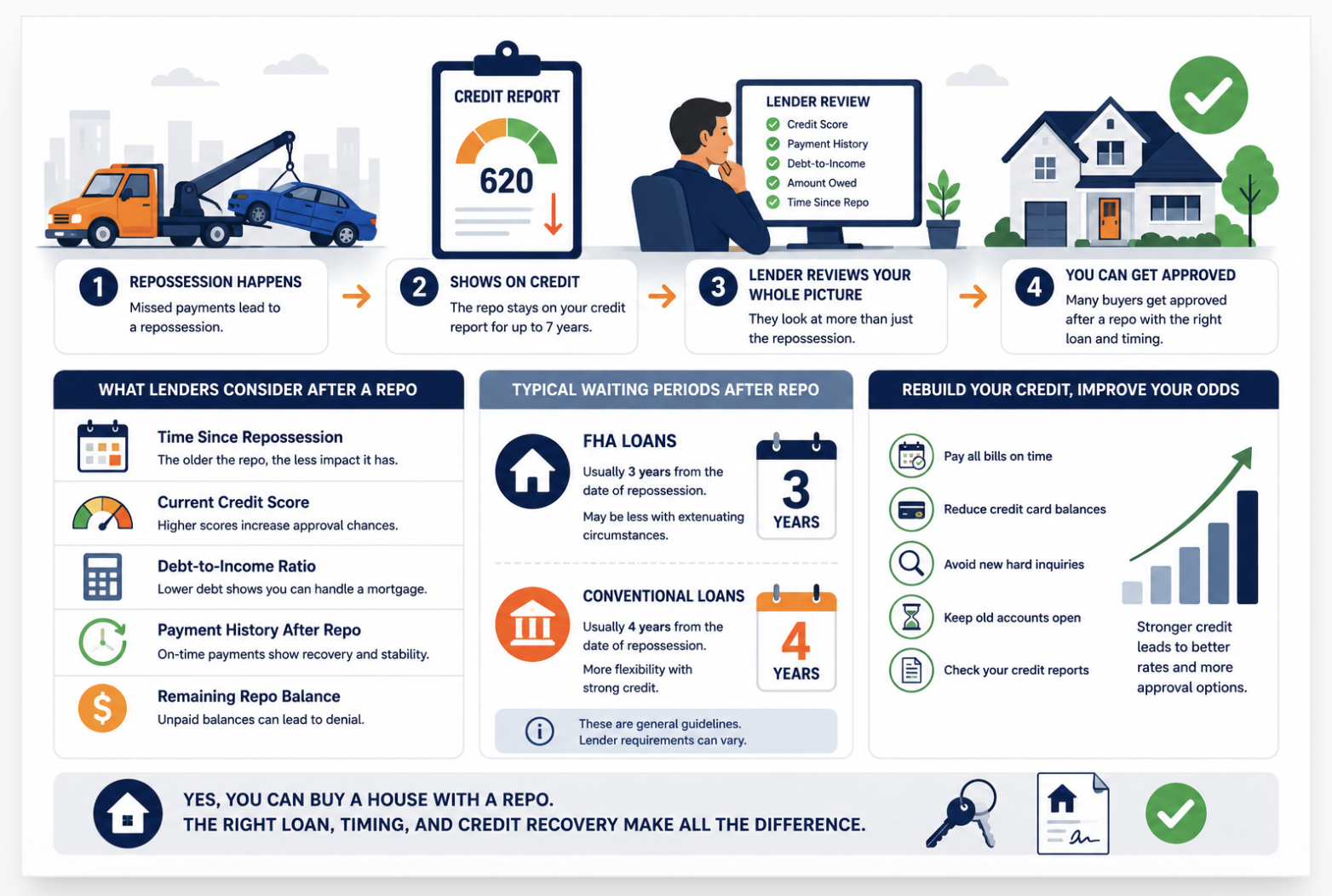
Yes, you can buy a house with a repo on your credit. Many lenders still approve borrowers after a repossession if the repo is older, paid, and followed by stronger credit behavior. FHA and conventional loan guidelines may require waiting periods depending on the situation.
Now, does that mean getting approved will be easy? Not always.
Being on the credit repair industry for almost two decades, I’ve talked to a lot of people who think a repo automatically kills their chances of buying a house. Usually, that fear comes from hearing blanket advice online like “you need perfect credit” or “banks will never approve you after repossession.” That is not how underwriting actually works.
Mortgage lenders look at patterns more than one mistake.
A repo hurts because it tells lenders there was a breakdown in payment history on a major loan. But they also want to see what happened after that. Did you recover? Did you keep making late payments? Did collections pile up? Or did you rebuild your credit and stabilize your finances?
That part matters more than most people realize.
According to Experian, repossessions can stay on your credit report for up to seven years. But many borrowers get approved long before that account disappears. I’ve seen people qualify for FHA loans a few years after a repo because their recent payment history was clean and their debt was under control.
The timeline changes everything.
Someone with a repo from six months ago and maxed-out credit cards is a very different borrower from someone whose repo happened four years ago with solid credit behavior since then.
And honestly, this is where a lot of people get stuck.
They focus only on the repo itself. Meanwhile, lenders are looking at:
current credit score
debt-to-income ratio
recent late payments
savings
income stability
how you manage credit today
That is why some borrowers still get approved with a repo on their credit while others with “better scores” still get denied.
Can You Buy a House With a Repo on Your Credit?
How Does a Repo Affect Buying a House
A repossession tells a mortgage lender you missed multiple payments on a major installment loan, went into default, and lost the vehicle. That signals elevated risk. It drops your credit score, often triggers a deficiency balance that goes to collections, and shows as a derogatory mark on all three bureaus for seven years. But lenders also weigh how old the repo is, whether you resolved the balance, and how you managed credit since it happened.
The damage from a repo is not just one entry on your report.
It typically includes late payments for every month you missed before the repo occurred. Then the default itself. Then the charge-off or repo entry. If the car sold for less than you owed, the deficiency balance often goes to collections. That is three or four negative marks from a single event.
That is why a recent repo with a deficiency still in collections looks worse to a lender than an older repo where everything was resolved. One is an active risk signal. The other is a past event with a clear recovery track.
| What the Repo Creates on Your Credit File | How Long It Stays | Mortgage Impact |
|---|---|---|
| Late payment marks (per month missed) | 7 years from first delinquency | High , payment history is 35% of FICO |
| Repossession account entry | 7 years from first delinquency | High , flags major default to underwriters |
| Deficiency balance collection | 7 years from original delinquency | Very high , open collections often block FHA |
| Court judgment (if sued for deficiency) | 7 years (some states 10) | Severe , may require resolution before any mortgage |
As Experian's mortgage and repossession analysis confirms, lenders weigh the age of the repossession alongside other credit factors. Most tend to look at how long ago the event happened, the outstanding balance situation, and what the rest of the credit file looks like since the repo date.
Can You Get Approved for a Mortgage After a Repo
Yes. Approval after a repo is possible with most loan programs. The key variables are how old the repo is, whether the deficiency balance is resolved, your current credit score, your debt-to-income ratio, and your payment history since the repo. Two people can both have a repo and get completely different mortgage outcomes based on those factors.
There is no single answer because every file is different.
A borrower with a 4-year-old repo, a resolved deficiency, a 650 credit score, and 36 months of on-time payments since can often get approved. A borrower with a 6-month-old repo, an open deficiency in collections, and multiple recent late payments on other accounts will struggle with most lenders.
The loan program also matters. FHA is more flexible than conventional. Portfolio lenders and credit unions sometimes have more flexibility than major banks. Some non-QM (non-qualified mortgage) lenders work with recent repos but charge higher rates to account for the added risk.
FHA Loan Rules After Repossession
The FHA handbook (HUD 4000.1) does not set a mandatory waiting period for repossession the way it does for foreclosure or bankruptcy. FHA requires a minimum 580 score for 3.5% down and 500 for 10% down. The real FHA concern after a repo is not the repo itself but the deficiency balance. An unpaid deficiency that went to collections can block FHA approval if it shows as an outstanding debt that was not resolved.
This is where FHA and repossession get misunderstood.
Many borrowers think there is a firm 2-year or 3-year waiting period after a repo for FHA. There is not , not in the official guidelines. The FHA has mandatory waiting periods after Chapter 7 bankruptcy (2 years) and foreclosure (3 years). Repossession has no equivalent rule in the FHA handbook.
What actually matters in FHA underwriting after a repo is this:
- Is there a deficiency balance? If it is outstanding and in collections, FHA underwriters typically want it resolved before approval.
- Does the file show recovery? Twelve months of on-time payments across all accounts after the repo is the baseline most FHA lenders want to see.
- Is the credit score at or above 580? Below that, the required down payment jumps to 10%.
- Does the total debt-to-income ratio fit? FHA allows up to 57% DTI in some cases, but underwriters want the file to show the borrower can handle the new payment.
Individual lenders add overlays. A lender may require 620 minimum even though FHA allows 580. Or 24 months post-repo seasoning even though HUD does not mandate it. Shopping multiple lenders matters when your file includes a repo because overlays vary significantly.
As NerdWallet's 2026 FHA loan requirements guide explains, FHA loans accept lower scores and are more accessible for borrowers with credit challenges , but each lender sets their own minimums above the FHA floor.
Conventional Loan Rules After Repossession
Conventional loans (Fannie Mae and Freddie Mac) do not have a published mandatory waiting period specifically for repossession. But they require a minimum 620 credit score, and their automated underwriting systems evaluate the full credit profile. Most conventional lenders want 24 months of clean payment history after a repo before approving. A deficiency balance in collections creates DTI and creditworthiness concerns that often block conventional approval until resolved.
Fannie Mae's underwriting guidelines address multiple types of derogatory credit events. Bankruptcy has a 4-year wait for Chapter 7. Foreclosure has a 7-year standard wait. For repossession, there is no equivalent published waiting period , it falls under general derogatory credit evaluation.
What Fannie Mae does care about: the overall risk profile. Automated underwriting systems (Desktop Underwriter) evaluate the pattern, not just the individual event. A file with a repo plus multiple recent lates plus high utilization gets a different risk rating than a file with an old repo, clean payment history since, and low current debt.
Conventional loans also require private mortgage insurance (PMI) for down payments under 20%. A borrower with a repo-damaged score applying for conventional often pays a higher PMI rate, which increases the monthly cost on top of any rate premium for the credit profile.
How Long Should You Wait After a Repo
There is no mandatory waiting period for repossession in FHA or conventional guidelines. Most FHA lenders want 12 months of clean post-repo payment history. Most conventional lenders want 24 months. The best time to apply is when your credit score is strong enough, the deficiency is resolved, and your payment record since the repo shows consistent reliability , not when a calendar timer expires.
The chart shows why timing still matters even without a formal waiting period.
Month 6 typically gets borrowers to FHA score territory if they rebuild actively. Month 12-18 brings most into the conventional range. Month 24-36 is where most borrowers find consistent approval with reasonable rates.
If you are at month 8 post-repo with a 605 score and an open deficiency, waiting another 4-6 months to hit 630 and resolve the deficiency often changes the outcome completely. Understanding the auto loan default and repo timeline helps clarify exactly when different thresholds become accessible in your specific situation.
Does a Paid Repo Help Mortgage Approval
Paying the deficiency balance helps. It removes an open collection from your file, reduces DTI concerns, and shows underwriters the debt is resolved. Paying does not remove the repo entry from your credit report , the mark stays for 7 years from the original delinquency date. But it changes the story from "unresolved risk" to "past event that was handled."
The distinction between the repo entry and the deficiency balance matters in underwriting.
The repo entry is a fixed historical mark. It shows you defaulted on the loan. Paying does not change or remove it.
The deficiency balance is a different issue. If the lender sold the car and you owed $4,000 more than it sold for, that $4,000 is the deficiency. If it went to collections, it shows as an open collection account. Open collections in FHA underwriting often require resolution or documented justification before approval.
Resolving the deficiency kills two problems at once: it closes the collection that may be blocking approval, and it eliminates the ongoing interest and fees that compound on an unresolved balance. Some deficiency collectors will negotiate , settling for less than the full amount if you can make a lump sum payment.
What Credit Score Do You Need After a Repo
580 opens FHA with 3.5% down. 500 opens FHA with 10% down. 620 is the conventional loan floor. Most lenders add overlays , expect real-world FHA approval to start around 600-620 at most participating lenders. Better rates and broader lender access arrive at 680+. A repo on an otherwise strong file hurts less than the same repo on a file with multiple other derogatory items.
| Credit Score | Loan Option | Down Payment | Typical Approval Scenario After Repo |
|---|---|---|---|
| 500-579 | FHA only | 10% minimum | Possible with 12+ months clean history and resolved deficiency. Limited lenders participate. |
| 580-619 | FHA | 3.5% down | Stronger approval odds. Repo needs to show some age (6-12 months). Most lenders want resolved deficiency. |
| 620-659 | FHA or conventional | 3.5-5% typical | Both programs open. Old repo with clean history since often clears underwriting. PMI required. |
| 660-699 | FHA, conventional, some VA | 3-5% typical | Repo matters less at this range. Score demonstrates recovery. Better rate pricing available. |
| 700+ | All programs | 3-20% | Old repo rarely blocks approval. Credit behavior since repo outweighs the event itself at this level. |
One thing that surprises borrowers: two people with the same credit score and same repo can get different outcomes based on what else is in their file. Late payments on credit cards, open collections on other debts, or a high DTI alongside the repo create compounding risk that the score alone does not fully capture.
Can You Remove a Repo From Your Credit Report
If the repo entry contains inaccurate information , wrong dates, wrong balance, inaccurate account status , you can dispute it under the FCRA and potentially have it removed or corrected. An accurate repo with correct information is harder to remove. It ages off automatically after 7 years from the original delinquency date. Some borrowers successfully negotiate goodwill deletion after paying the deficiency, but lenders are not required to agree.
Start by pulling all three bureau reports and reviewing every detail of the repo entry.
Check the original delinquency date. Check the balance. Check whether the account status is accurate. Check whether the same debt appears twice , once from the original lender and again from a collection agency. Inaccurate information gives you grounds for a formal FCRA dispute.
If the entry is accurate, you have three realistic options. Wait the full 7 years. Send a goodwill letter to the lender after resolving the deficiency, asking for early removal as a courtesy. Or request a pay-for-delete agreement with the collection agency holding the deficiency balance before paying. Pay-for-delete works more often with smaller agencies and is harder with major lenders.
The guide on how to get a repo off your credit report covers the specific dispute process and removal strategies in more detail, including how to challenge inaccurate account information across all three bureaus simultaneously.
What Lenders Look at Besides the Repo
A repo is one data point. Lenders look at the full file. These factors often determine the outcome more than the repo entry itself.
Payment history since the repo. This is the biggest one. Every account current for 12-24 months after the repo , that behavioral pattern matters to underwriters. It shows the financial problem was a past event, not a current pattern.
Debt-to-income ratio. A DTI above 43-45% creates problems regardless of the credit score. Mortgage lenders need confidence you can handle the new payment alongside existing obligations. Lower DTI means more flexibility on other risk factors.
Down payment size. A larger down payment reduces lender risk. A borrower putting 10% or 20% down on a post-repo application is a different risk profile than one putting 3.5% down. More equity at closing gives the lender more protection.
Employment and income stability. A two-year consistent employment history at the same employer or in the same field signals that the income used to qualify the mortgage is reliable. Gaps, frequent job changes, or recent income changes add complexity to an already complex file.
Other derogatory items. A repo on a clean file with one negative event reads differently than a repo combined with recent late payments, open collections, and high utilization. The repo in isolation may not block approval. The repo as part of a pattern often does.
Understanding the full requirements to buy a house as a first-time buyer gives a broader picture of what lenders evaluate beyond the credit score and derogatory events in the file.
How to Improve Mortgage Approval Odds After Repossession
Contact the collection agency or lender holding the deficiency and negotiate settlement or payment. Before paying, get the agreement in writing , full pay-off amount, confirmation the account closes, and any pay-for-delete terms if applicable. An open deficiency in collections is often the single biggest FHA approval blocker after a repo.
Priority 1 , Do this first if the deficiency shows as an open collectionUtilization is the fastest thing to improve after a repo. Getting every card below 10% before the statement close date can add 20-40 points in one billing cycle. A 620 score sometimes becomes 655 from this single change. That shift moves a borderline file into stronger approval territory.
Timeline: 25-35 days | Potential: 20-40 pointsOne new late payment at this stage resets the underwriting clock. Lenders want to see a pattern of reliable payments since the repo. Set autopay on every account. Every on-time payment from this point adds to the post-repo recovery narrative that underwriters evaluate.
Timeline: Starts building immediately. 12 months of clean history is the key milestone.Pull all three bureau reports. Check dates, balances, and account status. If the original delinquency date is wrong, the balance is inflated, or the account appears twice, dispute those items under the FCRA. Removing even one inaccurate entry from the file can add meaningful points and simplify underwriting review.
Free at AnnualCreditReport.com | 30-day dispute investigation windowA post-repo credit file often has thin positive history. Adding a secured credit card or credit builder loan that reports monthly to all three bureaus creates 12 positive payment marks per year. Combined with existing accounts paid on time, this builds the payment history record underwriters want to see as evidence of recovery.
Timeline: First positive mark in 30 days | 12 positive marks per year per accountOne lender's denial does not mean all lenders will deny. Credit unions, community banks, and non-QM lenders sometimes work with post-repo borrowers where national banks and large mortgage companies decline. A mortgage broker can access multiple lenders simultaneously without stacking hard inquiries if applications go out within a 14-45 day rate shopping window.
Multiple applications within 14-45 days count as one inquiry for scoring purposesAs NerdWallet's research on derogatory marks confirms, positive information and time are the two most reliable tools for offsetting a repossession's credit impact. Consistent on-time payments added to the file alongside an aging repo create the recovery story lenders need to see.
Can you get a mortgage with a repossession?
Yes. A repossession does not automatically disqualify you from mortgage approval. FHA loans have no mandatory waiting period for repossession and require a minimum 580 score. Conventional loans require 620. The key factors are how old the repo is, whether the deficiency balance is resolved, how your credit has recovered since, and whether your current DTI fits the loan guidelines. Recent repos with unresolved deficiencies create the biggest approval barriers.
Is a voluntary repo better than an involuntary repo for mortgage purposes?
Slightly, in some cases. A voluntary repo typically involves fewer late payment marks because the borrower turned the vehicle in before the lender pursued involuntary repossession. That means fewer negative entries on the credit report from the same event. Both types still show as a repossession on the credit file. Neither prevents mortgage approval automatically. Lenders generally care more about what followed the repo than the type of repo.
Can underwriters deny a mortgage because of a repossession?
Yes. Underwriters can deny any application based on their risk assessment. A recent repo with an open deficiency collection, low score, and high DTI can and does produce denials. An old repo on a file that shows strong recovery may sail through underwriting without the repo being the deciding factor at all. Underwriters evaluate the full risk profile , not just individual events in isolation.
Can you refinance after a repossession?
Yes, if you already own a home. Refinancing after a repossession follows the same credit evaluation as a purchase. FHA cash-out refinance requires 580+. Conventional refinance requires 620+. A rate-and-term refinance with a clean payment record since the repo often proceeds without the repo being a major underwriting issue, especially if the repo is 2 or more years old. Any deficiency balance in open collections still needs attention before underwriting.
Trying to Buy a House After a Repo? Start Here.
A free 3-bureau audit shows exactly what Equifax, Experian, and TransUnion currently report on the repo, the deficiency, and any related accounts. Knowing the full picture before you apply helps you fix the right things first and avoid surprises during underwriting.
Get My Free 3-Bureau Audit → Secure · 2 minutes | No credit card required-
How to Dispute Apartment Collections and Protect Your Credit Like a repo, apartment collections are derogatory marks that affect mortgage underwriting. This covers the dispute process for rental collection accounts, what documentation collectors must provide, and how removing an apartment collection shifts your credit profile in the direction lenders need to see before approving a home purchase.
-
How to Maintain Good Credit for a Home Loan Once your credit has recovered from a repo and you are approaching mortgage application territory, this covers how to protect the score gains you have built. The specific behaviors and account management strategies that keep your file looking strong during the critical 90-day window before a lender pulls your credit for a mortgage pre-approval.
-
Zero Down Mortgage Credit Score Requirements After a repo, saving for a down payment and rebuilding credit at the same time can feel like two competing priorities. This covers the zero down mortgage programs available through VA and USDA, the credit score requirements for each, whether a past repossession affects eligibility, and how to determine which path to homeownership fits your specific post-repo credit recovery timeline.