

Can You Terminate a Car Lease Early?
Yes, you can terminate a car lease early, but it often comes with fees, remaining payments, or negative equity costs. Common options include lease transfers, buyouts, trade-ins, or early termination through the leasing company. The cheapest solution depends on your lease terms, vehicle value, and remaining balance.
Most people discover how hard it is to exit a car lease only after they want out. Maybe the payment became too expensive. Maybe you moved, lost income, changed jobs, or simply no longer need the vehicle. The problem is a lease is still a legal financial contract, and the lender expects every remaining payment unless another solution replaces it.
The good news is early lease termination is possible. The bad news is some options are dramatically more expensive than others. One strategy may cost a few transfer fees. Another can leave you paying thousands in penalties and negative equity.
Across car finance forums, one pattern shows up constantly: people assume returning the car automatically ends the obligation. Usually, it does not. The lender still calculates depreciation, remaining payments, fees, and vehicle value before determining what you owe.
Can You Get Out of a Car Lease Early
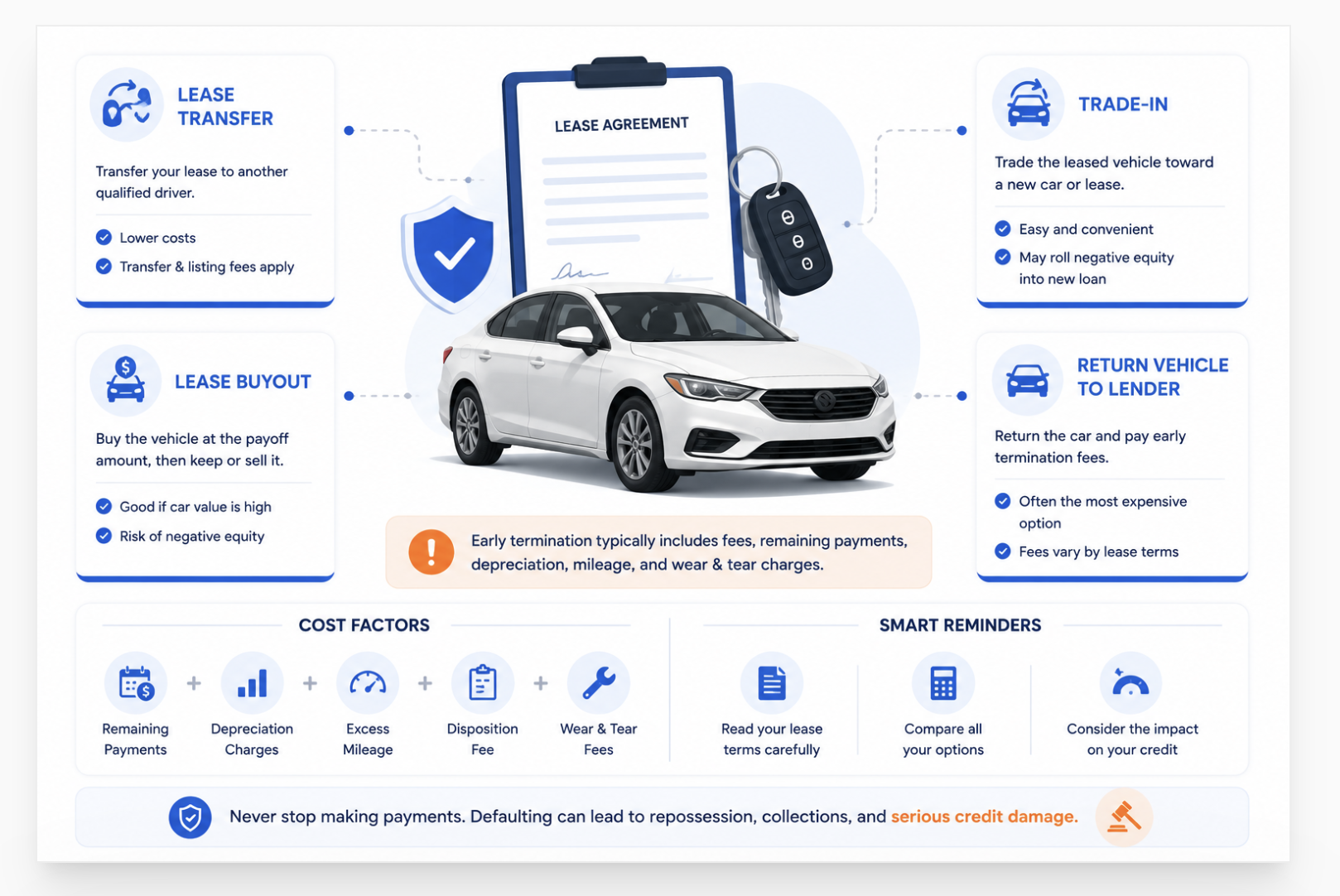
Yes. You can get out of a car lease early. The contract gives you the right to exit before the term ends, but it also defines the financial cost of doing so. Early exit options include lease transfer, lease buyout, dealer trade-in, and direct return to the leasing company. Each option carries a different cost structure. None of them is free.
People get into this situation all the time. A job changes. Income drops. A family grows. A city move makes a car unnecessary. Life shifts faster than a 36-month lease contract does.
The short answer is yes, you can get out. The more useful answer is how , because the path you choose determines whether you walk away with a manageable expense or a financial crater on your credit report.
Read your lease contract first. Look for these specific terms: early termination clause, early termination liability calculation, lease transfer policy, and buyout terms. Every major lessor includes these sections. The numbers inside those sections tell you exactly what you are dealing with before any conversation with the dealer or lessor starts.
As Edmunds' early lease exit guide explains, the earlier in the lease you exit, the higher the cost. This is because most of the depreciation charges concentrate in the first half of the lease term. A car that leases for 36 months loses the most value in months 1 through 18. Exiting in month 6 of a 36-month lease is considerably more expensive than exiting in month 28.
What Happens When You Terminate a Lease Early
When you formally terminate a car lease early through the lessor, they calculate your Early Termination Liability. This is the sum of everything you owe.
The calculation typically includes:
- Remaining monthly payments , or a portion of them, depending on where you are in the term
- Depreciation charges , the difference between the car's expected value at lease end (residual) and its current market value at early exit
- Early termination administrative charge , a set fee, often two base monthly payments
- Disposition fee , typically $300-$500, charged for preparing the vehicle for resale
- Excess mileage charges , if you exceeded the annual limit before the exit date
- Wear and tear charges , for any condition issues above normal use standards
For example: a 36-month lease terminated after 17 payments, with a $476/month payment and 19 months remaining, might produce a liability of $3,800-$6,500 depending on the vehicle's current market value and the specific lessor's formula.
The key variable is what the lessor determines as the "realized value" , what they can actually sell the vehicle for at wholesale auction. If the used car market is strong and the vehicle brings a high wholesale price, your termination cost drops. If the market is soft, the gap between residual value and wholesale price widens and your bill grows.
Cheapest Ways to End a Car Lease Early
The cheapest way to terminate a car lease early is a lease transfer. Another qualified driver takes over the remaining payments and contract obligations. You pay a transfer fee, typically $150-$500, and exit without paying remaining months or depreciation charges. Other options , buyout, dealer trade-in, and direct early return , each carry higher costs.
Lease Transfer vs Lease Buyout
| Factor | Lease Transfer | Lease Buyout |
|---|---|---|
| Out-of-pocket cost | $150-$500 transfer fee | Full buyout price (residual value + fees) , typically $20,000-$45,000+ |
| Best when | Vehicle is desirable, several months remain, lessor allows transfers | Vehicle market value exceeds buyout price , you can sell at a profit |
| Credit impact | Account closes cleanly when transfer completes and new driver is released | Account paid in full , clean close, no damage |
| Risk | If new driver misses payments and you were not fully released, you may remain liable | Negative equity if market value dropped below buyout price |
| Time required | 1-4 weeks to find a match + lessor approval processing | 2-7 days once financing secured |
| Platforms | Swapalease.com, LeaseTrader.com, AutoTempest | Credit union, bank, or dealer financing |
The lease transfer is financially superior in most situations. But one critical detail changes the outcome: whether the lessor fully releases you from the contract after the transfer completes. Some lessors keep the original lessee as a backup guarantor. If the new driver misses payments, the account can hit your credit. Always request written documentation of full release from the lessor before considering the transfer complete.
The buyout makes sense when the used car market pushes the vehicle's current value above the buyout price. During the 2021-2023 used car boom, many lessees bought their vehicles at residual price and sold them for thousands more than they paid. In a softer market, the math inverts. Check the vehicle's current wholesale value , not retail , against your buyout price before deciding. Wholesale Kelley Blue Book and Manheim market reports give the most accurate comparison to what the lessor will price the auction at.
As Bankrate's early lease termination breakdown confirms, early buyout calculations depend on the vehicle's current market value relative to the residual set at lease signing. When market value exceeds residual, buyout is financially attractive. When residual exceeds market value, you face negative equity no matter which exit path you choose.
Does Early Lease Termination Hurt Credit
Terminating a lease early does not hurt credit if the process completes correctly and all amounts owed are paid in full. Credit damage comes from missed payments, default, repossession, or unpaid deficiency balances , not from the act of terminating the lease itself. A completed lease transfer or buyout paid in full closes the account with no negative mark.
Let me be direct: the act of ending a lease early is neutral to your credit. The way you end it determines everything.
A properly executed lease transfer where the new driver is approved and the account transfers cleanly closes the lease with no derogatory entry. A lease buyout paid in full produces a paid account with clean payment history. A direct early return where you pay the full termination liability before the account goes delinquent closes with no damage.
Credit damage enters when the exit breaks down: payments stop, accounts go delinquent, the vehicle is repossessed, or a deficiency balance remains after repossession sale.
One specific risk: if you transfer the lease but never confirm full release in writing, and the new driver later defaults, the account can still appear on your report under your Social Security Number. Auto lenders evaluate more than your score when reviewing a financing application. A lease account that shows late payments from a driver who took over your lease looks identical to a late payment you made yourself on your report. Confirming full release in writing is not optional , it is the step that protects your credit after the transfer.
Understanding which FICO score an auto lender will use matters here too. Different lenders may use different scoring models , specifically FICO Auto Score 2, 4, and 8 for most auto financing decisions. A derogatory lease entry on any bureau affects your middle FICO Auto Score and changes your rate tier on the next vehicle you finance.
What Happens if You Stop Paying the Lease
This is the path that produces the worst outcome.
Stopping payments feels like the easiest exit when money is tight. It eliminates a bill immediately. But the financial and credit consequences make it the most expensive decision in the long run.
A 30-day late mark posts to Equifax, Experian, and TransUnion simultaneously. Cost: 60-110 points depending on starting score. This mark stays on the report for seven years.
60-day lates carry greater weight than 30-day marks. The lessor escalates contact and begins formal default proceedings. Some lessors refer the account to an outside collections department at this stage.
At 90+ days, the lessor initiates repossession. The vehicle is located and seized , without advance notice in most states. The lessee loses use of the vehicle immediately. The account is now in default.
The lessor sells the vehicle at wholesale auction. If the auction price falls short of the total amount owed (remaining balance plus fees plus auction costs), the difference is a deficiency balance. The lessee receives a bill for that amount. If unpaid, the deficiency balance transfers to a collection agency and a collection tradeline posts to the credit report.
Deficiency balances above a certain threshold , typically $1,000 or more , sometimes result in civil lawsuits. A judgment against you gives the creditor the right to garnish wages and levy bank accounts in most states. Understanding the risks of defaulting on a lease before any payment stops is the step most people skip , and it is the most important one.
From the credit repair side: repossession marks are among the hardest derogatory items to resolve. Unlike inaccurate entries, a repossession that actually occurred cannot be disputed out. It stays for seven years. It appears in full on any tri-merge mortgage or auto financing report. Lenders who see a repossession within the past 3 years frequently decline or require substantial down payments as compensating factors.
When Early Lease Termination Actually Makes Sense
Not every early exit is a sign of financial trouble. Some exits are strategically correct.
Relocation where a car is no longer needed
A move to a city with strong public transit makes a car financially unnecessary. A $659/month payment plus $200 in insurance plus fuel and parking can reach $1,000-$1,200 per month. Paying $2,000-$4,000 to exit that lease can pay for itself within four months of not paying the ongoing costs. Run the math before assuming the termination fee is too expensive.
Approaching mileage limits fast
Many leases set annual limits at 10,000 or 12,000 miles. If you are 18 months into a 36-month lease and already at 22,000 miles, the mileage overage at lease end could reach $2,000-$4,000 at $0.20-$0.30 per mile over limit. An early exit now , through transfer or buyout , locks in the overage at the current mileage rather than the final mileage. For high-mileage drivers, early exit sometimes costs less than finishing the lease.
The used car market is temporarily strong
When used car prices spike , as they did sharply in 2021-2023 , the buyout becomes a money-making opportunity. Your car's market value exceeds the residual set at lease signing. You buy it, sell it, pocket the difference, and start fresh. This window opens and closes based on market conditions. Check market value against your buyout price before every quarterly renewal.
Military deployment
The Servicemembers Civil Relief Act (SCRA) allows active duty military to terminate an auto lease without early termination fees or penalties when called to service for 180 days or more, or when receiving PCS orders outside the continental U.S. The vehicle must be returned within 15 days of deployment. This is a federal protection. Lessors cannot charge the standard termination fee under these conditions.
Life change that the lease no longer fits
A growing family that needs more space, a career shift that adds a long commute, or an income increase that makes ownership more practical than leasing , all of these create legitimate grounds for early exit. The question is always cost versus benefit. Calculate what you will spend to exit versus what you save or gain by exiting. When the benefit exceeds the cost, the termination makes financial sense regardless of how early you are in the term.
As NerdWallet's lease exit guide notes, the best early termination decisions are based on a complete cost comparison , not just the termination fee, but also the ongoing cost of keeping the lease versus the one-time cost of exiting it. For many drivers in changing life situations, exiting makes financial sense even when the upfront fee seems large.
Early lease termination makes financial sense when the ongoing cost of keeping the lease exceeds the one-time cost of exiting it. Relocation, mileage overages, favorable market conditions, military deployment, and life changes all create legitimate exit cases. The exit math is simple: calculate total cost to exit versus total cost to stay through lease end. When the exit number is lower, terminate strategically.
Can you terminate a car lease early?
Yes. Every car lease contract includes an early termination clause. You can exit before the scheduled end date through a lease transfer, lease buyout, dealer trade-in, or direct early return to the lessor. Each option carries a different cost. Lease transfer is typically cheapest. Direct early return carries the highest formal termination fee. Default and repossession carry both financial and credit consequences that far exceed any of the formal exit options.
What is the cheapest way to get out of a car lease early?
A lease transfer is the cheapest legal exit in most situations. You pay a transfer fee of $150-$500 and a qualified new driver takes over the remaining payments. Platforms like Swapalease.com and LeaseTrader.com connect lessees with people looking for short-term leases. The key requirements: the lessor must allow transfers (not all do), the incoming driver must pass credit review, and both parties must complete the transfer paperwork through the lessor. Confirm full written release from the lessor after the transfer completes.
Does early lease termination affect your credit score?
Terminating a lease properly does not damage credit. Paying the termination fee in full, completing a lease transfer with written release, or buying out the lease closes the account without a negative mark. Credit damage happens when payments stop, the account goes delinquent, the vehicle is repossessed, or a deficiency balance stays unpaid. Avoid missing even one payment during any exit negotiation , a single 30-day late costs 60-110 points and stays for seven years.
Can I return a leased car without paying early termination fees?
Returning the car physically does not eliminate the contract obligation. You still owe the early termination liability , the calculated total of remaining value loss, fees, and administrative charges. The exceptions include: the manufacturer offers an early exit window (typically within 3-6 months of lease end), a completed lease transfer where another driver takes over, active military deployment under SCRA protection, and some manufacturer loyalty programs that waive fees when you lease a new vehicle from the same brand. Call the lessor and ask specifically about any applicable programs before assuming the standard termination fee is the only option.
Your Credit Position Determines Your Exit Options
A lease transfer requires the incoming driver to pass credit review. A new lease or auto loan to replace the current one requires your credit approval. Inaccurate entries on your Equifax, Experian, or TransUnion report may be suppressing your score below where your real payment history would place it. A free 3-bureau audit shows exactly where you stand before any lender or lessor reviews your file.
Get My Free 3-Bureau Audit → Secure · 2 minutes · No credit card required-
Can Bad Credit Stop a Car Loan , What to Do Exiting a lease often leads to financing a new vehicle. This covers how auto lenders evaluate bad credit applications , the specific FICO Auto Score models they use, which factors matter most beyond the score, and the preparation steps that move a borderline application into approval territory before the dealer pulls your report.
-
How Lenders Read Your Credit Report When you apply for a new auto loan or lease after terminating early, the lender reads your full credit file , not just the score. This covers the five sections auto underwriters evaluate in order, why a former lease account on your report reads differently from a standard tradeline, and how the pattern of your payment behavior over the past 24 months carries more weight than the score itself.
-
Tri Merge Credit Report , What Lenders Really See Auto lenders pull a tri-merge credit report combining all three bureau files and use the middle FICO Auto Score for rate pricing. A repossession or lease default that appears at even one bureau affects your qualifying score for any subsequent auto financing. This covers how the tri-merge works, how the middle score determines your rate tier, and why bureau-specific entries matter more than the single-bureau score on your consumer app.