
Collection Bureau of the Hudson Valley contacted you about a debt. Before you pay, find out exactly what they are trying to collect. Check the creditor, balance, account details, and age of the debt. A mistake in any of these areas can change what you should do next.
Collection Bureau of the Hudson Valley, also known as CBHV, is a collection agency based in Newburgh, New York. If you received a call or letter from CBHV, do not assume that paying is your only option. First, compare the collection notice with your own records.
The age of the debt is especially important in New York. Under the state's Consumer Credit Fairness Act, many consumer credit debts have a three-year statute of limitations for filing a collection lawsuit. This does not erase a debt after three years. It can, however, affect whether a creditor can sue you to collect it.
Your next move depends on what you find. Not your debt? Investigate and dispute it. Wrong balance? Gather proof. Old debt? Check the legal time limit. Received a court summons? Respond to the court by the deadline.
At ASAP Credit Repair, nearly 20 years of credit repair experience has shown us that a collection account, credit report entry, and debt lawsuit should not be treated as the same problem.
This guide will help you verify the CBHV debt, spot possible errors, check important New York rules, and decide whether your next step is to dispute, pay, negotiate, or respond to court.
Collection Bureau of the Hudson Valley Contacted Me in New York: What Should I Do Next?
If Collection Bureau of the Hudson Valley contacts you, do not rush to pay or ignore the notice. First check who the debt belongs to, whether the balance is correct, and how old the account is.
These checks matter. In 2025, the New York Attorney General received 4,235 complaints involving credit, banking, and mortgages, a category that includes debt collection, credit reporting, credit card billing, and debt settlement. Nationally, the CFPB reported about 112,600 debt collection complaints involving attempts to collect debt consumers said they did not owe in 2025. That represented 41% of debt collection complaints in its reported issue breakdown.
New York also gives debt age extra importance. For many consumer debts, the state's Consumer Credit Fairness Act reduced the statute of limitations for filing a collection lawsuit from six years to three years.
That is why your next step should depend on what you find. Wrong debt? Investigate it. Wrong balance? Gather proof. Old debt? Check the legal time limit. Court summons? Respond to the court.
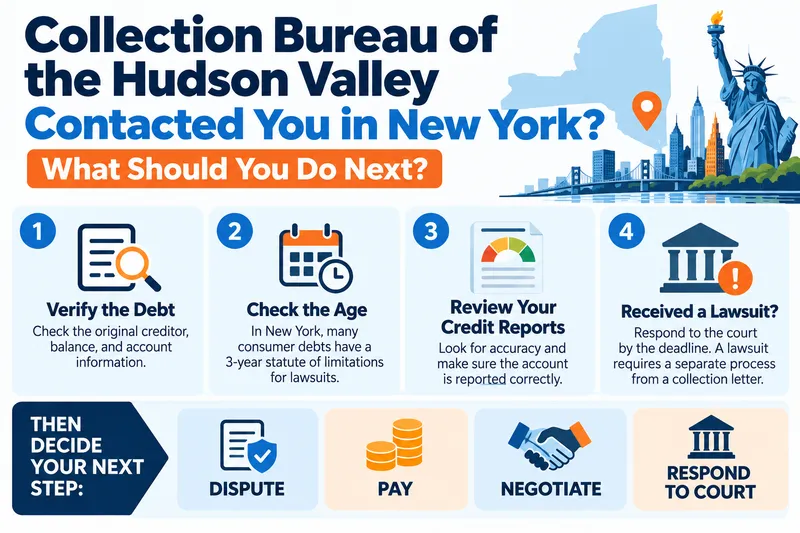
The infographic below gives you a simple path for deciding what to check first and whether your next move may be to dispute, pay, negotiate, or respond to a lawsuit.
Collection Bureau of the Hudson Valley Contacted Me in New York: What Should I Do Next?
If Collection Bureau of the Hudson Valley contacts you, verify the debt before deciding whether to pay. Identify the original creditor, current creditor, balance, account details, and age of the debt. Compare that against your own records and credit reports. Document any discrepancy and use the applicable dispute process. If you receive a court summons, respond through the court by the required deadline — not through an ordinary collection reply.
The CBHV Decision Tree
Don't work through the same seven generic steps regardless of your situation. Your facts determine your path:
Who Is Collection Bureau of the Hudson Valley?
Collection Bureau Hudson Valley, Inc. lists its corporate office at 155 North Plank Road, Newburgh, New York. Its official contact page maintains two separate lines: one for general client services, and a distinct number for consumer and credit-reporting matters.
Knowing who contacted you is step one. The more useful question is what account they are trying to collect, and from whom.
Why Is Collection Bureau of the Hudson Valley Contacting Me?
CBHV contacts consumers because an account has been assigned to it for collection. Identify three separate roles before going further:
- Original creditor — who originally provided the credit or service?
- Current creditor — who currently owns the debt?
- Collection agency — who is attempting to collect it?
→ Collection Bureau of the Hudson Valley → consumer contacted
Don't assume CBHV owns your debt just because it's calling. Confirm which role it's playing on your specific account.
See What's Actually on Your Credit Report First
Before you verify anything with CBHV, see what's already reporting across all three bureaus — free. You can't compare their claim to your records if you haven't pulled your records.
Get My Free Credit Analysis Now →Before You Pay CBHV, Check These 6 Things
- Your identifying information. Does the account belong to you?
- Original creditor. Do you recognize it?
- Current creditor. Who owns the debt today?
- Account balance. Does it match your records?
- Last payment or activity date. This matters for aging and limitations analysis.
- Collection authority. Why is CBHV collecting this specific account?
That turns "should I pay?" into the right question: "do I have enough verified information to make a payment decision?"
What Kind of Debt Is This?
Different debt types raise different follow-up questions. Identify the class before choosing a remedy.
| Debt Type | What to Check First |
|---|---|
| Medical | Provider, insurance adjustments, financial assistance eligibility |
| Credit card | Original creditor, balance, last payment date |
| Utility | Service address, service dates, final bill |
| Telecom | Account number, equipment charges, cancellation date |
| Education-related | School or provider, balance, account type |
| Other consumer debt | Contract, creditor, dates, itemization |
What Information Should CBHV Give You About the Debt?
Federal Regulation F requires debt collectors to provide specific validation information, either in the initial communication or generally within five days of it. That's the federal floor. New York adds more on top of it.
A validation notice is initial information about the debt. Substantiation, below, is a different and stronger process — don't treat the two words as interchangeable.
New York Gives You Additional Debt Verification Rights
New York's Department of Financial Services established a debt substantiation framework letting consumers request documentation supporting an allegedly owed debt. Under the applicable rules, collection activity must stop while a qualifying substantiation request is pending, and specific documentation requirements apply to the response.
Use this when a validation notice alone doesn't resolve your doubt about the account — substantiation goes further than the federal minimum.
What If You Live in New York City?
This is the most important recent change for NYC consumers specifically. NYC's SHIELD debt-collection rule took effect September 1, 2026. Under it:
- Collectors are limited to three contact attempts within seven days, per communication channel.
- Consumers can dispute a debt at any point during the collection process, in any communication mode they've already been using with the collector.
- After a dispute or verification request, collectors must provide documentation within 60 days.
- If no proper documentation arrives within 60 days, the consumer receives a Notice of Unverified Debt, and the collector loses the ability to continue pursuing that debt.
- The rule adds specific medical-debt protections, including disclosure of hospital financial-assistance programs.
New York State and New York City are not the same thing. The three-attempts-per-seven-days rule and the 60-day documentation deadline are NYC-specific SHIELD protections. Don't apply them to a collection contact outside city limits — confirm which rules cover your address.
How Old Is the Debt?
This comes before "should I pay," not after — that ordering is one of the biggest gaps in generic collection-agency content.
New York's Consumer Credit Fairness Act reduced the statute of limitations on lawsuits for most consumer credit transactions from six years to three, effective April 7, 2022. That governs whether a lawsuit can be filed. It does not mean the debt disappears, and different rules can apply to other debt types and circumstances.
Can Making a Payment Restart the Statute of Limitations in New York?
No, for debts covered by the Consumer Credit Fairness Act. New York's Attorney General confirms that a payment made after the three-year limitations period has expired does not revive that period for covered consumer debts. New York Courts guidance reflects the same rule for consumer debt cases.
Don't turn that into "never pay an old debt." Whether a debt is time-barred and whether it still exists are two different questions, and your decision should rest on both, not just one.
Time-Barred Does Not Mean the Debt Vanished
Three separate clocks can apply to the same debt, and people routinely confuse them:
Clock 2 — Credit-reporting period: can the collection still appear on a credit report?
Clock 3 — Debt/account status: does the underlying obligation still exist?
A time-barred debt can still be reported, can still be owed, and can still be a legitimate subject of a (non-litigation) collection attempt. Know which clock applies.
Is Collection Bureau of the Hudson Valley on Your Credit Report?
Don't assume yes by default. CBHV maintains a separate contact channel specifically for credit-reporting inquiries, which indicates it reports to the bureaus in at least some cases. Check your own Experian, Equifax, and TransUnion reports for the collector name, original creditor, balance, date opened, account status, date of first delinquency where shown, and any duplicate reporting across bureaus. Compare all three — they don't always match.
What If CBHV Is Reporting the Wrong Balance?
Don't jump straight to "dispute CBHV." Establish exactly what's wrong first. Example: CBHV reports $1,860, but your documentation shows the account was settled for $1,100. Now the dispute has a factual basis instead of a general complaint.
Skip the "609 letter" templates circulating online — they don't carry special legal weight. A specific, evidenced dispute does the work instead.
What If the Collection Isn't Yours?
Possible causes include a similar name, a wrong consumer, an old address mismatch, a mixed credit file, identity theft, an account already paid, an insurance issue, or a plain data error. Don't just say "not mine" — document why. If identity theft is genuinely involved, use the proper identity-theft process. Don't report a legitimate debt as identity theft to try to make it disappear; that creates its own legal problems.
What If the Debt Was Already Paid?
Gather payment confirmation, a settlement letter, a bank statement, a receipt, an account statement, or prior correspondence. Then be precise about which of these happened: paid, settled, transferred, or still reporting a balance. Those four outcomes are not interchangeable, and the right next step depends on which one applies.
What If This Is a Medical Collection?
CBHV's business can involve healthcare receivables. Work through the chain before accepting the balance:
→ financial assistance considered → unpaid balance placed for collection → credit reporting
Check whether insurance was billed correctly, whether a claim was denied or is still pending, whether you qualified for financial assistance, and whether the amount is genuinely your responsibility. That's more useful than a general warning that medical collections hurt your score.
Should You Pay Collection Bureau of the Hudson Valley?
Paying can make sense when:
You recognize the debt, the balance is accurate, you've confirmed who has authority to collect, the terms are acceptable, and you've considered the debt's age and legal status.
Stop and investigate first when:
You don't recognize it, the amount is wrong, you've already paid it, insurance should have covered it, you suspect identity theft, you think it's time-barred, you've gotten contradictory information, or you're being sued.
Can You Negotiate With Collection Bureau of the Hudson Valley?
Potentially. Get the material terms in writing before paying anything: original balance, settlement amount, payment deadline, installment terms if any, remaining balance after payment, how the account will be reported afterward, and who has authority to accept the settlement. Don't expect a "pay-for-delete" promise — a collector isn't obligated to agree to deletion, and its reporting still has to comply with its own obligations.
Will Paying CBHV Remove It From Your Credit Report?
Not automatically. Payment and credit-report deletion are separate events. A paid or settled collection can remain as historical information if it's otherwise accurate and within its reportable period.
Will Paying CBHV Raise Your Credit Score?
There is no universal score increase from paying a collection. The effect depends on the scoring model used, the rest of your report, the collection's age, your other accounts, and your current balances and payment history. Don't expect a fixed number.
Can Collection Bureau of the Hudson Valley Sue You?
A creditor or a party with legal authority to collect can pursue a lawsuit where the law permits it. Whether a specific debt can be sued on depends on the debt type, who owns it, the available documentation, and the statute of limitations. That's a conditional answer, not "CBHV will sue you" — don't let fear substitute for verification.
What If You Receive a Summons?
Collection Letter
Verify → investigate → respond appropriately. No court deadline attached.
Court Summons
Court deadline → answer or respond → preserve your defenses, including the statute of limitations.
New York Courts guidance confirms consumers who receive a summons in a debt case have the right to answer and can raise defenses, the statute of limitations among them.
Do not dispute a court summons only through the credit bureaus or with the collection agency. A lawsuit requires a response filed with the court, by the deadline on the summons. Missing that deadline can lead to a default judgment against you.
Can CBHV Garnish Your Wages or Freeze Your Bank Account?
Not from a collection contact alone. Ordinary collection activity and post-judgment enforcement are different stages.
A phone call does not skip straight to garnishment. Each arrow in that chain requires its own legal step — don't respond to a collection call as though a judgment already exists when it doesn't.
Complaints About Collection Bureau of the Hudson Valley
Treat consumer complaint data as context, not a verdict. A complaint records an allegation submitted by a consumer — it does not establish that your debt is invalid, that a specific communication violated the law, or that the company is illegitimate. It also doesn't tell you anything about whether your own credit-report entry is accurate. Use complaint patterns to understand what others have reported, not as a substitute for verifying your own account.
The 5-Question CBHV Decision Test
Answer these before paying anything:
- Is the debt mine? No → investigate and dispute.
- Is the amount correct? No → document the discrepancy.
- Who owns the debt? Unknown → verify before proceeding.
- How old is it? Possibly time-barred → check New York's limitations rules before acting.
- Has a lawsuit been filed? Yes → respond through the court, immediately.
Only after those five answers should you decide: pay, negotiate, dispute, or seek legal help.
Treat the Debt and Credit Report as Separate Questions
A call from Collection Bureau of the Hudson Valley and an entry on your credit report can involve the same account, but they require different questions.
Nearly 20 years of credit repair work at ASAP Credit Repair has shown us why separating those questions matters. For the debt itself, determine whether it belongs to you, who currently owns it, whether the balance is correct, and how old the obligation is. For the credit report, look at what's being reported — compare the collector, original creditor, balance, account status, and relevant dates across your reports. If something is inaccurate or incomplete, document the specific problem rather than disputing an account simply because it's negative.
Paying an accurate debt does not automatically erase accurate historical reporting. Disputing a credit-report entry does not resolve a lawsuit. Identify the actual problem first, then use the process built for that problem.
Is Collection Bureau of the Hudson Valley Showing Up on Your Credit Reports?
Start by comparing what's being reported with your own records. Check the creditor name, balance, account status, and dates on each report. If something doesn't match, identify the exact discrepancy and gather records that support your position. ASAP Credit Repair can help you examine potentially inaccurate reporting connected to this account. If you received a court summons, treat the lawsuit separately and respond through the appropriate legal process first.
Get My Free Credit Analysis Now →Frequently Asked Questions
What is Collection Bureau of the Hudson Valley?
Collection Bureau Hudson Valley, Inc. is a debt collection company headquartered in Newburgh, New York. It handles consumer collection inquiries and credit-reporting questions through separate contact channels, according to its official site.
Why is Collection Bureau of the Hudson Valley calling me?
CBHV contacts consumers about accounts assigned to it for collection by an original creditor or a current debt owner. The first step is identifying which creditor placed the account and what type of debt it involves — not deciding whether to pay.
Is Collection Bureau of the Hudson Valley legitimate?
CBHV is a real, operating collection agency based in Newburgh, New York. Legitimate as a company does not mean every detail of a specific contact is accurate — verify the debt independently before paying.
What debts does Collection Bureau of the Hudson Valley collect?
CBHV's business can involve consumer accounts including medical, credit card, utility, telecom, and other receivables. Identify the specific debt type on your account before deciding how to respond, since each type raises different questions.
Is Collection Bureau of the Hudson Valley a debt buyer?
Not necessarily. A collection agency can work an account on behalf of the original creditor or current owner without owning the debt itself. Confirm which role CBHV is playing on your specific account rather than assuming either answer.
Is Collection Bureau of the Hudson Valley on my credit report?
Check your reports directly. CBHV maintains a dedicated contact channel for credit-reporting inquiries, which suggests it does report to the bureaus in at least some cases. Confirm by reviewing the tradeline on your own Experian, Equifax, and TransUnion reports.
Can I dispute Collection Bureau of the Hudson Valley?
Yes, if specific information is inaccurate, incomplete, or not yours. Identify the exact discrepancy — wrong balance, wrong status, wrong consumer — before filing a dispute, rather than disputing simply because the account is negative.
Should I pay Collection Bureau of the Hudson Valley?
Only after verifying the debt is yours, the balance is correct, you've confirmed who has authority to collect, and you understand the debt's age and legal status. Paying before verification risks paying the wrong amount to the wrong party.
Can I negotiate with Collection Bureau of the Hudson Valley?
Potentially. Get any settlement terms in writing first, including the amount, deadline, remaining balance, and how the account will be reported after payment. Confirm who has authority to accept the settlement before sending money.
Will CBHV delete a collection if I pay?
Not automatically. Payment and credit-report deletion are separate events. A paid or settled collection can remain on your report as historical information if it is otherwise accurate and reportable. Get any deletion agreement in writing before paying if that's your goal.
Will paying CBHV improve my credit score?
There is no universal score increase from paying a collection. The effect depends on the scoring model used, the rest of your credit file, the account's age, and your other balances and payment history.
Can Collection Bureau of the Hudson Valley sue me?
A creditor or a party with legal authority to collect can pursue a lawsuit when the law permits it. Whether a specific debt can be sued on depends on the debt type, who owns it, the available documentation, and the statute of limitations.
How long can a debt collector sue you in New York?
New York's Consumer Credit Fairness Act set a three-year statute of limitations on lawsuits for most consumer credit transactions, effective April 7, 2022, down from six years. Different rules can apply to other debt types.
What is the statute of limitations on consumer debt in New York?
Three years for most consumer credit transactions under the Consumer Credit Fairness Act, effective April 7, 2022. This governs whether a lawsuit can be filed — it does not erase the debt itself or guarantee removal from a credit report.
Can an old debt be restarted in New York?
No. Under the Consumer Credit Fairness Act, a payment made after the three-year limitations period has expired does not revive the period for covered consumer debts. This rule applies to debts covered by the Act going forward from its effective date.
What happens if I ignore Collection Bureau of the Hudson Valley?
Ignoring an accurate debt does not make it disappear and can lead to continued collection activity or a lawsuit if the debt is still within the statute of limitations. Ignoring a court summons specifically can lead to a default judgment against you.
What if Collection Bureau of the Hudson Valley has the wrong balance?
Document the exact discrepancy — what CBHV reports versus what your records show — and request supporting documentation. A specific, evidenced dispute is far more effective than a general denial.
What if the CBHV collection isn't mine?
Check for a similar name, an address mismatch, a mixed credit file, or identity theft. Document why the account isn't yours and use the appropriate dispute or identity-theft process rather than ignoring the contact.
What if I received a summons?
A court summons is not an ordinary collection letter. New York Courts guidance confirms you have the right to answer and raise defenses, including the statute of limitations. Respond through the court by the deadline — don't address it only through a credit bureau dispute or with the collection agency.
Can a New York debt collector garnish wages?
Not from a collection contact alone. Wage garnishment requires a court judgment and a separate post-judgment enforcement process. Ordinary collection activity and judgment enforcement are different stages, and one does not automatically lead to the other.