

TL;DR: Collection removed from your credit report but score didn't increase? High utilization, late payments, charge-offs, or thin credit may be limiting growth. In some situations, a collection removal produces little or no score improvement because another factor is already limiting the score.
If a collection was removed from your credit report but your score did not increase, the collection may not have been the factor holding your score back.
Many consumers expect a deleted collection to produce a large score increase. Credit scoring models evaluate multiple factors, including payment history, credit utilization, charge-offs, account age, and recent delinquencies.
According to FICO, payment history and credit utilization make up the largest portion of most credit scores. A collection can be removed while the factors causing the most score damage remain unchanged.
At ASAP Credit Repair, we often see consumers remove a collection account and gain only a few points because high credit card balances, recent late payments, or charge-offs are still reporting.
Understanding what affects your score after a collection is removed helps identify the next issue preventing score growth.
Why Didn't My Credit Score Increase After a Collection Removed?
The most common reason is simple. The collection was not the largest scoring problem on your credit report. Credit scoring models evaluate multiple risk factors simultaneously. If other negative items remain, removing a collection may have little visible impact.
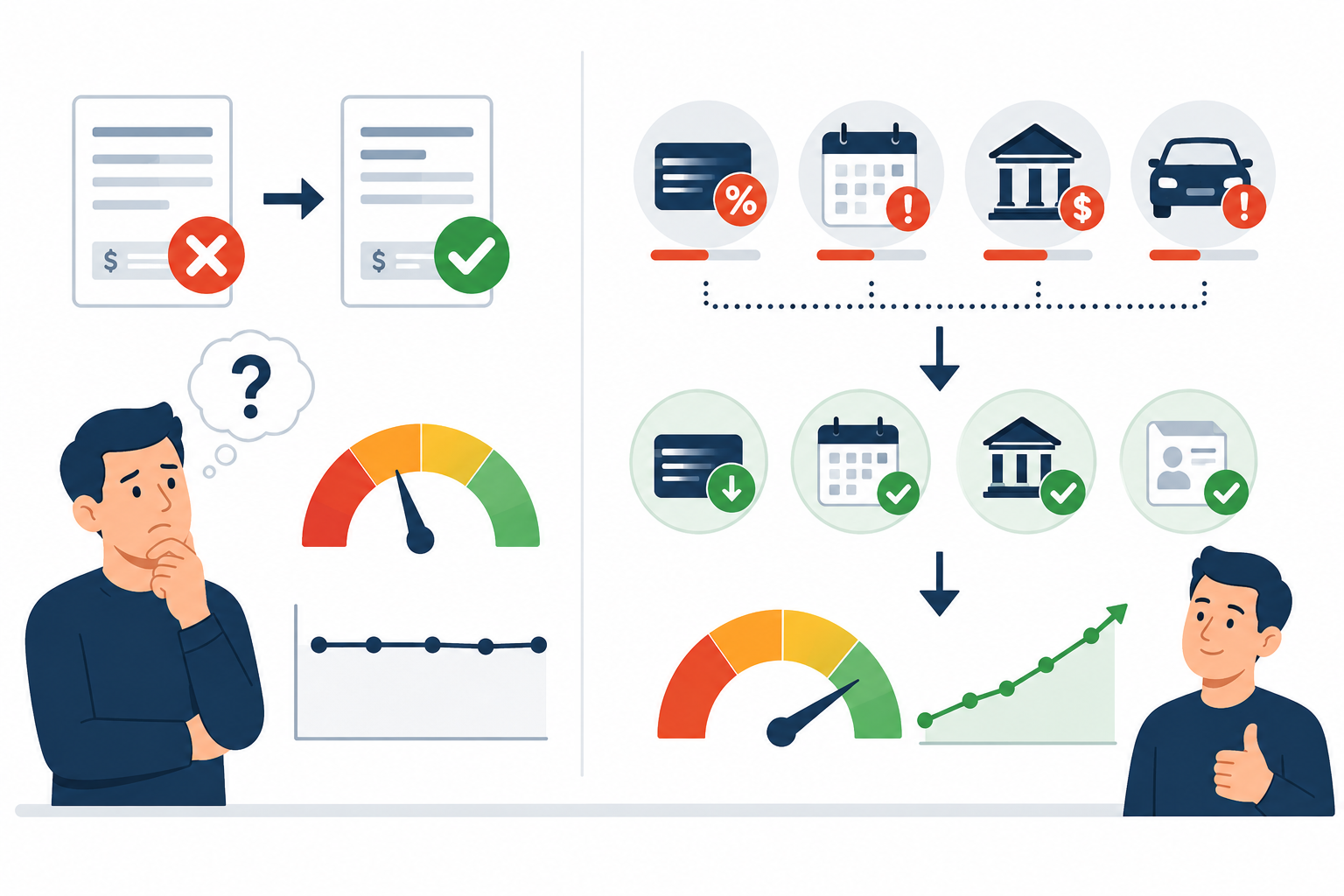
A Real Example From ASAP Credit Repair
This case is from an actual client file reviewed at ASAP Credit Repair. The details are representative of a very common pattern.
What the file actually showed: The collection was not the dominant scoring issue. Four credit cards were reporting at or near their limits , 92%, 88%, 95%, and 100% utilization. Those four cards were suppressing the score by an estimated 60 to 80 points on their own. The two 60-day late payments from the prior year were suppressing it further.
What happened after reducing utilization below 30% on all four cards: The score moved from 593 to 645. Fifty-two points in one billing cycle. No new disputes. No new accounts. Just the card paydowns.
The collection removal helped. But the utilization was the primary suppresser. Fixing that produced the actual score breakthrough.
How FICO Actually Calculates Your Score
A collection is just one input. Here are all five FICO factors and how much each one weighs.
Here is a simple way to think about this.
Your credit score is a math problem with five parts. You fixed one part. The other four parts stayed the same. So the total number barely changed.
The collection was part of the "payment history" category. But that category also includes your late payments. And if late payments remain after the collection is gone, payment history is still damaged.
Credit Utilization: The Factor That Likely Hurt You More
High utilization hurts in two ways.
First, it directly lowers the FICO score through the Amounts Owed category. A card at 90% utilization suppresses the score significantly. Four cards at 90% suppresses it even more , each card is scored individually, not just the portfolio average.
Second, high minimum payments increase the debt-to-income ratio that lenders calculate during underwriting. So the utilization damage isn't just the score , it affects loan eligibility directly.
The full breakdown of how available credit affects your credit score covers why crossing below 10% on each individual card , not just the overall average , produces the largest single score gain and why the statement close date matters more than the payment date itself.
What Typically Hurts More , Collection vs Utilization vs Late Payment
The Late Payments That Stayed After the Collection Left
A collection often originates from a missed payment on an original account.
Here is the chain:
- You miss a payment on a credit card or medical bill.
- A 30-day late payment mark appears on the original account.
- More missed payments follow , 60-day, 90-day marks.
- The account goes to a collection agency.
- A separate collection entry appears on the credit report.
When the collection is deleted, only step 5 disappears. Steps 2, 3, and 4 remain on the original account. Those late payment marks still pull the score down. They stay for seven years from the original delinquency date regardless of the collection deletion.
Charge-Offs: Often Worse Than Collections
Many consumers have a collection removed but still have a charge-off from the same creditor.
Here is how that works.
The original creditor charges off the debt. This appears as a charge-off entry on the credit report. The debt then gets sold to a collection agency. The collection agency reports a separate collection entry. Two negatives. One underlying debt.
The collection gets disputed and deleted. But the charge-off from the original creditor stays.
The charge-off is often the more damaging entry because it represents the original creditor declaring the debt a loss. It updates monthly in some cases , continuing to report as a negative for the full seven years.
| Remaining Negative After Collection Deletion | Score Impact | Removal Path |
|---|---|---|
| Late payment marks (30/60/90 day) | Ongoing suppression , each one is a separate entry | Accurate ones stay 7 years; dispute wrong dates or statuses |
| Charge-off from original creditor | Often more damaging than the collection | Dispute for inaccuracies; stays 7 years from first delinquency if accurate |
| High credit card utilization | 30-80+ points of suppression depending on number of cards | Pay to under 10% before statement close , improves in 30 days |
| Second collection from same debt | Duplicate entries for same event , both suppressing score | Dispute both separately; if same underlying debt, dispute for accuracy |
Thin Credit Files: Not Enough Positive to Fill the Gap
Some consumers have a simple file:
- One collection (now removed)
- One credit card
- No installment loan history
- Short average account age
The collection disappears. The score stays flat.
Why? The scoring model needs positive data to replace the negative data. One credit card with a short history doesn't generate enough positive scoring signals to produce a large gain. The absence of negative data is not the same as the presence of positive data.
FICO rewards active accounts, diverse credit types, established payment history, and long average account age. A thin file after collection removal may need new positive tradelines , a secured credit card, a credit builder loan, or a small installment account , to generate the score movement the removal created space for.
Which Score Are You Checking?
This is an underrated reason for the confusion.
Many consumers moniter scores on:
- Credit Karma (uses VantageScore 3.0)
- Credit Sesame (uses VantageScore)
- WalletHub (uses VantageScore)
Most lenders pull:
- FICO Score 8 (most common)
- FICO Auto Score 8 (for car loans)
- FICO Score 2, 4, or 5 (for mortgages)
A collection deletion may produce a 30-point gain on FICO 8 and only an 8-point gain on VantageScore 3.0. The score you are looking at and the score a lender would pull may respond differently to the same credit event.
As Experian's collection scoring guide confirms, different scoring models treat collection accounts differently , some newer models ignore paid collections entirely, while older models may weigh them heavily regardless of payment status. The score version used by your lender may differ from the one you monitor daily.
Joe Mahlow's team reviews all three bureau reports and identifies every factor currently suppressing the score , not just the items that were addressed, but the ones still pulling it down after the repair work is done.
Get a Free Credit File Review →How Long Before You See the Real Score Impact
Even when a collection is the primary scoring issue, the score update takes time.
| Event | Estimated Timeline |
|---|---|
| Collection marked as deleted by bureau | 0 to 30 days after dispute win |
| Bureau file updates and score recalcuates | 0 to 45 days after deletion |
| Third-party monitoring tools reflect change | May lag an additional 7 to 14 days |
| Full credit report cycle reflects update | 30 to 60 days from confirmed deletion |
If 60 days have passed since the confirmed deletion and the score has not moved, timing is no longer the explanation. Other factors in the file are the cause.
As Experian's guide on collection removal timelines confirms, medical collections under $500 are already excluded from credit reports entirely , so if the deleted collection was a small medical debt, it may have been producing minimal score impact even before deletion.
What ASAP Credit Repair Sees in Files Where the Score Didn't Move
"At ASAP, when we see a file where a collection was removed and the score barely moved, we run the same review every time. We look at three things: what is the utilization on every card in the file? Are there charge-offs from the original creditor still reporting? Are there late payments from the past 24 months on any account? In probably 80% of these cases, we find at least one card above 70% utilization that wasn't addressed during the dispute process. The client fixed the collection. The collection wasn't the top problem. The quick fix after that , paying those cards down before the next statement , produces more score movement in 30 days than three months of dispute work produced. That's not a criticism of the dispute work. It's a sequencing issue. Utilization responds fast. Disputes take time. When both are problems, do the utilization first."
What to Do When the Score Didn't Move After Collection Removal
As Motley Fool's credit reporting coverage confirms, citing expert analysis: "That 100-point increase won't apply as much if you have a bunch of other delinquencies or if you have a ton of debt." The collection removal creates the potential. The other factors determine wether the potential turns into visible score movement.
The companion guide to why credit repair results don't appear in the first 30 days covers the broader timing picture , how bureau investigation windows work, why scores lag behind file updates, and how to tell when timing is the issue versus when another factor is suppressing the score.
Can a collection be removed without affecting my credit score?
Yes. If the collection was not the dominant scoring issue in the file, its removal produces minimal visible impact. This is most common when high credit card utilization, recent late payments, or charge-offs remain on the report after deletion. The collection was removed , it's just that the other factors were responsible for more of the score suppression than the collection was.
Is it possible my score went down after a collection was removed?
Yes, though it's uncommon. This can happen when the deleted collection was older than most other accounts , removing it may have shortened the average account age, which affects the Length of Credit History category. It can also happen when another negative event (a new late payment, a hard inquiry, a new collection) occurred at the same time as the deletion and outweighed the positive impact. If the score dropped after deletion, check the report for any new negative entries that appeared in the same period.
How many points should I gain from a collection removal?
There is no fixed number. CFPB data shows the average gain from removing a medical collection is 25 to 32 points when the collection is the only significant negative in the file. Gains of 50 to 100+ points are possible for borrowers with a clean file outside of that one collection. Gains near zero are common when multiple other negatives remain active. The rest of the credit profile determines how much the collection removal produces , not the removal itself.
Joe Mahlow's team reviews all three bureau reports , not just the collection that was removed, but every factor still suppressing the score: utilization on each individual card, charge-offs from original creditors, late payment marks, thin file issues, and cross-bureau inconsistencies. The review is free and identifies specifically what to address next.
Get My Free Credit Analysis → CROA Registered | 20 Years in Business | Free, No Obligation-
Why You're Not Seeing Credit Repair Results After 30 Days The timeline issue applies here too. After a collection deletion, scores update on their own cycle , not immediately. This covers how bureau investigation windows work, why the score lags behind the deletion by days to weeks, and how to tell when timing is the cause of the wait versus when another factor is suppressing the score.
-
How Available Credit Affects Your Credit Score Utilization is the most common reason a score doesn't move after collection removal. This covers the exact mechanics , why individual card utilization matters more than the portfolio average, why paying before the statement close date is what actually produces the score change, and why crossing below 10% on each card produces a larger gain than crossing below 30%. The fastest available score improvement for most files where a collection was removed and the score barely moved.
-
Improving a 593 Credit Score: Steps to Reach 650 Faster The 589-610 range is where most consumers land after a collection removal that didn't produce the expexted gain. This covers the specific month-by-month plan for moving from that score range to 650 and beyond , utilization reduction in month one, dispute wins in months two and three, and positive history building through month 12. The most direct path forward when the collection removal created space but the score didn't fill it.