
A 593 credit score falls within the fair credit range on the FICO scoring model. While a 593 score is not considered poor credit. It may limit access to the best loan terms, credit card offers, and mortgage rates.
What's worth knowing is that many consumers with scores in the high-500s can improve their credit by addressing the specific factors affecting their reports, such as credit utilization, payment history, collection accounts, and reporting inaccuracies.
The challenge is that there is no single reason a credit score stays at 593. For some people, the biggest issue is maxed-out credit cards. For others, it may be late payments, charge-offs, or collection accounts. Understanding what is holding your score back is the first step toward reaching 650 and beyond.
We at ASAP Credit Repair, regularly review credit reports for consumers whose scores fall between 580 and 600. One of the most common patterns they see is that borrowers focus on opening new accounts when their largest opportunity for improvement is reducing existing debt or correcting inaccurate information.
Knowing which factor is affecting your score can make the difference between gaining a few points and making meaningful progress.
Improving a 593 Credit Score: Practical Steps to Reach 650
A 593 credit score is considered fair credit and can often be improved by lowering credit card balances, correcting reporting errors, making on-time payments, and addressing collection accounts.
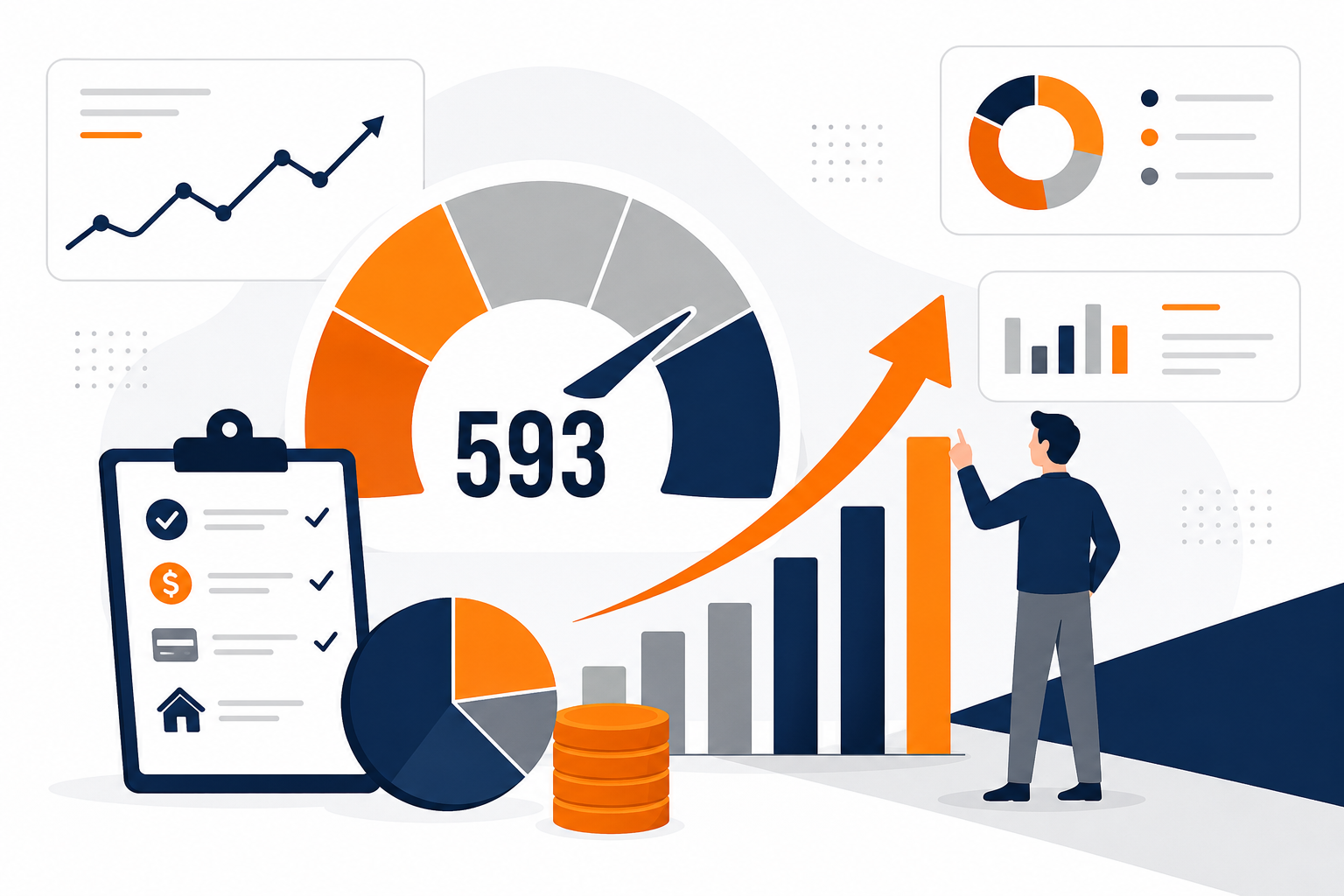
Many consumers can see measurable improvements within three to six months when they focus on the factors causing the score to remain below 600.
"After reviewing hundreds of credit files sitting between 580 and 600, I can tell you the most common pattern is identical: high credit card utilization plus one or two unresolved collection accounts. In most cases, addressing both moves the score from the low 590s to 640-660 within 90 days. The people who stay stuck are usually focusing on the wrong variable."
What Does a 593 Credit Score Mean
A 593 credit score falls in FICO's fair credit range (580-669). It is not considered bad credit by the most widely used scoring scale. But it is below the threshold where most lenders offer their best rates, and it sits just 13 points above the FHA mortgage minimum. Most lenders will work with a 593 score , but at higher rates, with more documentation requirements, and with fewer product options than borrowers at 650 or above.
Is 593 Considered Bad Credit?
Not technically. FICO defines bad credit as below 580 (the "poor" range). A 593 sits in the "fair" tier. That distinction matters for loan qualification , it means FHA and most conventional programs are available.
But fair credit and good credit produce very different financial outcomes. myFICO's credit score education resources confirm that "fair" borrowers consistently pay higher rates, face stricter approval conditions, and encounter more friction in underwriting than "good" credit borrowers starting at 670.
The practical difference between 593 and 650 on a $300,000 mortgage: approximately $50 to $90 more per month and $18,000 to $32,000 more in total interest over 30 years. That gap makes improving from 593 one of the highest-ROI financial actions available.
Where 593 Falls in the FICO Range
| FICO Range | Category | Typical Lender View |
|---|---|---|
| 800-850 | Exceptional | Best rates, maximum options |
| 740-799 | Very Good | Competitive rates, easy approval |
| 670-739 | Good | Most products available, standard rates |
| 580-669 | Fair | Limited options, rate premiums, more scrutiny |
| 593 (You Are Here) | Fair | FHA eligible, higher rates, underwriting friction |
| 300-579 | Poor | Very limited options, secured products primarily |
Why Most People Get Stuck at 593
The most common reason scores stagnate between 580 and 600 is the simultaneous presence of two problems: high credit card utilization suppressing the score in the utilization category (30% of FICO), and one or two collection accounts creating ongoing negative pressure in the payment history category (35% of FICO). Both factors push in the same direction at the same time. Improving either one produces score movement. Improving both simultaneously in the first 30 to 90 days produces the largest single jump.
High Credit Card Balances
At ASAP Credit Repair, Joe Mahlow and his team see this consistently. Cards sitting at 75-90% of their limits. The borrower makes minimum payments faithfully but the balance barely moves. Each month the score stays suppressed because the utilization signal , 30% of the FICO calculation , reads as heavy credit dependence.
Utilization resets every billing cycle. Pay the card to under 10% before the statement closes. The score responds within 30 days. No dispute process required. No new accounts needed. Just a lower balance.
Collection Accounts
A single collection account from an unpaid medical bill, a utility balance, or an old credit card can suppress a 593 score by 30 to 80 points depending on its age and balance. Many of these collections come from debt buyers who cannot fully validate ownership , making them disputable under the FCRA even when the underlying debt is legitimate.
Late Payments in the Recent Past
Payment history is 35% of a FICO score. A late payment from 8 months ago carries more weight than one from 4 years ago. The score recovers from late payment damage as time passes and positive payment history accumulates , but the process takes 12 to 24 months of perfect payments to meaningfully offset a recent serious delinquency.
Thin Credit File
Some 593 scores exist not from too many negatives but from too few positives. A young borrower with one or two accounts, no installment loan history, and limited credit age may score 593 simply from the "thin file" problem. The fix: add a secured card and a credit builder loan. Both report monthly positive payment history across all three bureaus.
Reporting Errors
According to the FTC, one in five consumers has at least one error on a credit report significant enough to affect credit decisions. A wrong late payment date. A collection from an account that was discharged in bankruptcy. A balance that doubled when a debt buyer re-reported the same account. These errors directly suppress the score without any underlying financial behavior causing them.
What Joe Mahlow and the ASAP Team See Most Often at 593
"The 593 file is one of the most predictable profiles we review. In roughly three out of four cases, the primary driver is credit card utilization above 50% on at least one card , usually combined with one collection from a debt buyer who purchased the account two or more times. The original creditor charged it off. A buyer purchased it. Sometimes a second buyer purchased it from the first. Each sale creates potential documentation gaps that form the basis of a successful FCRA dispute. The consumer often believes these accounts are untouchable. They frequently are not."
After reviewing over 100,000 credit files, here are the patterns the ASAP Credit Repair team identifies most often in files sitting at 593:
- Average utilization on 593-score files: 67%. Most borrowers at this score are using two-thirds of their available revolving credit. Getting to under 30% , ideally under 10% , produces a measurable score jump every time.
- Average number of collection accounts: 2.3. Most 593-score files show two to three collection accounts. Not all are valid. Not all are verifiable. The dispute process frequently removes one or two in the first cycle.
- Most common collection balance: $400 to $1,800. Small to medium balances from medical providers, utilities, and fintech lenders. These accounts change hands frequently , creating validation documentation gaps that make them vulnerable to FCRA dispute.
- Most common quick win: utilization reduction. When a 593-score file shows 70%+ utilization and the borrower has the cash to pay one card to under 10%, that single action produces 20 to 40 points in one billing cycle more reliably than any other intervention.
A professional three-bureau review identifies the exact combination of factors in your specific file , not generic advice. Joe Mahlow's team at ASAP Credit Repair reviews the utilization, collections, payment history, and reporting accuracy across all three bureaus before recommending any action plan.
Get My Free Credit Report Review →The Fastest Ways to Improve a 593 Credit Score
The five fastest actions for improving a 593 score in order of speed: (1) reduce credit card utilization to under 10% on every card before the statement closes , produces score movement in 30 days, (2) dispute reporting errors through FCRA , resolves in 30 to 90 days, (3) dispute unverifiable collection accounts through debt validation , results in 30 to 90 days, (4) bring any past-due accounts current , stops the ongoing delinquency damage, (5) add positive payment history through a secured card or credit builder loan , compounds over 6 to 12 months.
1. Reduce Credit Card Utilization
This is the fastest single action available. Utilization resets every billing cycle. Pay cards to under 10% of each card's limit before the statement closes. The lower balance reports to the bureaus. The score reflects the change within 30 days.
On a card with a $2,000 limit currently at $1,700 (85% utilization): paying it to $180 (9% utilization) produces a measurable score jump in the next billing cycle. No dispute. No new account. No waiting period. Just the payment.
Understanding how available credit affects credit scores explains the exact FICO mechanics behind this , including why paying before the statement close date matters and how the non-linear improvement curve works (the biggest gains come from crossing below 10%, not just below 30%).
2. Dispute Inaccurate Reporting
Pull all three reports at AnnualCreditReport.com. Check every negative item for wrong dates, wrong balances, duplicate entries, or accounts that do not belong to you. File FCRA disputes with each bureau for every inaccuracy. Bureaus have 30 days to investigate. Items failing verification must come off the report.
3. Dispute Unverifiable Collections
Send written debt validation requests to every collection agency via certified mail. Collectors must respond with documentation proving ownership of the debt. Debt buyers who purchased accounts through multiple transfers frequently lack complete chain-of-title documentation. When they fail to validate, the account becomes disputable across all three bureaus.
4. Bring Past-Due Accounts Current
A currently delinquent account , one still generating new late marks every month , causes ongoing score damage. Bringing it current stops the new damage and starts building a clean payment streak from that date forward. Every new on-time payment contributes to the payment history category.
5. Add Positive Payment History
A secured credit card with a $200 to $300 deposit. A credit builder loan at $10 to $15 per month. Both report monthly to all three bureaus. Both build the positive tradeline history that the 593 file often lacks. Use the secured card for small recurring purchases and pay in full before the statement closes each month.
Can You Reach 650 From 593
Yes. Reaching 650 from 593 is a 57-point gap. That gap is achievable in 3 to 6 months for most borrowers when the credit file contains high utilization (fastest fix) plus at least one disputable collection account. For files with only accurate negative items and no inaccuracies to dispute, 650 typically takes 12 to 18 months of consistent on-time payments plus utilization reduction.
Joe Mahlow's team at ASAP Credit Repair consistently sees the 593-to-650 gap close in two situations:
Fast path (30 to 90 days). Borrower reduces utilization from 75% to 8% AND one collection deletes through FCRA dispute. Combined impact: 50 to 80 points in one dispute cycle. The 650 target is often reachable within the first 45 days when both actions align in the same billing cycle.
Standard path (3 to 6 months). Utilization reduction produces an initial 20 to 40 point gain. First dispute cycle completes at 30 to 45 days. Second dispute cycle addresses remaining items. Positive payment history accumulates. The 650 target arrives somewhere in the 3 to 6 month range.
Typical Timelines From 593
| Timeline | Realistic Score Target | Actions Required |
|---|---|---|
| 30 days | 610-645 | Pay all cards to under 10% utilization before statement close. Impact in one billing cycle. |
| 90 days | 630-660 | Utilization reduction + first dispute cycle results. One collection deletion typical in this window. |
| 6 months | 645-680 | Multiple disputes complete. Utilization maintained low. 6 months of perfect payment history accumulating. |
| 12-24 months | 670-720 | All disputable items addressed. Positive tradelines established. Payment history consistently clean. |
What Usually Prevents Credit Score Growth From 593
Four patterns prevent most 593 scores from growing: maxed-out credit cards creating permanent utilization pressure, frequent new credit applications generating hard inquiries that briefly reduce the score, new collections appearing while old ones sit in active dispute, and missed payments on accounts currently in good standing. The first is the most fixable. The last creates the most damage.
"One pattern I see constantly: the person with a 593 score opens two new credit cards trying to build credit. Both come with hard inquiries. Both have small limits that, when partially used, push utilization higher rather than lower. The score drops 15 points over 60 days from the applications. Meanwhile, the existing collection account that a dispute might have deleted for free is still sitting on all three bureaus. The action taken made things worse, not better. The order of operations matters enormously at this score level."
- Maxed-out cards. A card at 90% utilization suppresses the score every single month. Minimum payments barely move the balance when interest continues accruing. The only effective fix is a meaningful paydown before the statement closes.
- Frequent new applications. Each hard inquiry from a new credit application costs 5 to 10 score points temporarily. Multiple inquiries in a short period signal active credit seeking , a risk pattern lenders flag. At 593, this hole is particularly expensive.
- New collections during the recovery process. A medical bill goes to collections while a prior collection sits under dispute. The new collection resets progress. Preventing new collections is as important as resolving existing ones during a 593-score recovery.
- Missed payments on current accounts. A single new missed payment at 593 drops the score 25 to 50 points. Set every account to autopay for the minimum. One accidental miss can undo two months of dispute and paydown progress.
Can Credit Repair Help a 593 Credit Score
Credit repair produces the most value at 593 when the file contains inaccurate or unverifiable collection accounts, reporting errors, or items from identity theft. It produces less value when negative items are all accurate and recent , because the dispute process cannot legally remove accurate information. At 593, files frequently contain at least one disputable item. A three-bureau review identifies which accounts are legitimate candidates versus which require a different strategy.
Situations Where Credit Repair Helps at 593
- Collections from debt buyers with incomplete documentation. Debt buyers who purchased accounts from the original creditor or from other debt buyers often lack complete chain-of-title records. FDCPA validation requests expose these gaps. FCRA disputes remove accounts that fail validation.
- Medical debt collections under new CFPB rules. Many medical collections under $500 no longer appear on credit reports under recent bureau policy changes. Collections above $500 remain disputable on validation grounds.
- Accounts reporting inaccurate dates or balances. A collection with the wrong original delinquency date effectively has a different 7-year removal timeline. Correcting or disputing this date changes when the account ages off the report.
- Duplicate reporting of the same underlying debt. When one original account shows as charged-off by the original creditor AND as a collection by a buyer, two negative entries exist for one event. Dispute processes can sometimes remove both or clarify the relationship between them.
Situations Where Credit Repair May Not Help at 593
- All negatives are recent, accurate, and fully documented. A bankruptcy from two years ago. A repossession from last year. A series of late payments from eight months ago. All reported correctly. Credit repair cannot remove these. The strategy shifts to building positive history while negatives age.
- Score is 593 purely from thin file, not damage. A new borrower with two accounts and no credit age may score 593 not from negatives but from insufficient positive history. The fix is adding tradelines , secured cards, credit builder loans , not disputes.
Before spending months guessing, get a professional three-bureau review. Joe Mahlow's team reviews the file and tells you directly: which items are disputable, which require a payment strategy, and what the realistic improvement timeline looks like for your specific situation. No fee for the review.
Review My Credit Report With a Specialist →Can You Get Approved for Loans With a 593 Credit Score
Yes , for most loan types, including mortgages, auto loans, and credit cards. But the rate and terms at 593 carry meaningful penalties compared to 650 or 680. The biggest approval friction appears in conventional mortgage underwriting, where 593 sits in the 580-619 range that carries the highest LLPA pricing surcharges and is more likely to require manual underwriting.
| Loan Type | Availability at 593 | Key Concern |
|---|---|---|
| FHA Mortgage | Qualifies (580 min) | Rate premium vs 650 borrower. FHA MIP required for life of loan with under 10% down. |
| Conventional Mortgage | 620 minimum required | 593 does not qualify for conventional. FHA is the available path. |
| VA Loan | Eligible (no agency min) | Most VA lenders approve at 580+. No LLPA surcharges. Best option for veterans at this score. |
| Auto Loan | Qualifies , subprime | Expect 13-19% APR range (subprime/nonprime tier). Used cars realistic. New cars very limited. |
| Personal Loan | Limited , high rate | Subprime lenders, credit unions for existing members. Rates 20-30%+ APR. |
| Credit Cards | Available | Secured cards, credit union cards, subprime unsecured cards available. Best used for building history. |
As Experian's credit improvement guide confirms, the score improvements that most reliably change loan terms , not just approval odds , come from addressing utilization and disputing inaccuracies simultaneously, rather than waiting for time alone to improve the file.
593 vs 650 vs 700 Credit Score
| Factor | 593 (Today) | 650 | 700 |
|---|---|---|---|
| FICO Category | Fair | Fair (upper) | Good |
| FHA Mortgage | Qualifies | Qualifies (better terms) | Qualifies (strong file) |
| Conventional Mortgage | Does not qualify (620 min) | Qualifies (just above min) | Qualifies (competitive) |
| Mortgage rate position | FHA only , high LLPA tier | 660+ tier , lower LLPA | 680-699 tier , favorable |
| Monthly savings vs 593 | Baseline | ~$50/month on $300K | ~$100/month on $300K |
| Auto loan tier | Subprime (~19% APR used) | Nonprime (~13% APR) | Prime (~9% APR) |
| Credit card options | Secured and subprime | More options opening | Most products available |
| Typical timeline to reach | Now | 3-6 months | 12-24 months |
Action Plan for the Next 90 Days
Free at AnnualCreditReport.com. List every negative item: the account name, balance, original delinquency date, and which bureaus report it. List every credit card: the limit, current balance, and calculated utilization percentage. This baseline takes 90 minutes and determines every subsequent action in the plan.
Start with the highest-utilization card. Pay it to under 10% of the limit. If budget allows only one card, prioritize the one closest to the limit rather than the one with the highest balance. The score improvement comes from the utilization percentage, not the dollar amount of the paydown. Time the payment before the statement closing date so the lower balance reports to bureaus this cycle.
Each collection agency that received a certified mail debt validation request has 30 days to respond with documentation proving debt ownership. Keep the certified mail tracking receipts. If a collector fails to respond or responds with incomplete documentation, that creates the basis for FCRA disputes with all three bureaus. Do not pay any collection before the validation response arrives.
Check the score after the first billing cycle reflects the utilization paydown. Note the improvement. Then file written FCRA disputes with each bureau for: any account with wrong dates, any unverified collection, any duplicate entry, and any collector who failed to respond to the validation request. Bureaus have 30 days to investigate.
First dispute results arrive within 30 to 45 days. Review every response. Items that returned "verified" , but where the collector provided incomplete documentation , qualify for escalated disputes citing the specific documentation gap. Items deleted produce immediate score improvement. Add a secured credit card if no positive revolving tradeline currently reports.
Pull all three reports again. Calculate the new score. Map the remaining distance to 650. At this point most borrowers have completed two dispute cycles and maintained low utilization for three months. If any collections remain, evaluate pay-for-delete negotiation for the remaining valid accounts. The secured card started 60 days ago now adds its first two months of positive payment history to all three bureaus.
As NerdWallet's credit score improvement guide confirms, the fastest measurable gains at any score level come from utilization reduction and dispute wins , not from waiting, opening new accounts, or hoping time resolves the underlying issues.
The full recovery timeline , including what happens in months 4 through 24 as positive history accumulates and remaining negatives age , follows the same framework covered in the credit score improvement timeline guide. The starting scores differ (522 vs 593) but the actions and timelines are identical.
How long does it take to go from 593 to 650?
At ASAP Credit Repair, Joe Mahlow's team sees most 593-score borrowers reach 650 in 3 to 6 months when the file contains high utilization and at least one disputable collection account. Utilization reduction alone can add 20 to 40 points in 30 days. A collection deletion adds 30 to 70 more. These two actions combined often close the 57-point gap in a single dispute cycle. Files with only accurate negatives and no quick-fix actions take 12 to 18 months to reach 650 through payment history accumulation alone.
What is the fastest way to increase a credit score from 593?
Reduce credit card utilization to under 10% of each card's limit before the statement closing date. This is the fastest single action available , producing score movement in 30 days or less. Combined with one FCRA dispute cycle that removes one collection account, most borrowers see 40 to 80 points of improvement within 45 days. Nothing else produces this speed of improvement. Disputes, new accounts, and authorized user additions all take longer or require more conditions.
Should I pay collections or dispute them at a 593 credit score?
Dispute before paying , always. Paying a collection without a deletion agreement leaves the entry on the report for seven years and produces only 5 to 10 points of score improvement. Disputing first gives the collector the chance to fail validation , which often produces free deletion. If the dispute fails and the account is valid, negotiate a pay-for-delete agreement: payment in exchange for written confirmation that the collector removes the entry from all three bureaus. That sequence produces deletion plus debt resolution simultaneously.
Can I get a mortgage with a 593 credit score?
Yes , through FHA (580 minimum). At 593, FHA is the available mortgage path. Conventional loans require 620 minimum and most conventional lenders prefer 640+. The rate at 593 through FHA runs approximately $50 to $90 more per month on a $300,000 loan than at 650 through the same FHA program. For most buyers, spending 3 to 6 months improving to 650 before applying saves more than $20,000 in total interest. For buyers who need to move now, FHA at 593 remains a valid path.
-
How Available Credit Can Raise Your Credit Score Faster Than You Think Utilization reduction is the fastest action available for improving a 593 score , and this is the complete mechanics guide. Why the score updates within 30 days when balances drop, why paying before the statement close date matters, and how the non-linear improvement curve means crossing below 10% produces the largest single score gain. For borrowers at 593 with high card balances, this is the most important article to read before any other action.
-
How Long Does It Take to Raise a Credit Score? Realistic Timelines The 593-to-650 journey follows the same action timeline as any score improvement , utilization reduction in 30-60 days, dispute wins in 30-90 days, collection deletions in 3-12 months, full rebuild in 12-36 months. This covers each action with point estimates and timelines so the 90-day plan above has a specific week-by-week and month-by-month framework to attach to. The bar chart comparing points-gained-per-action is the planning tool most 593-score borrowers need before deciding where to start.
-
Is It Worth Paying Someone to Fix My Credit? Honest Cost vs Results After reading this guide, the natural next question is whether to pursue credit repair professionally or handle disputes independently. This covers the honest answer from Joe Mahlow as a credit repair company owner: when paying for professional help produces clear ROI (multiple disputable items, mortgage timeline pressure, identity theft complexity), and when the DIY path is genuinely sufficient. The cost-vs-results calculation for a 593-score borrower pursuing a mortgage is included.