
Court Summons Example: What It Looks Like & What to Do? A legal document that officially notifies you that someone has filed a lawsuit against you and that you must respond within a set deadline. The document names both parties, identifies the court, states the case number, and tells you exactly what to do next. A summons almost always comes attached to a complaint, which explains why you are being sued.
Running a credit repair company, I see this situation more than most people realize. One of the most common accounts I hear from clients goes like this: they received a summons in the mail, did not understand it, set it aside, and ended up with a default judgment that destroyed their credit score. That one decision cost them years of financial recovery.
A 2024 thread on r/personalfinance showed dozens of people sharing that same story. Users reported receiving summons documents for old debts and ignoring them, only to later find wage garnishments and frozen bank accounts. One commenter wrote that they owed $1,800 in original debt but ended up paying over $4,000 after the court added attorney fees and interest (source: Reddit r/personalfinance). Across debt collection lawsuits in the U.S., default judgments are alarmingly common because defendants simply do not respond.
What Is a Court Summons?
A court summons is an official court document that tells you a lawsuit has started against you. Courts issue summons documents in civil cases, debt collection cases, small claims cases, and some criminal proceedings.
The summons does not mean you lost. It means someone is suing you, and the court requires a response.
Every summons contains these key sections:
Court name and address — identifies the jurisdiction handling your case
Case number — a unique ID you will use on every document you file
Names of parties — the plaintiff (person suing you) and defendant (you)
Nature of the claim — a brief description of what the lawsuit is about
Response deadline — the number of days you have to file an answer
Instructions — exactly how and where to file your response
Court seal and signature — confirms the document is authentic
The complaint attached to the summons goes into more detail. It explains the specific claims the plaintiff is making and the dollar amount or relief they are seeking.
What Does a Court Summons Look Like? A Real Example Breakdown
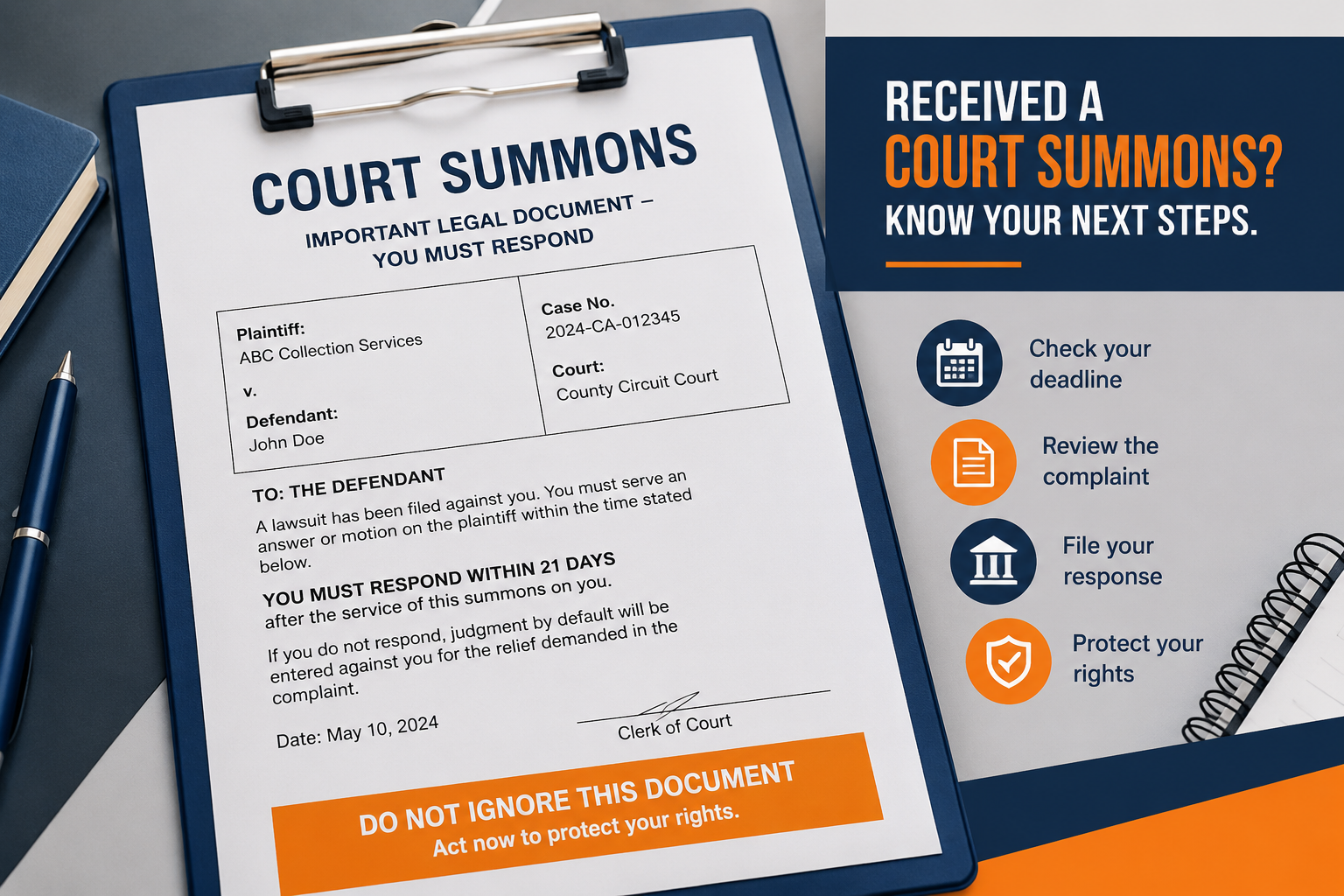
Federal courts use a standardized form called AO 440. State courts use their own versions, but the structure is nearly identical. Here is how a typical civil court summons reads, broken down section by section.
Header block:
UNITED STATES DISTRICT COURT
[District Name]
[Plaintiff Name] v. [Defendant Name]
Civil Action No. ___________
Body of the summons:
"To: [Defendant Name and Address]
A lawsuit has been filed against you. Within 21 days after service of this summons on you, you must serve on the plaintiff an answer to the attached complaint or a motion under Rule 12 of the Federal Rules of Civil Procedure."
Warning clause:
"If you fail to respond, judgment by default will be entered against you for the relief demanded in the complaint."
Signature block:
Signed by the Clerk of Court, with the court seal and date.
State court versions follow the same pattern. The New York Supreme Court summons, for example, tells defendants they have 20 days to respond if served in person within the state, or 30 days if served by mail (source: New York Courts). California uses Form SUM-100 and gives defendants 30 days, counting weekends and court holidays (source: California Courts Self-Help).
Massachusetts courts send a summons that opens with bold text reading: "YOU MUST ACT PROMPTLY TO PROTECT YOUR RIGHTS" and requires a written response within 20 days (source: Massachusetts Trial Court).
Types of Court Summons
Not every summons looks the same because not every summons serves the same purpose. Here are the four main types you may encounter:
1. Civil summons — used in lawsuits between two private parties, such as breach of contract, personal injury, or debt collection. This is the most common type.
2. Criminal summons — issued instead of an arrest warrant for minor criminal charges. You must appear in court on a specific date. Failing to appear can result in a warrant for your arrest.
3. Small claims summons — used for lower-dollar disputes, usually under $10,000 depending on the state. The process is simpler, and many people represent themselves.
4. Alias summons — issued when the first summons was not successfully delivered. Courts use this when the defendant was not found at the address on file. The alias summons is a second attempt, and the same response rules apply.
At our credit repair firm, we see alias summons situations most often in debt collection cases. Last quarter alone, we reviewed over 40 client files where an alias summons had been issued after the original was sent to an old address. In most of those cases, clients had no idea a lawsuit was in progress until the default judgment had already hit their credit report.
How a Court Summons Gets Delivered to You
Courts do not send summons documents through regular mail by default. Most states require formal service of process, which means a licensed process server or sheriff's deputy physically hands the document to you.
Common methods of service include:
Personal service — a process server hands the summons directly to you
Substitute service — left with another adult at your home or workplace
Service by mail — allowed in some states after personal service fails
Publication — used as a last resort when a defendant cannot be located
The date you receive the summons starts your response clock. That clock does not pause. If a process server hands you the documents on a Monday, your 21 or 30 days start the next day, Tuesday.
Verify that any summons you receive is legitimate. A real summons carries an official court seal, a case number you can look up on the court's public docket, and contact information for the issuing court. Scam summons documents do exist, particularly in debt collection fraud schemes.
What Happens If You Ignore a Court Summons?
Ignoring a court summons is one of the most damaging financial decisions a person can make.
When you do not respond within the deadline, the plaintiff files a motion for default judgment. The court reviews whether you were properly served. If the service was valid, the judge enters a default judgment, meaning the plaintiff wins automatically without you presenting any defense.
A default judgment gives the winning party legal tools to collect money from you:
Wage garnishment — your employer must withhold a portion of each paycheck
Bank account levy — funds are taken directly from your bank account
Property lien — a legal claim is placed against real estate you own
Seizure of assets — in some cases, physical property can be taken
The credit damage is immediate and severe. A judgment appears on your credit report and stays there for up to seven years. Lenders, landlords, and employers all see it during background and credit checks.
Federal Rule 55 governs default judgments in federal courts, and most states have mirrored this rule (source: Federal Judicial Center). The rule requires the plaintiff to prove that you were properly served before a default is entered. But once that box is checked, the court acts quickly.
Reversing a default judgment is possible but difficult. You must file a motion to vacate and prove that your failure to respond was due to excusable neglect, surprise, or mistake. Courts do not grant these motions easily. The Sacramento County Public Law Library notes that ignorance of the law does not qualify as an excusable mistake (source: Sacramento County Law Library).
In short, responding is always better than ignoring, even if the debt is legitimate. Filing an answer preserves your right to negotiate, dispute, or settle.
Received a Court Summons About a Debt?
Don't ignore it. A missed deadline can lead to a default judgment, wage garnishment, or long-term credit damage. Our credit experts can review your credit report, identify reporting errors, and help you understand your options before the situation gets worse.
Get Your FREE Credit Analysis✔ No Obligation | ✔ Personalized Credit Review | ✔ Trusted Credit Repair Specialists
Whether you've been sued for an old debt, received a collection summons, or simply want to protect your credit, we're here to help you take the next step with confidence.
How to Respond to a Court Summons
Responding to a summons does not require a lawyer, though consulting one helps. Here is what the process looks like:
Read the summons and complaint carefully on the day you receive them
Note your response deadline and write it somewhere visible
Research your state's rules for filing an Answer (the formal written response)
Draft your Answer, admitting or denying each claim made in the complaint
File the Answer with the court listed on the summons before the deadline
Serve a copy of your Answer on the plaintiff or their attorney
Keep copies of every document you file
If the lawsuit involves a debt, check whether the debt is past the statute of limitations in your state. Debt collectors sometimes sue on old debts they legally cannot collect through court. Raising this as a defense in your Answer can get the case dismissed.
The response window varies by state. California gives defendants 30 days. Federal courts give 21 days. Massachusetts and Connecticut require responses within 20 days of being served. Texas gives 20 days plus the next Monday if the deadline falls on a weekend.
Frequently Asked Questions
Can a summons be sent by email? Most states do not allow email service as the primary method. Some courts allow electronic service only when both parties agree in writing or when a court order permits it.
Does receiving a summons mean I will definitely go to court? Not always. Many civil cases settle before a hearing. But you must respond to the summons first to stay in the process and negotiate.
What if the summons has the wrong information on it? Do not ignore it. Raise the errors in your written Answer. Errors on a summons do not automatically invalidate the lawsuit.
Can I respond after the deadline has passed? You can try. File your Answer and simultaneously file a motion explaining why your response is late. Courts have discretion to accept late filings in some circumstances, but it is not guaranteed.
What is the difference between a summons and a subpoena? A summons initiates a lawsuit and names you as a defendant. A subpoena requires you to appear as a witness or produce documents in an existing case. They are two different documents with two different purposes.
Receiving a court summons example document can feel alarming. The language is formal, the stakes feel high, and many people freeze. But the summons itself is just the start of a process, not the end. You have time to respond, and responding correctly gives you options. Ignoring it removes every option you have.
Check the deadline on your summons today, look up the court's public docket with your case number, and file a written response before that clock runs out.