

You checked your credit score before applying for a new credit card. It was 700, comfortably within FICO's good credit range of 670 to 739. You submitted the application expecting approval.
Instead, the bank denied it. Now you're asking, "Why was my credit card application denied with a 700 score?" The answer is that lenders consider more than your credit score when deciding whether to approve an application.
A 700 credit score does not guarantee credit card approval. Banks also review your income, existing debt, recent credit applications, payment history, and the information in your credit report. For example, someone earning $45,000 a year with $25,000 in outstanding debt can face a different lending decision than someone with the same score and much less debt. Each lender applies its own approval standards.
Before applying again, read the adverse action notice from the card issuer. Under the Equal Credit Opportunity Act, creditors generally must provide specific reasons for denying a credit application or explain how to request them.
This article explains why lenders reject applicants with good credit scores, how to identify the actual reason for your denial, and what to check before submitting another application.
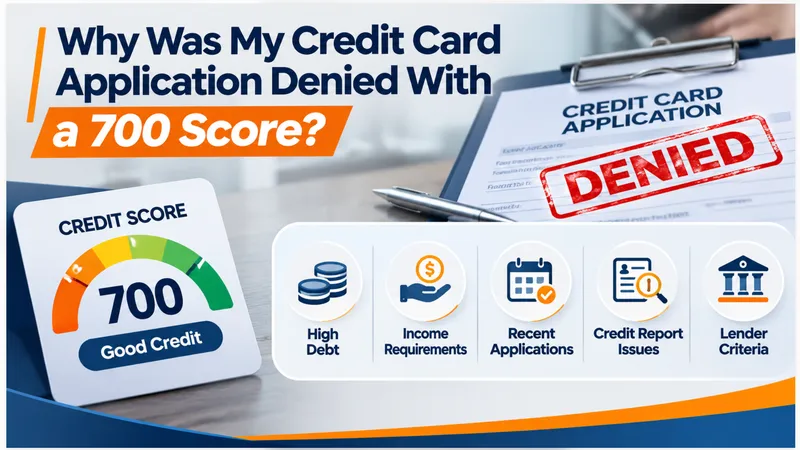
Why Was My Credit Card Application Denied With a 700 Score?
A credit card denied with a 700 score shows that good credit does not guarantee approval. A 700 FICO Score sits inside the Good range of 670 to 739, according to myFICO, yet no issuer approves a card on that one number alone.
Issuers also review your income, your monthly debt payments, your card balances, the age of your accounts, and the score model they pull. The bank scores you with its own model, and that number differs from the one on your banking app.
The law tells you why you were turned down. A creditor that denies your application must state the principal reasons or tell you how to request them, according to the CFPB. That notice is your best clue, so read it before you reapply.
This guide covers nine reasons a card application fails at 700, how to read the denial notice, an eight-step plan, and how to choose between reapplying and asking for reconsideration.
- A 700 FICO Score is Good, not guaranteed. myFICO places Good at 670 to 739, and issuers set their own approval rules.
- Federal rules require income review. Regulation Z requires a card issuer to consider your ability to make minimum payments, based on income or assets and current obligations.
- The denial notice names the reasons. Regulation B requires specific principal reasons, and "internal standards or policies" is not enough.
- Fixing a report error does not fix an income denial. Match your action to the reason on the notice.
Is a 700 Credit Score Good Enough for a Credit Card?
A 700 FICO Score is Good, but it is not an approval threshold. myFICO rates 670 to 739 as Good. Each issuer sets its own approval rules, and score is one input beside income, debt, and credit history.
A 700 qualifies for many cards, and it still fails some applications. FICO Scores run from 300 to 850, and 700 sits 30 points above the bottom of the Good range and 40 points below Very Good, which starts at 740.
The score leaves out your income. myFICO states that FICO Scores calculate from the details in your credit report, and income is not a scoring factor. The issuer reviews income separately.
Federal law requires that review. Under Regulation Z, section 1026.51, a card issuer must consider your ability to make the required minimum periodic payments, based on your income or assets and your current obligations, before it opens an account. A strong score does not satisfy that rule.
Card type also changes the standard. A premium rewards card applies stricter approval than a starter card, and a secured card relies on your deposit. Prequalification tools show likely matches using a soft inquiry, so they cost you no points.
9 Reasons Your Credit Card Application Was Denied With a 700 Score
Nine factors cause most denials at a 700 score: income, debt-to-income ratio, credit utilization, short credit history, recent applications, a different score model, negative or incorrect report data, existing credit with the same issuer, and card-specific rules. Your denial notice names the ones that applied to you.
1. Your Income Does Not Meet the Issuer's Requirements
Regulation Z requires the issuer to weigh your income against the payments you would owe. If your stated income is low for the credit line the card carries, the issuer declines or offers less. Applicants under 21 face an added test: section 1026.51(b) requires the ability to pay on your own or a written commitment from a cosigner, guarantor, or joint applicant.
Check the income you entered. A missing zero or an omitted source triggers an income denial that no score repairs.
2. Your Debt-to-Income Ratio Is Too High
Your debt-to-income ratio divides your monthly debt payments by your gross monthly income. A person who pays $2,000 a month toward rent, a car loan, and student loans and earns $5,000 a month carries a 40% ratio. Issuers read your debts from your credit report and add the new card's payment to the total.
A high ratio leads to a denial even when every payment arrives on time. Pay down installment debt or raise proven income before you apply again.
3. Your Credit Utilization Is High
Credit utilization is your reported card balance divided by your credit limit. myFICO says the amounts you owe carry 30% of a FICO Score. A $4,200 balance on a $5,000 limit equals 84%, and an issuer reads that as a borrower stretched thin.
Your issuer reports balances to the bureaus once a month, so a balance you pay after the statement closes still appears. Use the calculator below to see your number.
4. Your Credit History Is Too Short
Length of credit history carries 15% of a FICO Score, according to myFICO. A 700 built on a 14-month-old file looks different to an issuer than a 700 built over ten years. "Limited credit experience" is a standard denial reason.
Keep your oldest accounts open and in good standing, and let new accounts age. A secured card or a credit-builder account adds history while the file matures.
5. You Applied for Several Credit Accounts Recently
Each application triggers a hard inquiry, and new credit carries 10% of a FICO Score, per myFICO. Issuers read your inquiry list and new-account count as a sign of rising debt.
A cluster of applications in a short span stands out even at a 700. Stop applying, and use prequalification tools, which run soft inquiries, to narrow your options before you submit a full application.
6. The Issuer Used a Different Credit Score
Your issuer pulls its own score, not the one you saw. myFICO states that industry-specific versions, including the FICO Bankcard Score, range from 250 to 900, and lenders choose their own versions. VantageScore ranges from 300 to 850 and appears in many free apps.
The issuer also pulls one bureau, and Equifax, Experian, and TransUnion hold different data. A 700 in your app becomes a different number on the bank's pull. The denial notice names the score and bureau used.
7. Your Credit Report Contains Negative or Incorrect Information
Payment history carries 35% of a FICO Score, according to myFICO, and a recent late payment, collection, or charge-off lowers approval odds even at a 700. Errors cause the same damage: a wrong balance, a paid account shown as open, or an account you never opened.
Pull your reports from AnnualCreditReport.com and dispute every wrong item with the bureau and the furnisher. Accurate negatives stay on the report until they age off.
8. You Have Too Much Existing Credit With the Same Issuer
Issuers cap the total credit they extend to one customer. If you already hold several cards or a large combined limit with the bank, a new application meets that ceiling.
The denial reads as "excessive credit with us" in plain terms. Call the issuer and ask whether it will move a credit limit from an existing card to the new one, or choose a card from a different issuer.
9. You Do Not Meet the Card's Specific Eligibility Rules
Some cards carry rules that sit outside approval. A credit union card requires membership. A bonus offer excludes people who hold or recently held the same card.
A store card limits applicants by region. The application page and the card's terms list these conditions. Read them before you apply, because a rule-based denial has nothing to do with your credit and no report correction changes it.
How to Read Your Credit Card Denial Letter
Your denial letter lists the principal reasons for the decision, or tells you how to request them within 60 days. When a credit report contributed, the notice also names the credit reporting company and the score used, and it gives you the right to a free copy of that report.
Regulation B, section 1002.9, requires a creditor to notify you within 30 days after it receives a completed application. The notice states the action taken, the creditor's name and address, the ECOA notice, and either the specific reasons or your right to request them. If you request the reasons, you have 60 days from the creditor's notification to do it.
The reasons must be specific. Regulation B states that reasons must be specific and indicate the principal reasons. A statement that the action rested on the creditor's internal standards or policies does not qualify.
When your credit report contributed to the decision, the Fair Credit Reporting Act adds rights. The CFPB states that the lender must give you the credit score it used and the key factors that affected it. You are also entitled to a free copy of your report from the reporting company within 60 days of the notice.
Three different things appear on your paperwork, and each needs a different response.
Why the issuer said no
The principal reasons on the notice, such as income or excessive obligations. Your response depends on the reason.
What held your score down
The key factors the bureau attached to the score, such as high balances. These explain the score, not the decision.
Wrong data
Wrong balances, statuses, or accounts. A dispute corrects the report, and the correction matters only when the data drove the decision.
| Reason on the Notice | What It Points To | Your Next Move |
|---|---|---|
| Income insufficient | Your stated income did not support the credit line | Check the application for accurate, eligible income |
| Excessive obligations | Monthly debt payments are high against income | Reduce obligations and reassess affordability |
| Balances too high against limits | Your revolving utilization read high | Reduce revolving balances |
| Limited credit experience | Your file is thin or young | Maintain accounts and build history |
| Too many recent inquiries | You applied for credit often | Avoid unnecessary applications |
| Delinquent obligations | A late or past-due account appears | Review the accounts and correct inaccuracies |
| Unable to verify identity | The issuer failed to confirm who applied | Contact the issuer and provide the requested documents |
What to Do After Being Denied With a 700 Score
Read the denial notice first, then pull your free credit reports, then fix the reason the issuer gave. Reapply only after that reason is resolved. A repeat application with the same problem produces the same denial and adds another hard inquiry.
- Read the denial notice. Find the principal reasons, the score used, and the credit reporting company named.
- Identify the bureau and scoring model. The notice names them. Compare that score to the one you checked.
- Review your credit reports. Request a free copy from the named bureau within 60 days, and pull all three at AnnualCreditReport.com.
- Check income and application details. Confirm each figure you entered matches your records.
- Review credit utilization and existing debt. List balances, limits, and monthly payments, and run the calculator above.
- Dispute wrong reporting. File with the bureau and the furnisher, and attach proof for every item.
- Ask about reconsideration. Call the issuer, share new details, and ask it to review the decision.
- Reapply only after addressing the actual issue. Wait until the reason on your notice no longer applies.
The bureau investigates a dispute within 30 days in most cases, according to the CFPB. Allow that time before you apply again, so the corrected data reaches the issuer.
Credit Card Denied Despite a 700 Score?
A good credit score does not rule out reporting errors. Incorrect balances, outdated payment statuses, and unfamiliar accounts affect the details lenders review.
Review Your Credit Report → Credit report corrections do not guarantee approval, score increases, or the removal of accurate details.Should You Reapply or Request Reconsideration?
Request reconsideration when you hold details the issuer lacked, such as verified income or identity documents. Reapply when you have fixed the reason on the notice. Do both in that order, because reconsideration costs nothing and a new application adds a hard inquiry.
Reconsideration works best for fixable gaps. If the issuer failed to verify your identity or counted the wrong income, a phone call with the correct documents resolves the file without a new inquiry. The issuer then decides again on the same application.
Reapplication fits changes in your profile. Paying a card from $4,200 to $1,500 on a $5,000 limit, adding proven income, or letting a young account age changes the facts. The federal rules covered in this guide set no waiting period between applications, and each issuer sets its own policy.
A thin file or recent negatives point to a different route. A secured card uses your deposit as the credit line, which gives an issuer the protection it needs and gives you a reporting history to build on. Our guide to credit card denials with good credit covers the same decision from the issuer side.
Frequently Asked Questions About a Credit Card Denial With a 700 Score
Why did I get denied for a credit card with a 700 credit score?
The issuer weighed factors your score leaves out. Income, monthly debt, card balances, account age, recent applications, and the score model it pulled all count. Your denial notice lists the principal reasons under Regulation B, so read it and match your response to the reason printed there.
Is 700 a high enough credit score for a credit card?
A 700 FICO Score qualifies for many cards. myFICO rates 670 to 739 as Good, and issuers set their own approval rules, so no score guarantees a yes. Income and debt decide close calls. A prequalification check shows which cards fit your profile before you apply.
Is it possible to get denied with a 700 score and no missed payments?
Yes. Payment history carries 35% of a FICO Score, but issuers also review income, debt-to-income ratio, utilization, and recent inquiries. A perfect payment record does not offset an income shortfall or a balance near your limit. Check the notice for the principal reason.
Does income matter if I have good credit?
Yes. Regulation Z requires a card issuer to consider your ability to make minimum payments, based on your income or assets and current obligations. Your FICO Score excludes income, so a 700 paired with low income or heavy debt draws a denial. Confirm the income on your application is accurate.
Why is my credit score different from the score the bank used?
Banks pull different score models and different bureaus. myFICO states that industry-specific scores, including the FICO Bankcard Score, run from 250 to 900. Free apps often show VantageScore. Your denial notice names the score and the bureau the issuer used, so compare that number to yours.
Does high credit utilization cause a denial with good credit?
Yes. myFICO states that amounts owed carry 30% of a FICO Score, and issuers review your balances directly. A $4,200 balance on a $5,000 limit equals 84%. No single percentage guarantees approval, but a lower reported balance helps, so pay down cards before you reapply.
Does being denied a credit card lower your credit score?
The denial does not lower your score. The hard inquiry from your application does, by a small amount, and it stays on your report for two years. Every new application adds another inquiry, so fix the denial reason before you apply again.
How long should you wait to reapply after a credit card denial?
Reapply after you resolve the reason on your notice. The federal rules covered in this guide set no waiting period, and each issuer sets its own policy. Reconsideration through the issuer's phone line avoids a new inquiry, so try that first when the fix is a document.
Is it possible to dispute a credit card denial?
You dispute wrong data, not the decision. File disputes with the bureau and the furnisher under the Fair Credit Reporting Act. For the decision itself, ask the issuer for reconsideration, or file a complaint with the CFPB at consumerfinance.gov/complaint if you believe the issuer broke the rules.
Does a credit repair company help after a credit card denial?
It helps when wrong reporting contributed to the denial. A company reviews your reports and disputes errors on your behalf. It does not override approval, and it does not fix a denial based on income or debt. No company guarantees approval or a score increase.
A 700 score opens the door, and income, debt, and your report decide the rest. Read the notice, fix the reason it names, and apply again only then.
- Top Reasons Your Credit Card Application Was Denied Even With Good CreditWhat issuers review besides your score.
- Credit Report Correct but Denied? 7 Reasons WhyWhat lenders weigh beyond report accuracy.
- FICO Score ExplainedThe five factors behind your score.
- How to File a TransUnion Dispute & Fix Credit Report ErrorsDispute steps for an wrong entry.
- Credit Score RangeWhere 700 sits among the FICO tiers.
- What Is a Good Credit Score in 2026?How lenders rate each range.
- Regulation B — 12 CFR 1002.9, notifications (30-day notice, specific reasons, 60-day request)
- Regulation Z — 12 CFR 1026.51, ability to pay
- Consumer Financial Protection Bureau — What can I do if my credit application was denied because of my credit report?
- myFICO — What is a credit score? (score ranges)
- myFICO — FICO Score versions (Bankcard Scores, 250 to 900)
- myFICO — What is in your credit score
- AnnualCreditReport.com — Free credit reports
- Consumer Financial Protection Bureau — Submit a complaint