
A debt payoff calculator estimates how long it may take to eliminate debt based on your balances, interest rates, and monthly payments. Most calculators also show total interest costs and how extra payments may shorten your repayment timeline.
Most people underestimate how long debt lasts because minimum payments create slow progress while interest keeps compounding in the background.
A balance that feels manageable month to month can quietly stretch into years of repayment once interest charges, utilization pressure, and multiple accounts start stacking together.
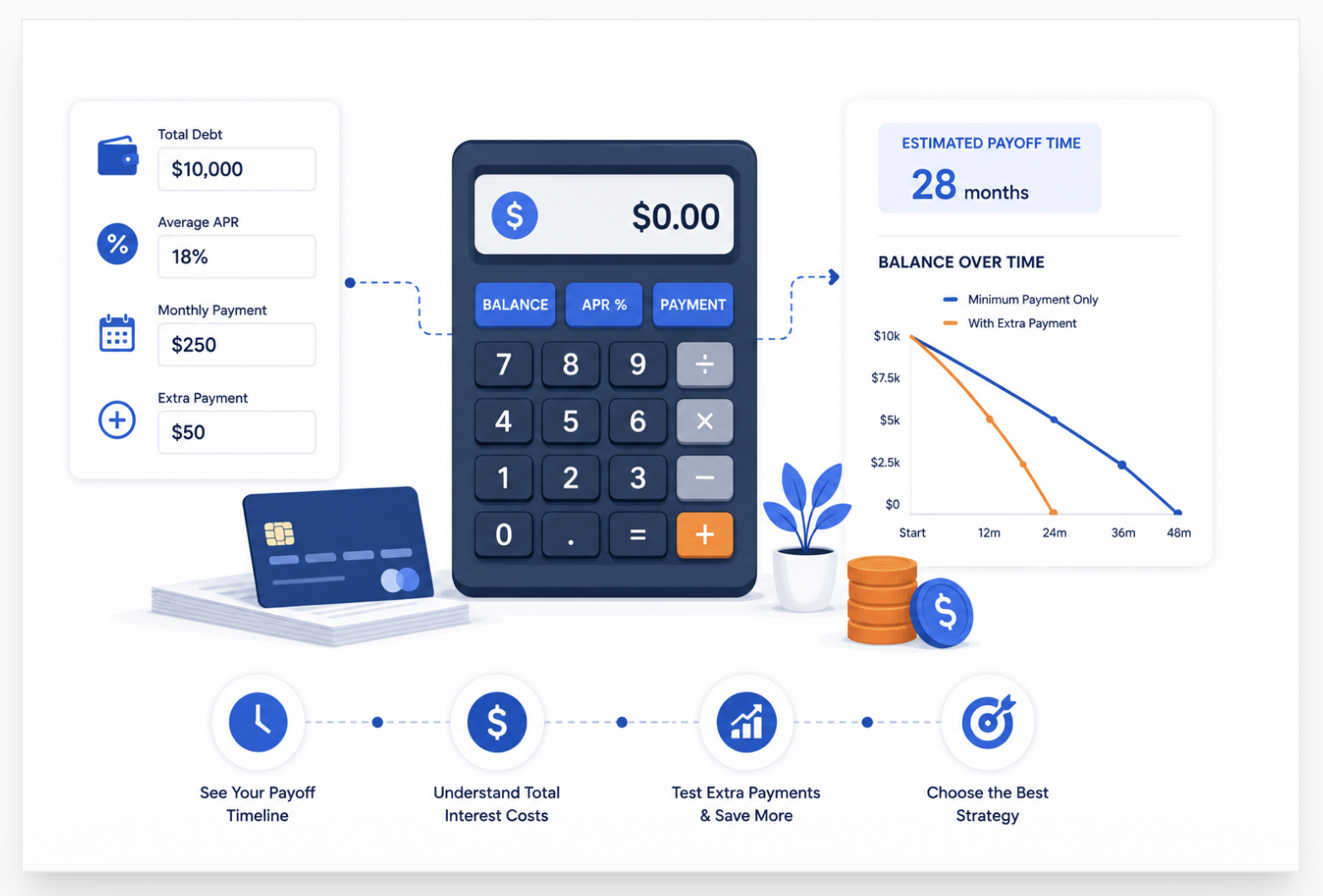
That is why debt payoff calculators comes handy. They turn vague financial stress into measurable numbers. Instead of asking:
“Can I eventually pay this off?”
the calculator reframes the problem into:
“How long will payoff actually take at this payment level?”
That distinction changes behavior.
A good debt payoff calculator helps consumers estimate:
payoff timeline
total interest paid
effect of larger payments
fastest repayment strategy
long-term borrowing cost
Across debt forums, one pattern appears repeatedly: borrowers often feel motivated once they finally see the math visually.
Many realize small extra payments shorten repayment far more aggressively than expected because interest compounds less over time when balances fall earlier.
The calculator itself does not eliminate debt.
But it helps reveal:
how repayment behavior changes financial outcomes.
Debt Payoff Calculator
Enter your balance, interest rate, and monthly payment to see your payoff timeline and total interest cost.
Orange = your payment · Gray dashed = minimum only (2% of balance)
Enter each debt below. Choose a strategy and set your extra monthly payment.
A free 3-bureau audit shows what Equifax, Experian, and TransUnion report right now.
A debt payoff calculator estimates how long it takes to pay off debt. Enter your balance, interest rate, and monthly payment. The calculator shows your payoff date and total interest cost. It also shows how paying extra each month changes the timeline.
What Does a Debt Payoff Calculator Do
A debt payoff calculator takes three inputs , balance, interest rate, and monthly payment , and projects how long payoff takes and how much interest you pay. It also lets you see what happens when you increase the payment amount.
Most people know they have debt. Few know the actual numbers behind it.
A calculator fills that gap. It answers three questions that matter:
- How long will payoff take at my current payment?
- How much interest will I pay in total?
- How much faster can I finish if I pay more each month?
Most free calculators are available on NerdWallet, Bankrate, and the CFPB website. You enter your numbers and see the results instantly.
The calculator does not pay off your debt. It shows you the math so you can make a smarter plan. Think of it as a flashlight, not a shovel.
How Debt Payoff Calculators Estimate Repayment Time
The math behind a debt payoff calculator is not complicated. Here is exactly how it works.
Each month, interest gets charged on whatever balance remains. Then your payment goes in. The payment covers the interest first. What is left over pays down the principal (the actual debt).
The calculator repeats this process month by month until the balance hits zero.
At this rate, the minimum payment barely reduces the debt. The balance falls by only $15 in the first month. The calculator sees this pattern and shows how many months it takes at this pace , often over a decade.
The only way to change the result is to change the inputs. Higher monthly payment. Lower interest rate. Or both.
Why Interest Rates Change Debt Timelines
Interest rate is the most powerful variable in any debt payoff calculation.
Here is why. A high rate means more of every payment goes to interest instead of principal. The principal shrinks slowly. The payoff timeline stretches out.
The most common situation is people paying 21-24% APR on a credit card balance. At those rates, a significant chunk of every payment goes to interest charges rather than reducing what is owed.
This is why high balances relative to your credit limit suppress your score while also costing you money in interest each month. The debt is working against you on two fronts at once.
As LendingTree's 2026 credit card interest rate report shows, someone with a $7,000 balance paying $250/month at 27.40% APR pays $4,293 in interest and takes 45 months to finish. Lower the APR to 20.09% and the same payment finishes in 38 months with $1,768 less in interest. APR is the most important number in the calculation.
A lower APR shrinks the interest portion of every payment. That means more of each payment hits the principal. That speeds up payoff without paying more each month.
How Extra Payments Accelerate Debt Payoff
Small extra payments create bigger results than most people expect.
Here is why. When you pay more than the minimum, the extra money goes directly to principal. A lower principal means less interest next month. Less interest means even more of the next payment goes to principal. The cycle builds on itself.
Adding $118 per month cuts the payoff from 170 months to 62 months. That is 108 months saved , almost 9 years , from one extra payment boost.
Even small amounts matter. An extra $50 per month, or one additional payment per year, reduces total interest significantly when applied consistently over time.
Make extra payments before the statement close date, not just before the due date. The balance at statement close is what gets reported to credit bureaus. A lower reported balance improves your utilization ratio, which helps your credit score at the same time you are cutting down the debt.
According to Bankrate's 2026 credit card debt report, experts recommend treating card debt as an urgent financial priority precisely because of how aggressively interest accumulates. The sooner extra payments start, the less total interest the debt generates.
Debt Snowball vs Debt Avalanche Calculations
When you have more than one debt, a payoff calculator can model two different strategies.
Debt Snowball
Pay the minimum on all accounts. Throw all extra money at the smallest balance first. When that debt is paid off, move that full payment to the next smallest balance.
Debt Avalanche
Pay the minimum on all accounts. Throw all extra money at the highest interest rate first. When that debt is paid off, move that full payment to the next highest rate.
| Factor | Debt Snowball | Debt Avalanche |
|---|---|---|
| Target first | Smallest balance | Highest APR |
| Total interest paid | Higher (more interest accumulates) | Lower (saves more money) |
| Speed to first payoff | Faster (smallest balance clears first) | Slower if highest APR card has large balance |
| Psychological benefit | Strong (wins come quickly) | Weaker early on (wins take longer) |
| Best for | People who need motivation to stay on track | People focused on minimizing total cost |
| Math winner | No | Yes |
Understanding how revolving debt affects your overall financial picture matters beyond just the payoff timeline. Managing revolving debt consistently connects directly to credit utilization , the second-largest factor in your FICO score at 30%.
What a Debt Payoff Calculator Cannot Predict
A calculator assumes your life stays the same. It does not.
Here is what no calculator can account for:
- Job loss or income change
- Emergency spending (medical, car, home repair)
- Rising interest rates on variable-rate cards
- New purchases added to the card you are paying off
- Missed or reduced payments during difficult months
This does not make calculators useless. It means you should treat the result as a plan, not a guarantee.
According to WalletHub's credit card debt research, approximately 18% of credit card holders carry debt for more than 5 years. Many of them started with a payoff plan. Life interrupted it. The lesson is to build some flexibility into the plan by setting the payment target slightly below your actual max capacity.
For people whose debt has already led to missed payments or collections on their credit file, understanding how lenders evaluate debt on your credit file is the parallel step to running a payoff calculator. Both work on the same problem from different angles.
Treat the calculator output as a baseline, not a contract. Plan for life to interrupt the timeline. Set your monthly payment target at a number you can hit even in a tight month. Consistent lower payments beat inconsistent higher payments every time.
Best Way to Use a Debt Payoff Calculator
Most people open a calculator, enter some numbers, see a result, and close the tab. That approach misses most of the value.
Here is how to use a debt payoff calculator the right way.
Log into each account and write down the current balance and the APR. Do not estimate. Use the actual number. Rounding up by $500 or guessing the interest rate makes the projection less useful. Pull this data from your most recent statement or the account portal.
See what happens at the minimum. This is often the most important number to view. The result shows how long minimum-payment behavior lasts and how much interest it costs. Most people are surprised by this number. That surprise is motivating.
Try your minimum plus $50. Then plus $100. Then plus $200. Note how much each extra amount changes the payoff date and total interest. This step shows exactly how much a specific extra payment is worth in time and money saved. For most people, $100 extra per month saves thousands in interest.
Not the one that shows the fastest payoff. The one you can actually hit every single month for the full duration. A $300/month payment you make consistently beats a $500/month payment you make for 3 months before reverting to the minimum.
Update the balance with the current number. Recalculate the timeline. Seeing the balance drop in the calculator is one of the strongest reinforcing behaviors in debt payoff. The visual progress keeps the plan going when motivation dips.
Paying down debt improves both your finances and your credit score simultaneously. High balances suppress the utilization ratio that controls 30% of your FICO score. Every dollar of principal you pay down reduces interest cost AND improves your credit profile at the same time. Run the payoff calculator and track your credit score monthly. Both numbers should move in the right direction together.
What is a debt payoff calculator?
A debt payoff calculator estimates how long it takes to pay off debt based on balance, interest rate, and monthly payment. It also shows total interest cost over the repayment period. Most calculators let you test different payment amounts so you can see how extra payments change the payoff timeline. Free versions are available on Bankrate, NerdWallet, and the CFPB website.
Can extra payments really reduce payoff time significantly?
Yes. Extra payments reduce the principal faster. A lower principal generates less interest the next month. This chain reaction means the payoff timeline compresses faster than most people expect. On a $6,523 balance at 21.52% APR, raising the monthly payment from $132 to $250 cuts payoff time from 170 months to 62 months. That is 9 fewer years of debt from one payment adjustment.
What is the debt snowball vs debt avalanche method?
Debt snowball targets the smallest balance first. It generates quick wins and motivation. Debt avalanche targets the highest interest rate first. It saves the most money over time. Both methods work. The avalanche is mathematically superior, but the snowball is psychologically easier for many people. The best method is the one you follow consistently.
How accurate are debt payoff calculators?
Calculators give estimates based on stable inputs. They assume the same payment every month and no new charges added to the account. If life changes , reduced income, an emergency, a missed payment , the timeline changes too. Use the calculator to build a realistic plan, not to set a guaranteed deadline. Accurate inputs produce useful projections. Overly optimistic inputs produce plans that fail.
High Balances Hurt Your Score While You Pay Them Down
Debt payoff improves your finances and your credit score at the same time. But inaccurate entries or errors on your credit report may suppress your score beyond what the balance alone causes. A free 3-bureau audit shows exactly what Equifax, Experian, and TransUnion report right now.
Get My Free 3-Bureau Audit → Secure · 2 minutes · No credit card required-
Credit Limit Meaning , What It Is and Why It Matters Your credit limit directly determines your utilization ratio , the factor that makes high debt balances visible to lenders even before any missed payment occurs. This covers how credit limits get set, why a higher limit helps your score when the balance stays low, and how the relationship between balance and limit affects your credit file while you pay down debt.
-
FSA Card Explained , How It Works and What You Can Buy Understanding all the financial tools available to you matters when building a debt payoff plan. An FSA card covers medical expenses with pre-tax dollars, which frees up cash that can go toward debt payments. This covers how FSA cards work, what qualifies as an eligible expense, and how maximizing pre-tax accounts is a legitimate way to accelerate debt payoff without cutting lifestyle spending.
-
Do Gas Cards Build Credit , What Actually Helps Your Score For borrowers working on debt payoff while also trying to build credit, gas cards represent a common starting point. This covers how gas cards report to bureaus, how the low credit limits on most gas cards create utilization problems during active payoff, and the specific usage pattern that builds credit without compounding the debt that a payoff calculator is already tracking.