
Gas cards are often marketed as easy starter credit cards, especially for people trying to build or rebuild credit. The idea sounds simple. You buy fuel, make payments, and slowly improve your score. In many cases, that actually works. But the part most consumers miss is this: a gas card only helps if the account reports properly and the user manages it correctly.
Some gas cards function like traditional revolving credit cards and report monthly payment activity to the major credit bureaus. Others are more limited, carry very small approval limits, or create utilization problems faster than people expect. A person charging $250 monthly on a card with a $300 limit may unintentionally create high utilization even while paying on time.
That is why two consumers can use gas cards very differently and see opposite credit outcomes. One builds positive payment history and strengthens their file. Another increases utilization, misses payments, and sees score declines instead.
Across credit forums, gas cards are commonly recommended for thin credit files because approval requirements are sometimes easier than major unsecured cards. But borrowers also frequently underestimate how quickly balances, fees, and interest can offset the credit-building benefit if spending is not controlled.
The real question is not simply:
“Do gas cards build credit?”
The better question is:
“Do they build credit efficiently and safely?”
That is where scoring behavior matters.
Do Gas Cards Build Credit?
Yes, gas cards can build credit if the issuer reports your payments to the major credit bureaus and you manage the account responsibly. On time payments, low balances, and consistent account history may help strengthen your credit profile over time.
How Gas Cards Build Credit
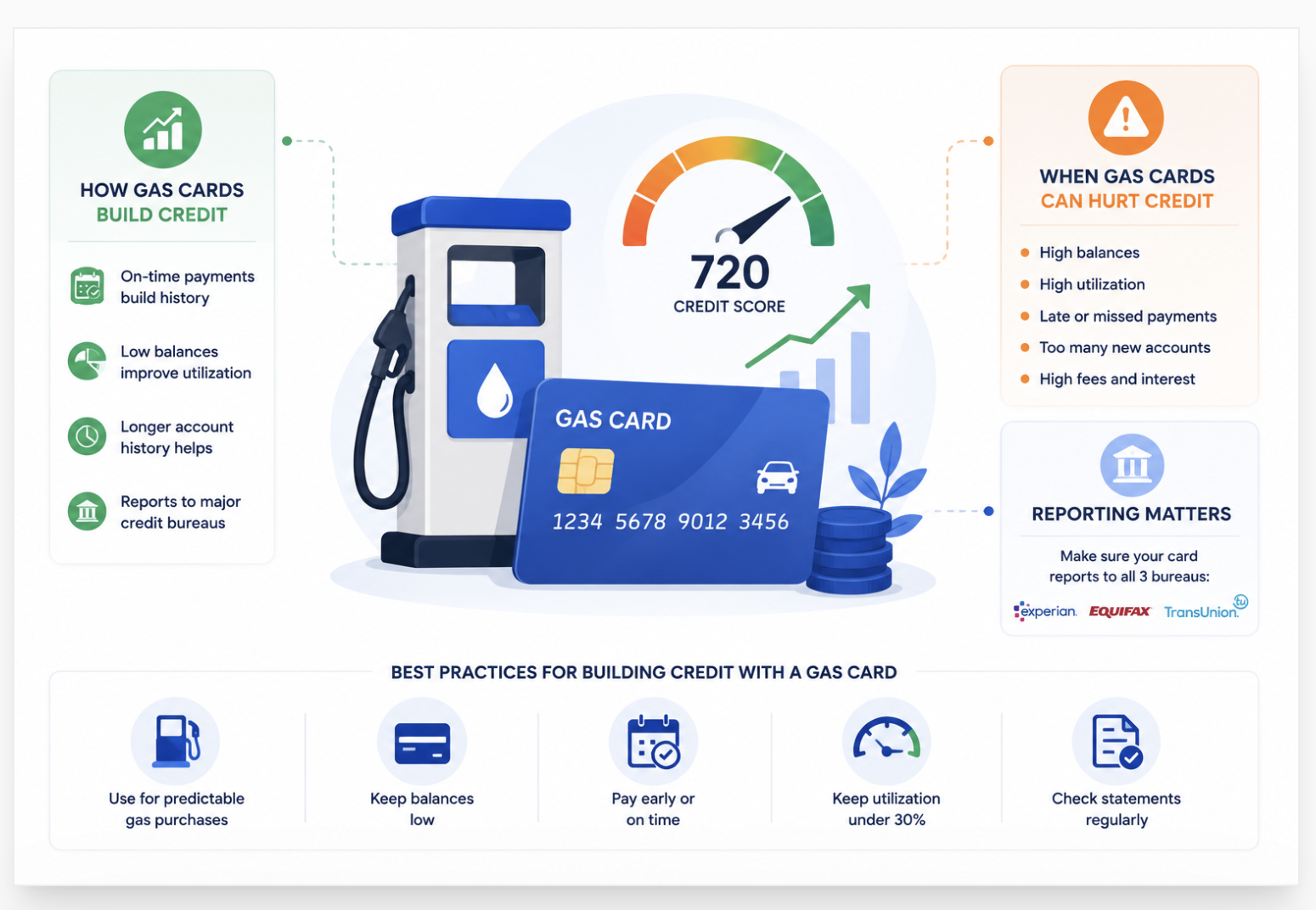
Gas cards build credit through the same factors that drive all revolving credit scoring. On-time payments build payment history (35% of FICO). Low balances build a healthy utilization ratio (30% of FICO). Account age strengthens length of credit history (15% of FICO). All three of these benefits only apply when the issuer reports activity to the three major credit bureaus monthly.
The mechanism is straightforward. When a gas card issuer reports your account to the bureaus each month, that report includes your payment status, your current balance, and your credit limit. If the payment is on time and the balance is low, those two data points work in your favor across the two largest FICO factors.
A gas card that reports monthly to all three bureaus produces 12 positive payment marks per year. Over two years, that is 24 consecutive on-time marks across Equifax, Experian, and TransUnion. For a borrower with a thin credit file or limited payment history, those marks represent a meaningful portion of the entire credit record. They demonstrate to any future lender that a revolving account existed, was used, and was paid on time without interruption.
Gas cards also contribute to credit mix (10% of FICO). A borrower who only has installment loans , a student loan or auto loan , lacks any revolving account history. Adding a gas card, if it reports as a revolving line, fills that gap. Credit scoring models generally reward borrowers who demonstrate they can manage both revolving and installment credit simultaneously.
As Experian's guide on using credit cards to improve scores explains, what matters most is how the account gets managed , not which brand appears on the front of the card. Payment behavior and utilization control the outcome. The gas station logo is irrelevant to the credit bureau that receives the monthly report.
Do All Gas Cards Report to Credit Bureaus
No. Reporting varies significantly by card type and issuer. Branded gas station credit cards issued through major banks typically report to all three bureaus. Fleet accounts designed for businesses often do not report to personal credit bureaus. Prepaid gas cards and debit cards never report because they are not credit products. Confirming bureau reporting before applying is a required step, not optional.
This is where many borrowers make a mistake. They get a gas card, pay it on time for a year, and then check their credit report , only to find the account never appears. The card did not report. The year of on-time payments generated zero credit-building value.
There are three distinct categories of gas payment products, and only one reliably builds credit:
| Card Type | Reports to Bureaus? | Examples | Credit Building? |
|---|---|---|---|
| Branded gas credit card (bank-issued) | Yes , all 3 typically | Shell Citi, BP Synchrony, ExxonMobil Capital One, Chevron Synchrony | Yes, if managed correctly |
| General rewards credit card (gas category) | Yes , all 3 | Citi Custom Cash, Amex Blue Cash, Capital One Savor | Yes , and higher limits available |
| Fleet card (business use) | Often no | WEX, Fleetcor, Fuelman | No , does not report to personal bureaus |
| Prepaid gas card / debit card | Never | Various station gift cards, prepaid debit | No , not a credit product |
| Store charge card (gas only) | Varies by issuer | Some regional station loyalty programs | Confirm before applying |
The confirmation step takes one phone call. Call the card issuer's new accounts number and ask directly: "Does this card report payment history to Equifax, Experian, and TransUnion?" If the answer is anything other than yes to all three, the card will not build a complete credit profile. Reporting to only one bureau means the other two remain uninformed , and most lenders pull from more than one bureau when making approval decisions.
When Gas Cards Hurt Your Credit Instead
Gas cards hurt credit most often through high utilization. Low credit limits of $300 to $500 mean that normal weekly fuel spending quickly pushes balances above 30 to 80 percent of the limit. High utilization suppresses the score even when every payment arrives on time. Late payments and hard inquiry stacking also cause damage, but the utilization trap is the most common and least understood risk.
The math above explains why two borrowers using gas cards see opposite outcomes. The borrower with a $500 limit paying in full at statement time still shows $200 in spending , 40% utilization , which begins to suppress the score. The borrower with a $2,000 limit shows the same $200 in spending at 10% utilization, which falls in the optimal range.
The solution is not to spend less on fuel. Fuel costs are what they are. The solution is to pay the balance before the statement closes. Not on the due date , before the statement close date. The balance that appears on your monthly statement is what the bureau receives. A zero balance at statement close produces 0% utilization and full payment history credit simultaneously.
High utilization can hurt scores even with on-time payments , and this effect compounds when the card carries a low limit. FICO models evaluate utilization on each individual card as well as overall across all accounts. A gas card at 80% utilization drags the score even if every other account sits at 0%. There is no averaging that wipes out the individual card penalty.
- ✗ High balance at statement close time suppresses score despite on-time payments
- ✗ Missing any payment costs 60-110 points and stays on the report 7 years
- ✗ Multiple applications in a short period stacks hard inquiries
- ✗ Annual fees add debt load that compounds if the card carries a balance
- ✗ High interest rates on gas cards (often 28-36% APR) make carrying balances expensive
Gas Cards vs Traditional Credit Cards
Gas cards and traditional credit cards build credit through the same FICO mechanics. The difference is limit size, spending flexibility, and long-term ceiling.
| Factor | Gas Cards | Traditional Credit Cards |
|---|---|---|
| Approval requirements | Often more accessible , sometimes 580+ or lower | Varies widely , from secured cards (any score) to rewards cards (700+) |
| Typical starting limit | $250-$500 | $300 (secured) to $5,000+ (unsecured) |
| Spending restrictions | Gas and sometimes automotive purchases only | Anywhere the network (Visa, MC) is accepted |
| Bureau reporting | Major bank-issued cards report all 3; others vary | Most report all 3 bureaus monthly |
| Utilization risk | High , low limits + regular fuel spend creates fast utilization spikes | Lower , larger limits give more utilization buffer |
| Long-term credit-building value | Limited , low limits restrict the utilization benefit over time | Higher , larger limits produce stronger utilization ratio improvement |
| Credit mix contribution | Adds revolving account to the file | Adds revolving account to the file |
The most important column in that table is starting limit. A $500 gas card builds the same type of credit history as a $2,000 traditional credit card , but the utilization math works against the gas card from day one. As NerdWallet's gas credit card analysis shows, many consumers ultimately find more credit-building efficiency in general rewards cards that include gas as a bonus category, because those cards tend to carry higher limits and broader acceptance.
A gas card serves as a starter tool for borrowers who cannot yet qualify for a traditional card. Once the gas card builds enough history to qualify for a traditional card with a higher limit, most borrowers benefit from adding that second card rather than relying on the gas card as a long-term credit-building vehicle. The gas card stays open (keeping the account age and available credit intact) while the new card carries the primary spending at a healthier utilization ratio.
This connects directly to why revolving account management matters more than card count. The specific card type matters less than how utilization, payment timing, and account age get managed across the portfolio.
Who Should Use a Gas Card to Build Credit
A gas card adds a revolving account and begins building payment history when no other revolving account exists. It opens the door to traditional cards 6-12 months later when the score and history improve.
Post-bankruptcy or post-derogatory borrowers who cannot qualify for traditional unsecured cards can use a gas card to demonstrate current responsible behavior while the derogatory history ages.
Drivers who spend $300 or more per month on fuel will hit or exceed the limit on most gas cards. This creates a persistent utilization problem that negates the payment history benefit. A higher-limit general card with a gas bonus category works better.
A gas card with a $300-$500 limit adds minimal value to a credit file that already has $20,000 in available revolving credit. The small limit barely affects overall utilization and the spending restriction limits practical use.
For the borrower in the "good fit" categories, one important verification step applies before applying: confirm the specific card reports to all three bureaus. Call the number on the card offer, speak to a representative, and ask directly. If the issuer cannot confirm three-bureau reporting, choose a different card. A secured traditional credit card that reports to all three bureaus is almost always a stronger credit-building product than a gas card that reports to only one or two.
Best Way to Use a Gas Card for Credit Building
Use the gas card only for fuel purchases. Pay the full balance online before the statement closing date , not the due date. This keeps utilization at or near zero when the bureau receives the monthly report. Set autopay for the minimum payment as a safety net. Never carry a balance from month to month. This strategy produces maximum payment history benefit and minimum utilization cost.
The statement close date is the critical date , not the due date. Most borrowers focus on the payment due date. That is too late. The bureau receives the balance from the statement, which closes 20-25 days before the due date. By the time the due date arrives, the bureau already has the balance from the closing date on file.
Pay before the statement closes. Not after.
Here is the exact sequence that produces the best outcome:
- ✓ Confirm the card reports to all three bureaus before applying
- ✓ Use the card for fuel only , one predictable, recurring expense
- ✓ Find the statement close date in the account settings or by calling customer service
- ✓ Pay the full balance online 2-3 days before the statement closes every month
- ✓ Set autopay to the minimum payment as a backup to prevent a missed payment if a manual payment fails
- ✓ Never carry a balance from month to month , interest at 28-36% APR compounds quickly on low-limit cards
- ✓ Keep the account open and active even after upgrading to a higher-limit card , account age matters
Setting up autopay is the safety net, not the primary strategy. Payment consistency remains critical , one missed payment costs 60-110 points and stays for seven years. Autopay set to the minimum prevents that mark from landing if a manual payment is forgotten. But autopay on the minimum does not help utilization. The manual payment before the statement close date is what controls what the bureau sees.
This matters. The gas card is not the credit builder. The behavior around the card is the credit builder. A gas card sitting in a drawer with no activity does nothing. A gas card used heavily with a high balance at statement close suppresses the score. The same gas card used with a small purchase paid before the statement close date builds 12 positive payment marks per year. The card is a reporting vehicle. What gets reported , and when the balance sits at zero to report , determines every outcome.
As Bankrate's analysis of gas cards for credit building notes, the best gas cards for rebuilding credit combine bureau reporting with manageable limits and low annual fees. The fee structure matters because an annual fee on a card with a $300 limit immediately uses a meaningful percentage of available credit when it posts , creating an instant utilization spike at account opening.
A gas card builds credit through the same FICO factors as any revolving account , payment history, utilization, and account age. The mechanics work in the borrower's favor only when the card reports to all three bureaus, the balance reaches near-zero before the statement closes, and every payment arrives on time. Missing any of these three conditions either eliminates the benefit or creates active damage to the score.
Do gas cards build credit?
Yes, when the issuer reports to Equifax, Experian, and TransUnion and the account is managed responsibly. On-time payments add to payment history (35% of FICO) and low balances at statement close maintain healthy utilization (30% of FICO). A gas card that does not report to the major bureaus , including prepaid debit cards and fleet cards , provides no credit-building benefit regardless of how carefully the account is managed.
Can gas cards hurt your credit?
Yes. The most common way is high utilization from low credit limits. A $300 limit card carrying $240 in fuel charges at statement close sits at 80% utilization, which actively suppresses the score even with on-time payments. Missing a payment on a gas card causes the same 60-110 point damage as missing any other payment. Multiple applications for gas cards in a short period also stacks hard inquiries that temporarily lower the score.
Are gas cards easier to get approved for?
Often yes. Branded gas station credit cards issued through Synchrony, Capital One, and Citi typically carry lower approval requirements than major unsecured rewards cards. Some approve applicants with scores in the 580 range. For borrowers with thin files or recent derogatory history who cannot yet qualify for a traditional unsecured card, a branded gas card can serve as an accessible entry point into revolving credit , provided three-bureau reporting is confirmed before applying.
Do all gas cards report to credit bureaus?
No. Branded gas station credit cards issued through major banks generally report to all three bureaus. Fleet cards used for business fuel management typically do not report to personal credit bureaus. Prepaid debit cards and store gift cards used at gas stations never report because they are not credit products. Confirm three-bureau reporting by calling the issuer before submitting any application for a gas card intended for credit building.
Want to Know What Is Actually Affecting Your Credit Score?
Sometimes the issue is not the gas card. It is utilization on another account, a reporting error, a collection, or an inaccurate entry suppressing your score below where your actual payment behavior would place it. A free 3-bureau audit shows exactly what Equifax, Experian, and TransUnion currently report before any new credit application goes in.
Get My Free 3-Bureau Audit → Secure · 2 minutes · No credit card required-
Does Having Multiple Credit Cards Hurt Your Credit? A gas card is usually the first revolving account in a thin credit file. This covers what happens to the score when a second or third card is added , how the utilization math improves with more available credit, when stacking inquiries becomes a real problem, and the specific FICO factor weight that determines whether more cards help or hurt based entirely on how each account is managed.
-
Why Credit Is Important , What a Strong Score Actually Opens Up Building credit with a gas card is a starting point, not the destination. This covers what a strong credit score unlocks in practice , lower mortgage rates, better auto loan terms, easier apartment approvals, and the specific score thresholds where each financial door opens. Understanding what the score enables makes the day-to-day discipline of managing utilization and payments tangible and worth sustaining.
-
Average Personal Loan Interest Rate , What Your Score Actually Costs You A gas card managed correctly builds the score that eventually determines the interest rate on every installment loan. This covers how lenders price personal loans by credit tier, the actual dollar difference between a 620-score rate and a 720-score rate over a 3-year loan term, and why the discipline of keeping gas card utilization low today produces measurable savings on every loan a borrower takes in the next three to five years.