

Gross vs net income comes down to two numbers: what you earn before deductions and what reaches your bank account after deductions. If your gross monthly income is $5,000 and $1,100 goes toward taxes, insurance, and retirement contributions, your net income is $3,900. That $1,100 difference changes how much money you have available for rent, credit cards, loans, and everyday expenses.
The distinction becomes especially important when borrowing money. According to the Consumer Financial Protection Bureau (CFPB), lenders calculate debt-to-income ratio by dividing monthly debt payments by gross monthly income. For example, $2,000 in monthly debt payments divided by $6,000 in gross income produces a 33.3% debt-to-income ratio.
In nearly 20 years working in credit repair, I've found that the income number used to evaluate a loan is not the same number people should use to plan their monthly spending. When reviewing a client's credit situation, I separate lender calculations from household cash flow. A borrower with $5,000 in gross income and $3,900 in take-home pay has $3,900, not $5,000, available before paying living expenses and debts.
“Use gross income to understand how lenders measure your debt. Use net income to decide what you can afford to pay.”
This guide breaks down gross and net income, shows how to calculate each amount from your paycheck. We'll explain how taxes, deductions, credit card payments, and loan applications affect the numbers.
Gross vs Net Income: Differences, Calculations, and Examples
Gross income is the money you earn before taxes and other deductions. Net income is the amount remaining after those deductions. For employees, net pay is commonly called take-home pay.
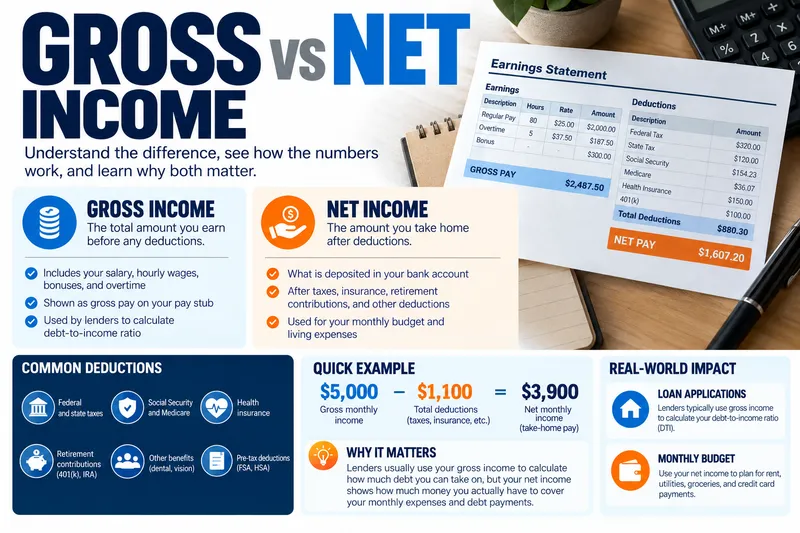
Lenders generally use gross monthly income to calculate debt-to-income ratios, while net income is the more practical starting point for a household budget.
Gross vs Net Income: Differences, Calculations, and Examples
Gross income is the money you earn before taxes and other deductions. Net income is the amount left after those deductions. For workers, net pay is often called take-home pay. Lenders use gross monthly income to calculate debt-to-income ratios. Net income is the better number for building a monthly budget.
Gross vs net income comes down to two numbers. One is what you earn before deductions. The other is what lands in your bank account after deductions.
Say your gross monthly income is $5,000. If $1,100 goes to taxes, insurance, and retirement, your net income is $3,900. That $1,100 gap changes how much money you have for rent, credit cards, loans, and daily expenses.
The gap matters most when you borrow money. The CFPB says lenders find your debt-to-income ratio by dividing monthly debt payments by gross monthly income. $2,000 in monthly debt divided by $6,000 in gross income equals a 33.3% ratio.
In nearly 20 years of credit repair work, I've learned the number lenders use is not the number you should use to plan your spending. When I review a client's situation, I separate the lender's number from the household's real cash flow. A borrower earning $5,000 gross with $3,900 net has $3,900 to spend, not $5,000.
Use gross income to see how lenders measure your debt. Use net income to set your affordable payment amount.
This guide breaks down gross and net income. It shows how to calculate each one from your paycheck. It explains how taxes, deductions, and loan applications change the numbers you see.
Key Takeaways
- Gross income is your pay before deductions. Net income is what's left after.
- Lenders calculate debt-to-income ratio using gross monthly income.
- Your household budget works better when it's built on net income.
- A $1,500 debt payment is 30% of a $5,000 gross income, but 38.5% of $3,900 net income.
Gross vs Net Income: What's the Difference?
Gross income is the money you earn before taxes and other deductions. Net income is the amount remaining after those deductions. For employees, net pay is commonly called take-home pay. Lenders generally use gross monthly income to calculate debt-to-income ratios, while net income is the more practical starting point for a household budget.
| Comparison | Gross Income | Net Income |
|---|---|---|
| Meaning | Earnings before deductions | Earnings after deductions |
| Also called | Gross pay | Take-home pay |
| Taxes removed | No | Yes, through withholding |
| Insurance and retirement removed | No | Yes, when deducted from pay |
| Used in standard DTI calculations | Yes | No |
| Useful for monthly budgeting | Less directly | Yes |
The IRS treats wages, salaries, and tips as gross income before deductions. Payroll withholding, including income tax, Social Security, and Medicare, comes out of that gross figure to produce your net pay.
What Is Gross Pay?
Gross pay is your total earnings before anything is taken out. It includes your base salary or hourly wage, plus bonuses, tips, commissions, and overtime pay. Your gross pay shows up at the top of your pay stub, before any deduction line.
How to Calculate Gross Income
The formula changes slightly by pay type:
- Hourly: hourly rate × hours worked in the period.
- Biweekly salary: annual salary ÷ 26 pay periods.
- Monthly salary: annual salary ÷ 12 months.
- Annual: hourly rate × hours per week × 52 weeks.
Example: $25 an hour, 40 hours a week, 52 weeks a year equals $52,000 in annual gross wages, before any overtime or bonus.
Adjusted Gross Income Example
Adjusted gross income, or AGI, is a tax-return number, not your paycheck's gross pay. The IRS defines AGI as your total gross income minus specific adjustments, such as student loan interest or deductible retirement contributions. Example: $71,000 in total income minus $2,750 in adjustments gives an AGI of $68,250. AGI appears on your tax return, not your pay stub, and it's calculated once a year.
What Is Net Pay?
Net pay is what's left after your employer subtracts taxes and other deductions from your gross pay. This is the amount deposited into your bank account or printed on your paycheck. Net pay is also called take-home pay.
Net Income Equation
| Net Pay Formula | |
|---|---|
| Gross pay | start |
| − Tax withholding | reduces |
| − Insurance premiums | reduces |
| − Retirement contributions | reduces |
| − Other deductions | reduces |
| = Net pay | take-home amount |
Paycheck walkthrough: $5,000 gross, minus $750 in tax withholding, $200 in insurance, and $150 in retirement contributions, equals $3,900 net pay.
Gross vs Net Income Examples: $40,000, $60,000, and $100,000 Salaries
These deduction amounts are illustrative examples, not tax estimates for any specific filer. Your own withholding depends on your state, filing status, and benefit elections.
| Annual Gross Salary | Illustrative Deductions | Illustrative Net Pay |
|---|---|---|
| $40,000 | $9,200 (23%) | $30,800 |
| $60,000 | $14,400 (24%) | $45,600 |
| $100,000 | $27,000 (27%) | $73,000 |
Deduction share tends to rise with income, since higher earnings often sit in higher tax brackets. Check your own pay stub or the IRS Tax Withholding Estimator for a figure specific to your situation.
Gross to Net Pay Calculator
Gross vs Net Pay Calculator
Enter monthly amounts from your pay stub. This is a deduction calculator, not a tax estimator.
Figures update as you type. Nothing you enter here is stored or sent anywhere.
Do Lenders Use Gross or Net Income?
Lenders use gross monthly income for debt-to-income ratio. The CFPB's formula is simple: total monthly debt payments divided by gross monthly income. In the CFPB's own example, $1,500 for a mortgage, $100 for an auto loan, and $400 in other debt total $2,000. Divided by $6,000 in gross income, that's a 33% ratio.
| Loan Type | Income Figure Used |
|---|---|
| Mortgage | Gross monthly income, for DTI |
| Personal loan | Gross income, stated on application |
| Credit card | Gross income, stated on application |
Lenders verify your stated gross income with pay stubs, W-2s, or tax returns, depending on the loan type and amount.
See what to do when a credit report stays wrong after a lender errorPreparing to Apply for a Loan?
Your gross income drives the lender's math. Your credit report drives the lender's decision. Review your report for errors before you apply.
Get My Free Credit Analysis Now →Does Gross or Net Income Affect Your Credit Score?
Neither one. Income isn't a factor in your FICO score. Your score comes from payment history, amounts owed, credit history length, new credit, and credit mix. Lenders check income separately from your score, as part of their affordability review - not as part of the score itself.
Should You Budget Using Gross or Net Income?
Build your budget on net income. That's the actual amount reaching your bank account, available for rent, groceries, debt payments, and savings. A budget built on gross income overstates what you have to spend, since it ignores taxes and other deductions already gone before you're paid.
| Figure | Amount | Share of Gross | Share of Net |
|---|---|---|---|
| Gross monthly income | $5,000 | 100% | - |
| Net monthly income | $3,900 | 78% | 100% |
| Monthly debt payments | $1,500 | 30% | 38.5% |
That same $1,500 payment takes up 30% of gross pay, but 38.5% of what lands in the bank. Net income shows the real weight of your debt.
Read how lowering reported balances speeds up credit repairGross vs Net Income for Self-Employed Workers
Self-employment changes the vocabulary. Revenue is total money collected from clients or customers, before any expense is subtracted. Business expenses - supplies, software, mileage, contractor fees - come out next. What remains is net business income, the self-employed equivalent of gross pay for tax purposes before personal deductions.
Lenders reviewing a self-employed applicant typically look at net income from tax returns, usually averaged over one to two years, rather than gross revenue. Gross revenue alone overstates what a self-employed borrower earns once expenses are paid.
One Number for Lenders, One Number for You
Nearly 20 years of credit repair work at ASAP Credit Repair has shown that confusing gross and net income is one of the most common budgeting mistakes. Use gross income to understand how a lender sees your file. Use net income to decide your spending limit.
Does Your Income Support Your Monthly Debt Payments?
Gross income tells lenders how much you earn before deductions. Net income tells you how much is available to manage expenses and repay debt. If inaccurate balances, payments, or collection accounts appear on your credit report, review those records before applying for additional credit.
Get Started With ASAP Credit Repair →Frequently Asked Questions About Gross vs Net Income
Is net income the same as take-home pay?
Yes. Take-home pay is the common name for net income on a paycheck - the amount left after taxes and other deductions.
Is a $60,000 salary gross or net?
A stated salary figure, like $60,000, is almost always gross pay, before taxes and deductions. Your net pay from that salary is lower.
How do I calculate net income from gross income?
Subtract tax withholding, insurance premiums, retirement contributions, and other payroll deductions from your gross pay. The result is your net income.
How much is $25 an hour annually before taxes?
At 40 hours a week for 52 weeks, $25 an hour equals $52,000 a year in gross wages, before taxes or overtime.
What is the difference between gross pay and net pay?
Gross pay is earnings before deductions. Net pay is what's left after taxes, insurance, retirement contributions, and other deductions come out.
Do mortgage lenders use gross or net income?
Mortgage lenders use gross monthly income to calculate your debt-to-income ratio, the standard measure of loan affordability.
Do credit card companies look at gross income?
Yes. Credit card applications typically ask for gross annual income, which issuers use to judge repayment capacity before approving a credit limit.
Does income affect your credit score?
No. Income isn't a factor in your FICO score. Lenders evaluate income and your credit score separately when deciding whether to approve a loan.
Is adjusted gross income the same as net income?
No. Adjusted gross income is a tax-return figure used to calculate taxes owed. Net income is your actual take-home pay after payroll deductions.
Should I budget using gross or net pay?
Budget using net pay. It's the amount that reaches your bank account and covers your spending and debt payments.
Related Reads
- IRS - Adjusted Gross Income (AGI) Definition
- IRS - Definition of Adjusted Gross Income
- CFPB - What Is a Debt-to-Income Ratio?
- IRS - Tax Withholding Estimator