

HELOC denied because of credit? Having equity in your home does not guarantee access to it. If your HELOC was denied because of credit, the next application should start with a review of the lender’s reasons, not another application form.
Lenders denied 33.86% of HELOC applications in the second quarter of 2026, according to Bankrate’s analysis of Home Mortgage Disclosure Act data. That compares with approximately 16.3% of first-mortgage applications, making the HELOC denial rate more than twice as high. Those figures cover denials across all reasons, not credit alone.
For an individual borrower, the distinction matters. An inaccurate late payment requires a different response from an accurate balance that leaves too little room for another monthly obligation.
Before reapplying, compare the reasons in your denial notice with your credit reports and financial records. Identify reporting errors, confirm the balances lenders see and ask which requirements your application failed to meet.
Another application also brings a potential credit cost. According to myFICO, one additional inquiry reduces most people’s FICO scores by fewer than five points, although the effect varies by credit profile.
The priority is to establish what has changed since the denial.
This guide explains what to review, which problems call for a dispute and what to confirm with a lender before applying again.
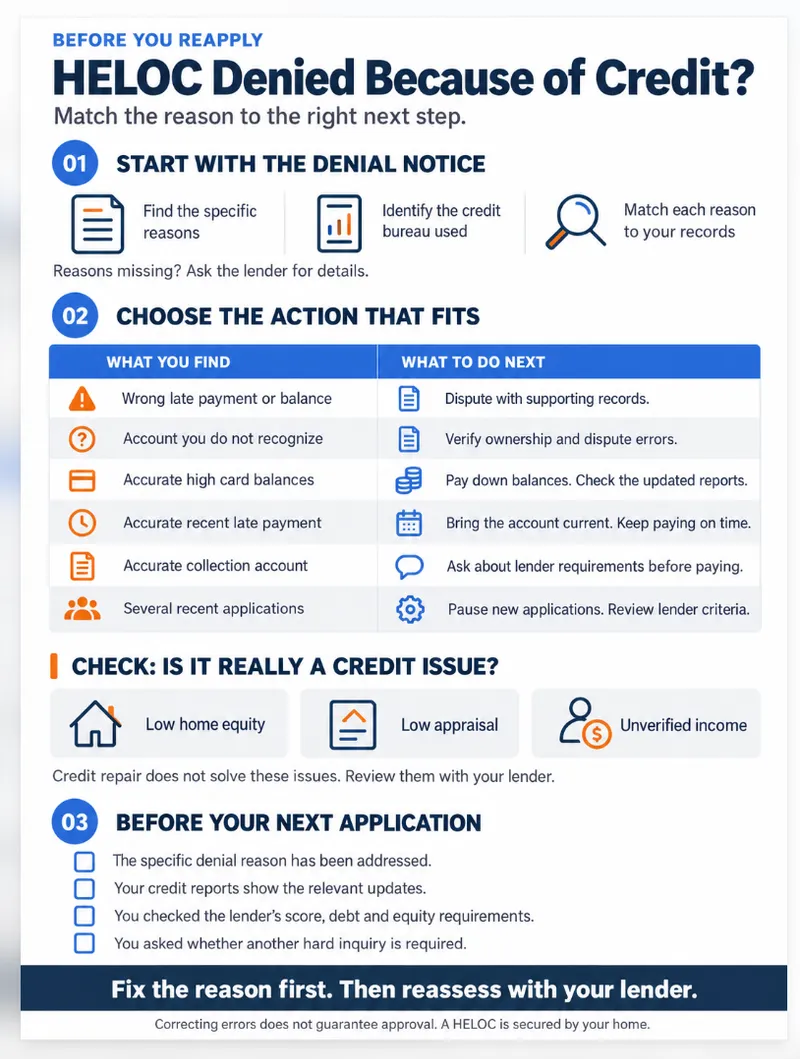
HELOC Denied Because of Credit? What to Review Before Reapplying
HELOC denied because of credit is a different problem from a HELOC denied for low equity, and the fix starts with knowing which one you have. A lender pulled your credit reports, ran your score and debts against its limits, and said no.
The denial letter tells you which limit you missed.
Credit-related denials come from a short list: a score below the lender's minimum, high card balances, recent late payments, collection accounts, or an error on a report. Some of those are accurate and need time and payments to fix.
Others are wrong and need a dispute.
Reapplying without that sorting step repeats the same result and adds another hard inquiry to your file. A review first costs nothing and tells you whether to dispute, pay down, or wait.
At ASAP Credit Repair USA, we review credit reports for inaccurate, incomplete, and unverifiable entries every day. We do not promise approval, and no one controls a lender's decision.
This article covers what your denial notice tells you, which credit factors cause HELOC denials, how to review your reports, when to reapply, and when a denial has nothing to do with credit.
If a lender denied your HELOC because of credit, read the adverse action notice for the reasons and the credit reporting agency it used. Pull your reports and dispute anything inaccurate. Pay down revolving balances, bring accounts current, and reapply only after the specific factor in the notice has changed.
Why Was Your HELOC Denied Because of Credit?
Lenders deny HELOCs on credit grounds when your score falls below their minimum, your debt-to-income ratio runs too high, or your reports show recent late payments, collections, or heavy card use. Your home secures a HELOC, so lenders hold the file to a tight standard.
A home equity line of credit is a revolving line you borrow against repeatedly during a draw period, according to the Consumer Financial Protection Bureau (CFPB). Your home is the collateral, and the CFPB warns that falling behind puts your home at risk.
Bankrate's lender survey (updated October 2026) puts the usual minimum score at 640 or higher, with many lenders setting the bar at 680. It lists 80% to 85% combined loan-to-value and a debt-to-income ratio of 43% or below as typical limits.
| Credit Factor | What the Lender Saw | What to Review |
|---|---|---|
| Credit score below minimum | A score under the lender's floor, often 640 to 680 | The score and key factors listed in the notice |
| High card balances | Revolving balances near their limits | Reported balance and limit on each card |
| Recent late payments | 30-, 60-, or 90-day delinquencies | Whether each late payment is accurate |
| Collection or charge-off accounts | Unpaid accounts handed to a collector | Ownership, balance, and dates |
| High debt-to-income ratio | Monthly debts that crowd your income | Every debt the report counts against you |
| Too many recent inquiries | Several new credit applications | Inquiries you did not authorize |
| An error on the report | Wrong status, balance, date, or owner | Every account against your own records |
Not Sure Which Credit Factor Sank Your HELOC?
Start with your credit reports. A review shows which entries are accurate, which are wrong, and which ones the lender weighed most.
Claim My Free Credit Analysis Now → Secure · 2 minutes · No credit card requiredWhat Does Your HELOC Adverse Action Notice Tell You?
An adverse action notice states that the lender denied your application and, when a credit report played a role, names the credit reporting agency that supplied it. It also gives your right to a free copy of that report within 60 days and your right to dispute errors.
Under Section 615(a) of the Fair Credit Reporting Act (FCRA), the FTC lists what the notice must include: the agency's name, address, and phone number, and a statement that the agency did not make the decision. It also states your right to a free report if you ask within 60 days, and your credit score if the lender used one.
The Equal Credit Opportunity Act adds the reasons. The CFPB's sample notice tells you to request the specific reasons for the denial within 60 days of the letter, and the lender provides them within 30 days after you ask.
How to Read the Notice
- Find the agency. The notice names Equifax, Experian, or TransUnion. Pull that report first.
- Find the reasons. Look for phrases such as "delinquent past or present credit obligations," "level of delinquency," or "proportion of balances to credit limits."
- Find the score and key factors. A score disclosure shows how the lender's model saw you.
- Match each reason to a report entry. A reason with no matching entry is a question for the lender.
Our post on credit limit increase denials walks through the same notice-first approach for credit cards.
What Should You Review on Your Credit Reports Before Reapplying?
Review all three credit reports for inaccurate late payments, wrong balances, duplicate or unfamiliar collections, wrong account statuses, and accounts that belong to someone else. Dispute every error with the credit reporting agency and the information furnisher, with evidence attached.
Free reports from all three bureaus are available at AnnualCreditReport.com. Start with the bureau named in your notice, then check the other two, since each bureau holds its own data.
- ✓Late payments you made on time, matched against bank statements
- ✓Balances and limits that differ from your statements
- ✓Collections you do not recognize or that appear twice
- ✓Account statuses that show open or delinquent on closed or paid accounts
- ✓Accounts that belong to someone else, including mixed-file entries
- ✓Delinquency dates that look wrong
A credit reporting agency has 30 days to reinvestigate a dispute, or 45 days if you send relevant new information in that window, under FCRA Section 611. Dispute before you reapply, because a pending dispute does not fix the score a lender pulls.
Accurate Entries Need a Different Fix
| What You Find | Your Next Step |
|---|---|
| An inaccurate late payment, balance, or status | Dispute with evidence at the bureau and the furnisher |
| An account that is not yours | Dispute and include identity documents |
| Accurate high card balances | Pay down revolving balances before the next statement reports |
| An accurate recent late payment | Bring the account current and keep every payment on time |
| An accurate collection account | Ask the lender how it treats the account before you pay |
| Several recent inquiries | Hold off on new applications |
Accurate negative information stays reportable. The FTC puts the period at seven years for most items and ten years for bankruptcy, and a dispute does not remove it.
Card balances move a score quickly. FICO weighs amounts owed at 30% of the score, according to myFICO, so lower balances change the number a lender sees after the issuer reports them.
Is Credit Really the Reason Your HELOC Was Denied?
Sometimes the notice cites equity, not credit. Bankrate lists too little home equity, income the lender cannot verify, and a low appraisal among the common reasons.
Those denials call for a different fix: a smaller line, a different lender, or an appraisal challenge. A credit review will not change an equity result.
Credit and equity can fail together. Check the notice for every reason listed, not just the first.
When Should You Reapply for a HELOC After a Credit Denial?
No federal waiting period applies, so reapply when the specific factor in your notice has changed. For credit and debt-to-income denials, Bankrate suggests 30 to 90 days of paying down balances. Each application adds a hard inquiry, which lowers a score by about five to ten points on average.
myFICO states that hard inquiries stay on a report for up to two years, and FICO scores consider only the last 12 months. A rushed second application costs points you need.
A wrong late payment is deleted and the credit reports now match your records. The lender's stated reason no longer exists.
Card balances are still near their limits. Pay them down first, so the lower balances report before the next pull.
Lender requirements vary, according to Bankrate, so a denial at one lender does not predict the result at another. Ask a new lender for its minimum score, maximum combined loan-to-value, and debt-to-income limit before you apply.
A Hypothetical HELOC Denial, Reviewed Step by Step
Consider a hypothetical homeowner whose denial notice lists two reasons: delinquent credit obligations and high revolving balances. The homeowner pulls the report named in the notice.
When Does Professional Credit Repair Make Sense After a HELOC Denial?
Some homeowners dispute the same entry repeatedly and get a verified result each time. They never learn why the entry stays on the report.
A review checks account ownership, balances, dates, payment history, and prior dispute results. ASAP Credit Repair USA helps consumers identify and address credit-report inaccuracies, and credit repair does not replace paying the debts you owe or guarantee a lender's decision.
For more on the process, read our guide to how credit repair works. If the denial came late in a mortgage process, see why borrowers get denied at closing.
Not Sure What's Hurting Your Credit?
Start by reviewing your credit reports. ASAP Credit Repair USA helps consumers identify inaccurate account information and understand the appropriate steps for addressing reporting errors.
Review My Credit Report → Secure · 2 minutes · No credit card requiredFrequently Asked Questions About a HELOC Denied Because of Credit
Is credit a common reason for HELOC denial?
Yes. Bankrate lists a credit score below the lender's minimum, high debt relative to income, too little equity, and unverifiable income as the common reasons. Credit and debt-to-income both come from your credit reports, so a report review is the first step after any denial.
What credit score do you need for a HELOC?
Bankrate reports a typical minimum of 640 or higher, with many lenders setting the bar at 680. Every lender sets its own floor, so ask before you apply. A score above the floor still leaves the debt-to-income ratio and equity requirements to meet.
Does a HELOC denial hurt your credit score?
The application adds a hard inquiry, which lowers a score by about five to ten points on average, according to myFICO. FICO scores consider inquiries from the last 12 months. Each reapplication adds another inquiry, so reapply once the notice's reason is fixed.
How long should you wait to reapply after a HELOC denial?
No mandatory waiting period exists. Bankrate suggests 30 to 90 days of paying down balances when credit or debt-to-income caused the denial. Reapply sooner if you fixed a wrong entry, and apply with a different lender right away if equity was the issue.
What is an adverse action notice?
An adverse action notice is the lender's written notice that it denied your application. When a credit report played a role, it names the reporting agency, your right to a free report within 60 days, your right to dispute errors, and your credit score if the lender used one.
Will the lender tell me why my HELOC was denied?
Yes. The notice lists the reasons or tells you to request them within 60 days. The CFPB's sample notice says the lender provides the statement of reasons within 30 days after you ask. Request the reasons in writing and keep the response.
What debt-to-income ratio do HELOC lenders require?
Bankrate reports that most lenders look for 43% or below. Its HMDA-based figure for the median HELOC borrower in the second quarter of 2026 was 38.55%. Lower the ratio by paying off monthly debts or by documenting more income, and ask the lender which debts it counted.
Does paying down credit cards help HELOC approval?
Lower balances improve the amounts-owed part of your score, which myFICO weights at 30%. The lower balance reaches the lender only after the issuer reports it, so pay before the statement closes. Lower balances also reduce the monthly payments counted in your debt-to-income ratio.
Should you dispute credit report errors before reapplying?
Yes, when an entry is wrong. A bureau must reinvestigate in 30 days, or 45 days if you send new information in that window. File the dispute with the bureau and the furnisher before the next application, so the lender pulls a corrected report.
Does a different lender change the HELOC outcome?
Sometimes. Bankrate notes that lender requirements vary, so one lender's minimum score or debt-to-income limit differs from another's. Ask for the limits before you apply, because each application adds a hard inquiry whatever the result, and fix the notice's reasons first.
Does a collection account block a HELOC?
A collection lowers your score and adds scrutiny, and each lender sets its own rule. Verify the collection is accurate first, since an inaccurate one is disputable under the FCRA. Ask the lender how it treats an accurate collection before you pay it.
Does credit repair guarantee HELOC approval?
No. Credit repair corrects inaccurate reporting and guarantees no lender decision or score increase. The Credit Repair Organizations Act bars a provider from charging before the service is fully performed. Lenders decide on score, debt-to-income ratio, equity, and income together.
A credit-related HELOC denial gives you a list of factors to work on. Read the notice, review the reports, fix what is wrong, and reapply when the reason is gone.
-
Why Was My Credit Limit Increase Denied? Why They Say No How to start with the reason listed in a denial notice.
-
Why You Got Approved for Pre-Mortgage Then Denied at Closing What changes between pre-approval and final underwriting.
-
Credit Report Correct but Denied? 7 Reasons Why What lenders weigh beyond the accuracy of your report.
-
How to File a TransUnion Dispute & Fix Credit Report Errors The dispute steps to follow once you spot an inaccurate entry.
- Consumer Financial Protection Bureau — What is a HELOC?
- Consumer Financial Protection Bureau — Regulation B, Appendix C, sample notification forms
- Federal Trade Commission — Using consumer reports for credit decisions: adverse action and risk-based pricing notices
- Federal Trade Commission — Credit Repair: How to Help Yourself
- 15 U.S.C. § 1681i — Fair Credit Reporting Act, procedure in case of disputed accuracy
- 15 U.S.C. § 1679b — Credit Repair Organizations Act, prohibited practices
- Bankrate — What to do if you're denied a HELOC or home equity loan (updated October 14, 2026)
- myFICO — What is in your credit score
- myFICO — How hard inquiries work
- AnnualCreditReport.com — Free credit reports