

Deferred interest is the reason a purchase advertised as “no interest if paid in full” can become far more expensive than expected. The offer sounds straightforward: buy what you need today, make monthly payments, and avoid interest for six, 12, or 18 months. But there is a financial consequence buried in the terms that many shoppers overlook.
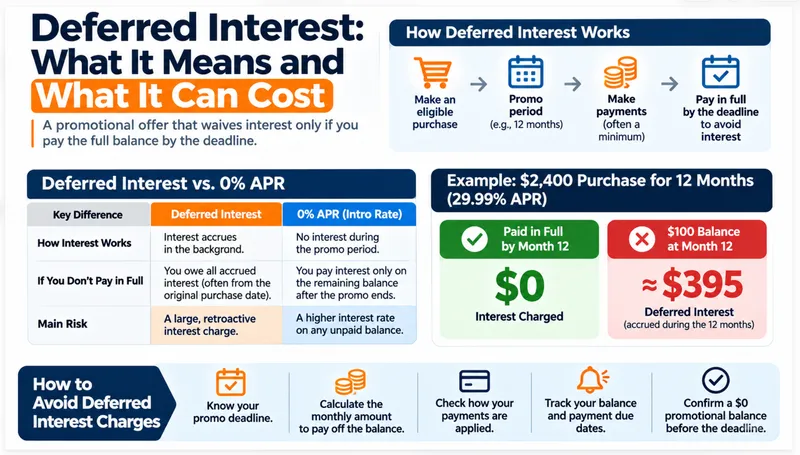
Consider a $2,400 appliance purchased with a 12-month deferred interest promotion at 29.99% APR. You make regular payments and reduce the balance to just $100 before the offer expires. Despite paying off nearly 96% of the purchase, you could still owe interest calculated from the original purchase date, not merely on the remaining $100. The exact charge depends on the account's balance history and financing terms.
The Consumer Financial Protection Bureau has repeatedly warned about the risks of deferred interest financing, particularly when consumers confuse these offers with traditional 0% introductory APR promotions. With deferred interest, failing to pay the promotional balance in full by the deadline can trigger interest charges dating back to the purchase. A standard 0% introductory APR offer generally applies interest only to the remaining balance after the promotional rate expires.
That difference matters when financing furniture, electronics, dental procedures, or emergency home repairs. A promotion designed to make a large purchase more manageable can create an unexpected expense if even a small balance remains.
This guide explains how deferred interest works, how lenders calculate the charges. What happens when you miss the payoff deadline, and how to determine whether a financing offer is worth accepting.
What Is Deferred Interest? How It Works and What You Could Owe
Deferred interest is interest that builds up during a promotion and disappears only if you pay the whole balance by the deadline. Picture a $2,400 appliance bought on a 12-month "no interest if paid in full" offer.
You pay on time all year and never miss a due date. Then, a month before the deadline, you open the statement and see $100 still unpaid.
That $100 triggers a bill for far more than $100. Depending on the contract, the issuer charges the interest it tracked quietly since day one on the balance you carried, and in this example that interest comes to $384.53.
Deferred interest is not a true 0% introductory APR. A 0% offer charges interest only on what remains after it ends, while a deferred-interest offer charges the interest it tracked all along.
This guide shows the math with a worked example, two calculators, and a payoff checklist. It also covers payment allocation, what to do after a charge, and how to tell a valid charge from a billing error.
What Is Deferred Interest?
Deferred interest is interest that accrues during a promotional financing period but is not charged if you meet the offer's repayment conditions. Pay the full promotional balance by the deadline and the interest is waived. Miss it and the accrued interest becomes payable.
Six terms control how it works. Each one shows up on your statement or in your agreement.
| Term | What It Means |
|---|---|
| Promotional purchase balance | The amount covered by the offer |
| Annual percentage rate (APR) | The rate used to calculate the interest that accrues in the background |
| Accrued interest | Interest tracked each month but not charged yet |
| Promotional expiration date | The deadline to pay the full promotional balance |
| Minimum monthly payment | The amount that keeps your account current, usually less than the amount needed to clear the balance |
| Full payoff requirement | The condition that waives the interest: the whole promotional balance paid by the deadline |
Minimum payments do not earn forgiveness. The CFPB states that minimum payments usually will not pay off the purchase before the period ends.
Retail cards use this structure often. The CFPB's December 2024 retail card analysis found the average promotional purchase was $637 and that about one fifth of deferred-interest promotional balances were charged retroactive interest, citing an earlier CFPB study.
How Does Deferred Interest Work?
You buy under the promotion, interest accrues each month, you make payments, and the issuer checks the balance on the deadline. A zero balance waives the accrued interest. Any remaining balance makes the accrued interest payable, counted from the purchase date.
- You make an eligible purchase. The offer names the minimum amount and the promotional period.
- The promotional period begins. The clock runs from the purchase date.
- Interest accrues. It builds each month at the stated APR and stays off your bill.
- You make required payments. The minimum keeps the account current. It rarely clears the balance.
- The issuer checks the balance at expiration. It looks for a zero promotional balance.
- Interest is waived or assessed. The contract controls the result.
What Does "No Interest If Paid in Full" Mean?
The word "if" carries the whole risk. "No interest if paid in full within 12 months" means interest is conditional, while "0% introductory APR for 12 months" means no interest accrues during the period at all.
Regulation Z backs this up for advertising. Under 12 CFR 1026.16(h), an ad that says "no interest" must show "if paid in full" next to the period and must state that interest will be charged from the date you became obligated if you do not pay in full.
Deferred Interest Example: What Happens If You Owe $100 After 12 Months?
In this hypothetical, a $2,400 purchase at 29.99% with $100 unpaid at month 12 triggers about $384.53 of accrued interest, not $29.99. The charge reflects a full year of interest on the balance you carried each month, not the final $100 alone.
The setup: you buy $2,400 on a 12-month deferred-interest offer with a 29.99% APR. You pay $200 for 11 months, then pay only $100 in month 12, leaving $100.
The schedule below uses one consistent method: interest on each month's starting balance for 30 days, at the APR divided by 365. Payments land at the end of each month, with no fees, no new purchases, and no compounding.
| Month | Starting Balance | Interest Accrued | Total Accrued | Payment | Ending Balance |
|---|---|---|---|---|---|
| 1 | $2,400 | $59.16 | $59.16 | $200 | $2,200 |
| 2 | $2,200 | $54.23 | $113.39 | $200 | $2,000 |
| 3 | $2,000 | $49.30 | $162.69 | $200 | $1,800 |
| 4 | $1,800 | $44.37 | $207.05 | $200 | $1,600 |
| 5 | $1,600 | $39.44 | $246.49 | $200 | $1,400 |
| 6 | $1,400 | $34.51 | $281.00 | $200 | $1,200 |
| 7 | $1,200 | $29.58 | $310.58 | $200 | $1,000 |
| 8 | $1,000 | $24.65 | $335.23 | $200 | $800 |
| 9 | $800 | $19.72 | $354.95 | $200 | $600 |
| 10 | $600 | $14.79 | $369.74 | $200 | $400 |
| 11 | $400 | $9.86 | $379.60 | $200 | $200 |
| 12 | $200 | $4.93 | $384.53 | $100 | $100 |
Scenario A vs. Scenario B
| Scenario A: Paid in Full | Scenario B: $100 Unpaid | |
|---|---|---|
| Last payment | $200 | $100 |
| Balance at the deadline | $0 | $100 |
| Accrued interest during the promotion | $384.53 | $384.53 |
| Deferred interest charged | $0, waived | $384.53 |
| Owed after expiration | $0 | $484.53 |
Both scenarios accrue the same interest. Only the final $100 decides whether it stays waived or lands on your account.
Do not multiply $100 by 29.99%. That shortcut gives $29.99 and misses the point entirely.
The CFPB's own hypothetical makes the same point: a $4,500 purchase with $180 unpaid at the end of a two-year promotion at 31.99% produces a $1,439.55 charge.
Deferred Interest Exposure Calculator
Deferred Interest vs. 0% APR: What's the Difference?
A true 0% introductory APR charges no interest during the promotion and charges the regular rate only on what remains afterward. Deferred interest tracks interest the whole time and charges all of it if you miss the payoff. The two offers are not interchangeable.
| Feature | 0% Introductory APR | Deferred Interest |
|---|---|---|
| Interest during the promotion | None accrues | Accrues each month in the background |
| Prior-period interest payable? | No | Yes, if the conditions are not met |
| Unpaid balance at expiration | Regular rate applies from the end date, on the remaining balance only | Accrued interest is added, charged back to the purchase date |
| Minimum payments | Required | Required, and usually too low to clear the balance |
| Promotional deadline | Rate changes on the end date | Full payoff due by the end date |
| Typical advertising language | "0% intro APR for 12 months" | "No interest if paid in full in 12 months" |
| Main financial risk | A higher rate on what is left | A large retroactive interest charge |
The CFPB's example shows the gap. On a $400 TV with $25 monthly payments at 25%, a 0% offer leaves you owing interest only on the $100 remaining, while deferred interest adds about $65 of accrued interest and leaves you owing $165.
How Is Deferred Interest Calculated?
Issuers apply the promotional APR to your balance as it stood each day or month during the promotion. A simplified estimate is balance times the APR divided by 365, times the days. The actual charge depends on the contract and the issuer's balance method.
Estimated interest over a constant-balance period = Balance × (APR ÷ 365) × Days
Five inputs drive the result: the promotional APR, the daily periodic rate, the balance subject to interest, the number of days, and payment timing. The monthly schedule above applies the formula to a falling balance, which is why the accrued total is far larger than a one-line multiply of the leftover amount.
For the full guide to daily periodic rates and average daily balance, read our purchase APR article. This page covers only the promotional mechanics.
How to Pay Off Deferred Interest Before the Deadline
Divide the promotional balance by the number of payments left before the deadline, and pay that amount every month. Finish at least one month early. Confirm the balance reads $0 on the statement before the expiration date.
- Find the exact expiration date. Look on the front page of your statement or in your agreement.
- Check the remaining promotional balance. Use the promotional line, not the total balance.
- Count your payment opportunities. Include only payments that post before the deadline.
- Divide the balance by the payments left. That is your monthly target.
- Check how the issuer allocates payments. The next two sections explain why this matters.
- Schedule the final payment early. Allow for posting time and weekends.
- Verify the promotional balance reaches zero. Check the next statement, not just your bank record.
Paying early protects you from one late or misposted payment sinking the offer. A one-month cushion costs a slightly larger payment, and the next table shows how much.
Deferred Interest Payoff Calculator
| Purchase Balance | Promotional Period | Equal Monthly Principal Payment |
|---|---|---|
| $1,200 | 6 months | $200 |
| $2,400 | 12 months | $200 |
| $3,600 | 18 months | $200 |
Why Minimum Payments Often Don't Pay Off Deferred Interest
A minimum payment is a contractual floor that keeps your account current. It is not calculated to clear your promotional balance by the deadline. The amount you need, the amount you owe, and the amount allocated to the promotion are three different numbers.
Take the $2,400 purchase over 12 months: clearing it takes $200 a month. A hypothetical $60 minimum covers $720 over the year and leaves $1,680 unpaid, with all of the accrued interest on the way.
Do not assume your program uses a formula like this one. Minimum payment rules vary by issuer and product, so compare your statement's minimum to the monthly target in the calculator.
What Happens If You Miss a Deferred Interest Payment?
Missing one payment triggers a late fee and possible interest consequences, but it does not automatically cancel the promotion. A minimum payment more than 60 days late is the serious threshold. Missing the payoff deadline or leaving any balance makes the accrued interest payable.
| What Happens | Typical Consequence |
|---|---|
| One late payment | A late fee and a possible late-payment report. Check your agreement for the promotion terms. |
| A payment more than 60 days late | The CFPB warns this puts the deferred interest period at risk. Regulation Z requires ads to disclose that default before the period ends brings interest from the date the balance was incurred. |
| Missing the payoff deadline | Accrued interest becomes payable, charged from the purchase date |
| Failing to pay in full | Same result: any remaining promotional balance triggers the charge |
Late payments carry a credit-reporting cost too. A payment reported 30 or more days late damages payment history, which FICO weights at 35% of the score, according to myFICO.
How Do Credit Card Payments Apply to Deferred Interest Balances?
Minimum payments follow the issuer's terms. Amounts above the minimum go first to the highest-APR balance, except during the final two billing cycles before expiration, when the excess must go first to the deferred-interest balance under Regulation Z, 12 CFR 1026.53.
Here is the practical problem. If your account holds a deferred-interest balance and a higher-rate balance, the CFPB says extra payments go to the higher-rate balance first until the last two billing cycles of the promotion.
Regulation Z adds a second rule: under 1026.53(b)(1)(ii), an issuer is permitted, at its option, to allocate excess payments the way you request, but it is not required to. Preprinted terms or a preselected checkbox do not count as a valid request.
The official commentary also counts a cycle among the last two only if the promotion expires before that cycle's payment due date. This is why you confirm the dates with your issuer instead of counting on your own.
- ✓Ask: "Which balance receives payments above the minimum right now?"
- ✓Ask: "Will you apply my extra payments to the deferred-interest balance before the final two cycles?"
- ✓Ask: "Which billing cycles count as the final two for my promotion?"
- ✓Ask: "What exact amount clears the promotional balance on the expiration date?"
Where Do You Find Deferred Interest on Your Credit Card Statement?
Look on the front page of your statement for the promotional balance, the deferred-interest end date, and the APR that applies if you miss it. The CFPB says that end date is not always your payment due date. Some issuers also list accrued interest.
| Statement Line | Sample Entry | What It Tells You |
|---|---|---|
| Payment due date | 04/08/2027 | When this month's minimum is due |
| Promotional expiration date | 11/15/2027 | The deadline to pay the promotional balance in full |
| Promotional purchase balance | $1,600.00 | The amount that must reach $0 |
| APR if not paid in full | 29.99% | The rate used to calculate accrued interest |
| Accrued deferred interest | $207.05 | Interest tracked so far (shown by some issuers) |
| Minimum payment due | $60.00 | The floor, below the $200 a month needed |
| Remaining amount to avoid interest | $1,600.00 | What you must pay by the expiration date |
The payment due date and the promotional deadline are two separate dates. You make the minimum payment by the due date every month, and you clear the promotional balance by the expiration date.
What Should You Do If Deferred Interest Was Already Charged?
Check the agreement, the expiration date, payment posting dates, and the allocation of your payments. Reconcile the charge, then ask the issuer to explain it. Dispute only a real billing error. A correctly assessed contractual charge is not a billing error.
- Review the promotional agreement. Find the terms for the deadline and the interest method.
- Confirm the exact expiration date. Compare it to your statement.
- Check payment posting dates. A payment that posted late changes the result.
- Review the balance and payment allocation. Confirm where each payment went, especially in the last two cycles.
- Reconcile the interest calculation. Rebuild it with the monthly method above and compare.
- Contact the issuer for an explanation. Ask for the balance history behind the charge.
- Dispute a real billing error. The CFPB says to send written notice within 60 calendar days after the charge appeared on your statement.
- Escalate unresolved issues. Submit a complaint to the CFPB complaint system.
Does Deferred Interest Affect Your Credit Score?
Deferred interest is not itself a credit-scoring factor. Its consequences are. Unpaid interest raises the reported balance and your credit utilization, and late payments or delinquency damage payment history.
Accepting a deferred-interest offer does not automatically lower a score. A new account does add an inquiry, which myFICO says costs about 5 to 10 points on average, but the offer itself is not scored.
The score effect starts when the charge lands: accrued interest posts to the account, the reported balance jumps, and utilization rises. FICO weights amounts owed at 30% of the score and payment history at 35%, according to myFICO.
Deferred Interest vs. Purchase APR: Which One Applies to Your Credit Card?
Both apply to the same purchase. Purchase APR is the annualized interest rate on your balance, while deferred interest describes promotional terms that decide whether accrued interest becomes payable.
A deferred-interest offer references an APR to calculate the accrued charge. Our purchase APR guide covers rates and daily interest, and our article on the best credit cards with no interest compares true 0% offers.
Which Promotional Offer Fits Your Situation?
| Your Situation | Better Fit | Why |
|---|---|---|
| You will pay in full well before the deadline | Either offer | Both cost $0 in interest if you finish on time |
| You want flexibility on timing | True 0% APR | Interest applies only to what remains, not retroactively |
| Your budget is tight or variable | True 0% APR, or a smaller purchase | A missed final payment on a deferred plan costs the most |
| The retailer offers only deferred interest | Set a payoff plan first | Divide the balance by the months and automate the payment |
| You cannot meet the monthly target | Skip the promotion | The risk exceeds the benefit |
When Credit Report Errors Appear After a Deferred Interest Charge
A valid deferred-interest charge is not a credit-reporting error. If you missed the payoff, the interest is a legitimate account balance and reports as one.
An error is different. A wrong balance, a payment status showing late when you paid on time, a wrong date, or an account that is not yours counts as inaccurate reporting.
Our guides on disputing credit report errors and the TransUnion dispute process show the steps.
Is Your Credit Report Showing the Wrong Balance or Payment Status?
A deferred-interest charge and a credit-reporting error are different problems. Review your credit reports to identify inaccurate balances, payment histories, or account details before deciding what to dispute.
Review My Credit Report → Secure · 2 minutes · No credit card requiredFrequently Asked Questions About Deferred Interest
What does deferred interest mean?
Deferred interest means interest that accrues during a promotional period but is not charged if you pay the full promotional balance by the deadline. If you miss it, the issuer charges the interest that built up, counted from the purchase date. It differs from a true 0% APR.
Is deferred interest the same as 0% APR?
No. A true 0% APR accrues no interest during the promotion and charges the regular rate only on the remaining balance afterward, while deferred interest accrues the whole time and becomes payable if any balance remains at the deadline. The CFPB treats them as different offers with different risks.
What happens if you don't pay deferred interest in full?
The issuer charges the interest that accrued on your balance during the promotion, back to the purchase date. In our $2,400 example at 29.99%, a $100 shortfall brings about $384.53 of accrued interest. The regular rate then applies to what remains.
Is deferred interest charged retroactively?
Yes, when you miss the payoff. The CFPB says interest is charged for each month on the balance you owed during the period, going back to the purchase date. The CFPB's December 2024 retail card analysis cites about one fifth of deferred-interest balances being charged retroactive interest in an earlier study.
How is deferred interest calculated?
A simplified estimate is balance times APR divided by 365, times the days, applied to your balance each month of the promotion. Actual charges depend on your issuer's contract and balance method. Use the exposure calculator above for an estimate, and ask your issuer for the real figure.
Does deferred interest affect your credit score?
Not directly, because deferred interest is not a scoring factor. If it posts, it raises your balance and utilization, and late payments damage payment history. According to myFICO, amounts owed carry 30% of a FICO score and payment history carries 35%.
Do minimum payments avoid deferred interest?
Rarely. The CFPB states that minimum payments usually will not pay off the purchase before the period ends, and only paying the full promotional balance by the deadline waives the interest. Divide the balance by the months left to find your real target.
What happens if you miss one payment?
You owe a late fee, and the payment affects your credit if it reports as late. A single late payment does not automatically cancel the promotion. The CFPB warns that a minimum payment more than 60 days late puts the deferred interest period at risk, so check your agreement.
Where is deferred interest shown on a statement?
Look on the front page for the promotional balance, the expiration date, and the APR that applies if you miss the deadline. The CFPB notes that the end date is not always your payment due date, and some issuers list accrued deferred interest.
How do you avoid deferred interest charges?
Divide the promotional balance by the months left and pay that amount every month. Finish at least one month early and ask your issuer to apply extra payments to the promotional balance. Verify the balance reads $0 on your statement before the expiration date.
Is deferred interest legal?
Yes, federal rules regulate it instead of banning it. Regulation Z, 12 CFR 1026.16(h), requires ads to state the period, show "if paid in full" next to "no interest," and disclose that interest is charged from the purchase date if you miss the payoff, while section 1026.53 governs payment allocation.
What should you do if deferred interest was charged incorrectly?
Confirm the expiration date, payment posting dates, and payment allocation, then ask the issuer to explain the charge. For a true billing error, send written notice within 60 calendar days after the charge appeared on your statement. If the issuer does not resolve it, submit a CFPB complaint.
Deferred interest is a deadline in disguise. Find the date, divide the balance, and pay early, so the promotion stays what it was sold as.
-
What Is Purchase APR? How Credit Card Interest Really Works Daily periodic rates, grace periods, and interest calculations.
-
Best Credit Cards With No Interest How true 0% offers compare.
-
Credit Report Correct but Denied? 7 Reasons Why What lenders weigh beyond the accuracy of your report.
-
How to File a TransUnion Dispute & Fix Credit Report Errors The dispute steps once you spot an inaccurate entry.
- Consumer Financial Protection Bureau — What is deferred interest?
- Consumer Financial Protection Bureau — Credit card promising no interest if paid in full within 12 months
- Consumer Financial Protection Bureau — How to understand special promotional financing offers on credit cards
- Consumer Financial Protection Bureau — Issue Spotlight: The High Cost of Retail Credit Cards (December 18, 2024)
- Consumer Financial Protection Bureau — Disputing a charge on your credit card bill
- Regulation Z — 12 CFR 1026.53, allocation of payments
- Regulation Z — 12 CFR 1026.16, advertising
- Consumer Financial Protection Bureau — Submit a complaint
- myFICO — What is in your credit score
- myFICO — How hard inquiries work