

How long to respond to debt summons depends on your state. But in most cases, the window is short, often between 14 and 35 days from the date you were served.
Miss that deadline, and the collector may ask the court for a default judgment. That can lead to wage garnishment, bank levies, or liens, depending on state law. The clock moves faster than most people realize.
I own a credit repair company, and my honest opinion is this, "Ignoring a debt summons is one of the worst financial mistakes a person can make". I have seen people freeze because the paperwork feels intmidating. They delay, hoping the problem will go away. It does not. What should have been a manageable legal response becomes a judgment with far fewer options.
In most cases, simply responding on time changes the entire outcome because it forces proof, opens negotiation, or creates room to defend the claim.
What stands out to me is how often consumers think answering means admitting guilt. It does not. A response is not surrender. A response is how you protect your rights. Debt buyers and collection law firms count on silence because silence is easier to win against. That is the truth.
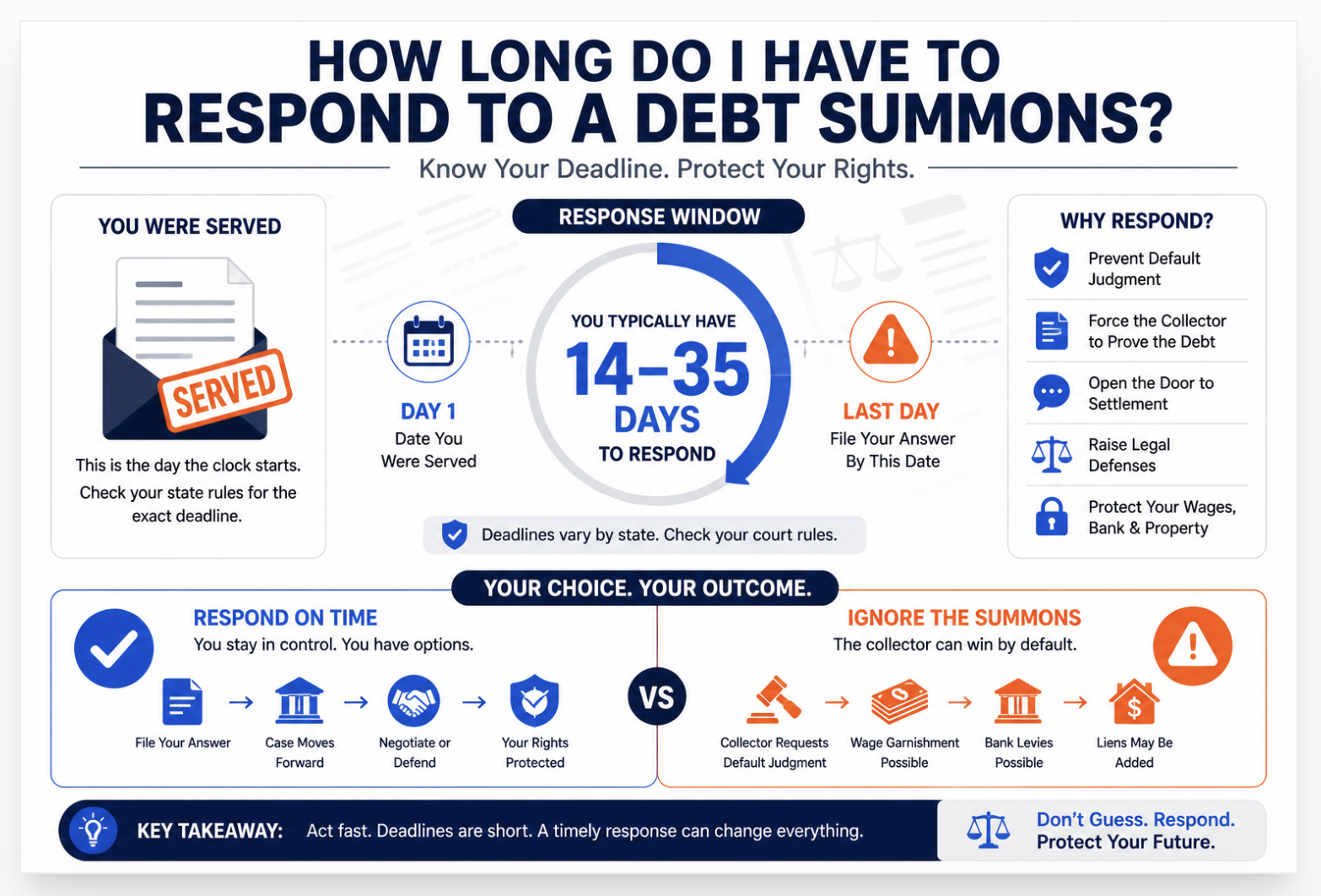
My view is simple, "The day you are served is the day you start working on your response". Not next week. Not after stress settles down. That day.
This guide explains how long to respond to a debt summons, what deadlines usually apply, and what actions protect you immediately.
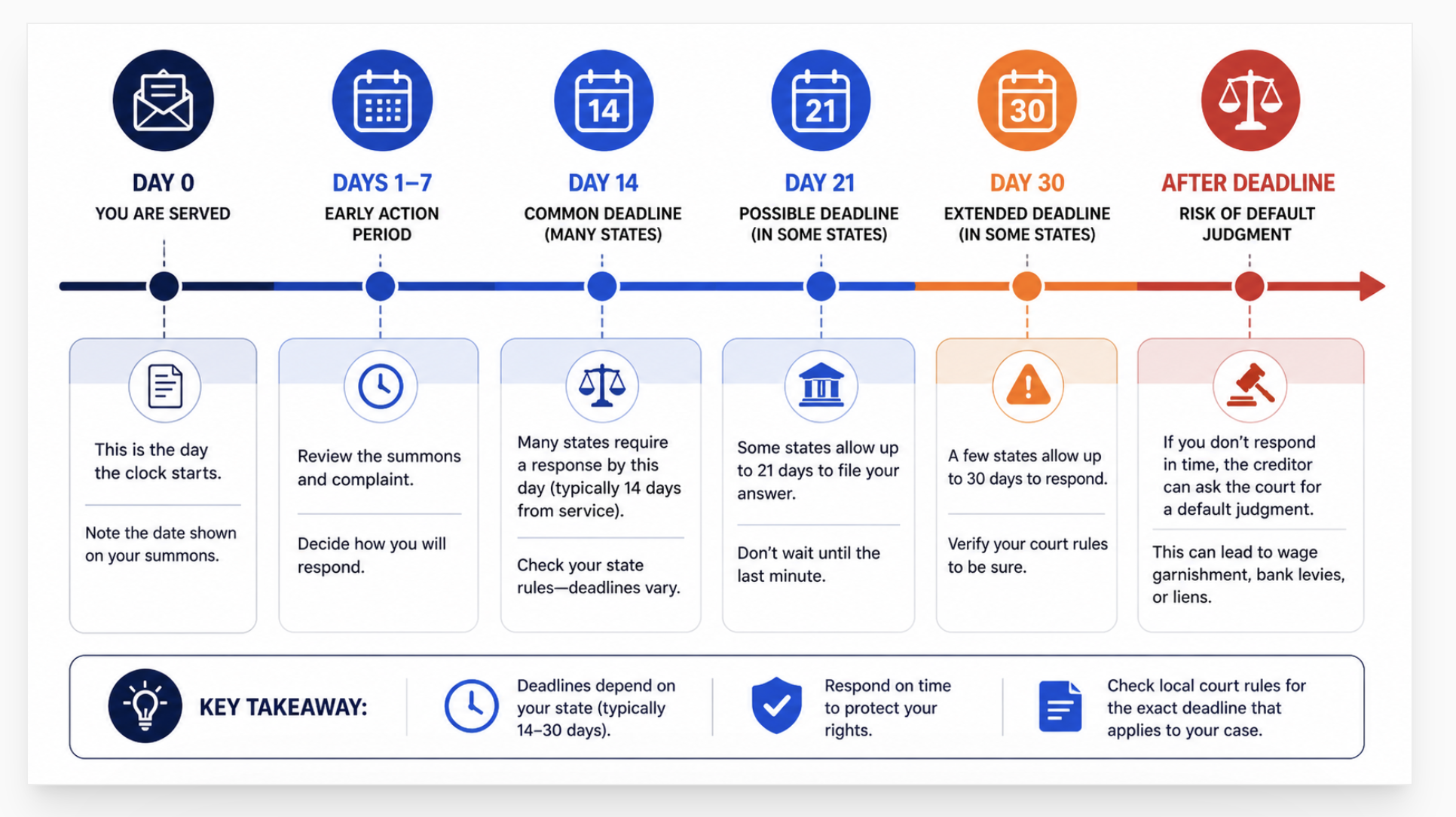
How Long To Respond to Debt Summons: Timeline
Last quarter alone, we worked with 33 clients who received debt collection summonses. Nine of those clients had already missed their response deadline before contacting us. In every one of those nine cases, the collector had already filed for a default judgment. Seven of the nine had valid defenses , wrong amount, wrong person, or an expired statute of limitations , that a timely response would have raised. Those defenses disappeared the moment the deadline passed. Responding is the only move that keeps every option open.
How Long Do I Have to Respond to a Debt Summons?
The deadline to respond to a debt collection summons depends on your state. Most states allow 20 to 30 days from the date you receive the summons. Federal courts give 21 days uniformly. The clock starts on the day you are served , not when the collector filed the lawsuit. Check the deadline printed on your summons first, then verify it against your state's civil procedure rules.
A debt collection summons arrives with two documents: the summons and the complaint. The summons states the deadline to respond. The complaint lists the specific allegations against you. Read both immediately.
The most important number on the summons is not the dollar amount the collector claims. It is the response deadline. That date controls whether you get to participate in the case at all.
As the CFPB confirms, responding to a debt collection lawsuit is one of the most important consumer rights actions you can take. Not responding eliminates every defense you have, including defenses the collector cannot overcome if you raise them in writing.
Response Deadlines by State , Key Examples
| State | Response Deadline | Notes |
|---|---|---|
| California | 30 days | From the date of service |
| Texas | 14 days (small claims) / 20 days (district) | Varies by court. Check your summons. |
| Florida | 20 days | From date of service per Fla. R. Civ. P. 1.140 |
| New York | 20 days (personal service) / 30 days (mail/other) | Service method controls the deadline |
| Illinois | 30 days | From the return date on the summons |
| Georgia | 30 days | From date of service |
| Colorado | 21 days | Colo. R. Civ. P. 12(a) |
| Washington | 20 days | Wash. R. Civ. P. 12(a)(1-2) |
| Wisconsin | 20 days | Wis. R. Civ. P. 802.06(1)(a) |
| Delaware | 15 days (JP Court) / 20 days (other courts) | Court type determines deadline |
| Federal Court (all states) | 21 days | Fed. R. Civ. P. 12(a) , uniform nationwide |
Most states give 20 to 30 days. Twenty days is the most common deadline across 22 states. Federal courts give 21 days uniformly. The clock starts on service date , when you received the documents, not when they were filed or mailed. Some states count only business days. Others count all calendar days. Verify your state's counting method before calculating the deadline.
What Happens If You Ignore a Debt Summons
Ignoring a debt summons produces an automatic default judgment. The collector wins without presenting evidence. A default judgment gives them legal authority to garnish your wages, freeze your bank accounts, and seize certain property depending on your state. The judgment also appears as a public court record. Every defense you had , wrong amount, wrong person, expired statute of limitations , disappears the moment the deadline passes without a response.
Default judgment is the collector's best outcome. It requires no court hearing, no evidence review, and no proof that the debt is yours, the amount is accurate, or the statute of limitations has not expired. The court simply notes that the defendant did not respond and enters judgment in the plaintiff's favor.
Per Nolo's debt collection lawsuit guide, once a default judgment enters, collectors gain immediate legal tools. In most states those tools include wage garnishment (typically 25% of disposable weekly income), bank account levies, and in some states property liens. These happen without further court involvement once the judgment exists.
The damage to your credit report compounds the financial damage. A court judgment appears as a public record on your Equifax, Experian, and TransUnion reports. Court judgments stay on credit reports for seven years and suppress scores significantly , often 50-100 points from the judgment alone, on top of whatever the underlying collection already caused.
How to Respond to a Debt Collection Summons
Read the summons and locate the response deadline date. Write it on a calendar. Set a phone reminder for 5 days before that date. Then verify the deadline independently: look up your state's rules of civil procedure and confirm the number of days. Count from the day you received the documents , not the filing date or the postmark date. If the final day falls on a weekend or court holiday, most states extend the deadline to the next business day. Confirm this for your specific state.
Under the FDCPA, you have the right to request debt validation. Send a certified mail letter to the collector's attorney requesting proof that the debt is yours, the amount is accurate, and they have legal standing to collect it. This creates a paper trail and may produce documentation gaps that support your written answer. Sending a validation letter does not replace filing your court answer , these are separate processes. The validation letter goes to the collector. The answer goes to the court.
Your answer must address every numbered paragraph in the complaint. For each claim: admit it, deny it, or state you lack sufficient knowledge to respond. Most defendants deny all claims and assert affirmative defenses. Common defenses: the debt is not yours, the amount claimed is wrong, the statute of limitations expired, you already paid, the collector lacks standing to sue, or you received improper service of the summons. List every defense that applies. Courts do not apply defenses you fail to raise. Your answer form is available from your state court's clerk office or website , many courts provide free blank forms for debt collection cases.
Take the completed answer to the clerk of the court listed on your summons. Pay any required filing fee , most states charge $30-$200 to file an answer in a debt collection case. Request a file-stamped copy for your records. Then mail or hand-deliver a copy of the filed answer to the plaintiff's attorney at the address shown on the complaint. Both steps are required. Filing with the court alone, without serving the plaintiff, is often treated as incomplete. Your state's rules of civil procedure govern the specific service method required.
Filing your answer buys time. Most debt collection cases never reach trial , they settle. Your filed answer signals to the collector's attorney that you intend to contest the lawsuit. Many collectors accept a negotiated settlement for 40-60% of the claimed balance once they see the case requires actual litigation. Contact the plaintiff's attorney after filing your answer. Open settlement discussions. Make a written offer. Our full guide on debt collection defense strategies covers the negotiation sequence, what leverage a filed answer creates, and how to structure a settlement offer that reduces the balance and protects your credit report simultaneously.
Sample Answer to a Debt Collection Summons
IN THE [Name of Court]
[County/District], STATE OF [Your State]
[Collector Name], Plaintiff,
v.
[Your Full Name], Defendant.
Case No.: [Case Number from Summons]
DEFENDANT'S ANSWER TO COMPLAINT
Defendant [Your Name] responds to the Plaintiff's Complaint as follows:
1. Defendant denies each and every allegation in Paragraph 1 of the Complaint.
2. Defendant denies each and every allegation in Paragraph 2 of the Complaint.
[Continue for each numbered paragraph in the complaint]
AFFIRMATIVE DEFENSES
1. Lack of Standing. Plaintiff has not established legal ownership of the alleged debt or the right to sue on it.
2. Statute of Limitations. The alleged debt falls outside the applicable statute of limitations for this type of debt in [State].
3. Incorrect Amount. Defendant disputes the accuracy of the amount claimed.
4. Not My Debt. Defendant has no knowledge of the alleged account or obligation.
Defendant requests that this Court dismiss the Complaint and award any other relief the Court deems just.
Respectfully submitted,
[Your Signature]
[Your Printed Name]
[Your Address]
[Date]
Responding to a debt summons requires five steps: find and verify the exact deadline, send a validation letter to the collector, draft a written answer denying all claims and asserting every applicable defense, file the answer with the court before the deadline, and send a copy to the plaintiff's attorney. Filing your answer opens settlement negotiations from a position of strength. Not filing eliminates every defense you have.
What Defenses Can You Raise Against a Debt Collector in Court
Collectors file lawsuits expecting default judgments. They count on defendants not responding. When you file an answer, you force the collector to actually prove their case , and that proof is often harder to produce than it sounds.
Statute of Limitations , The Most Overlooked Defense
Every state sets a time limit on how long a creditor or collector can sue to collect a debt. After that period expires, the debt is time-barred. The collector loses the legal right to win a lawsuit , but only if you raise the expired statute as a defense.
Statute of limitations periods range from 3 to 10 years depending on debt type and state. Credit card debt statutes run 3 to 6 years in most states. Written contract debt runs 4 to 10 years. The clock typically starts from the date of the last payment or the date the account became delinquent.
As the FTC's debt collection rights guide explains, time-barred debts still appear on credit reports and collectors can still try to collect them voluntarily , but they cannot win a court judgment on them. If you never respond to the summons, that legal protection disappears.
Lack of Standing to Sue
Debt buyers purchase portfolios of accounts from original creditors, often in bulk with minimal documentation. The chain of ownership from the original creditor to the current collector frequently contains gaps. At trial, the collector must prove they legally own the debt. Many debt buyers cannot produce the original account agreement, the complete payment history, or an unbroken chain of title from the original creditor through every subsequent sale.
Raising lack of standing as a defense in your answer puts the burden of proof on the collector. If they cannot produce documentation , and many cannot , their case fails on its merits. Last quarter, we identified 8 ASAP Credit Repair clients whose debt lawsuit cases were dismissed because the collector could not produce proof of ownership during discovery after a contested answer was filed.
Improper Service
Debt collectors sometimes serve summonses improperly: leaving papers with the wrong person, failing to mail a copy when required, serving at the wrong address, or using a process server who does not follow state-specific rules. Each state defines proper service. An improperly served summons may allow you to challenge whether your deadline even started running. Improper service is a procedural defense , it does not eliminate the debt but may require the collector to re-serve you and restart the clock.
Check your credit reports at all three bureaus while dealing with a debt lawsuit. The collection account driving the lawsuit may contain inaccuracies , wrong balance, wrong original delinquency date, or a duplicate entry , that are disputable separately from the lawsuit itself. Resolving the credit report entry independently of the lawsuit outcome protects your score regardless of how the case resolves.
Can You Negotiate After Receiving a Debt Summons?
Yes. Receiving a summons does not prevent settlement. File your written answer first to protect your rights, then open settlement negotiations with the collector's attorney. Most debt collection cases settle before trial, often at 40-60% of the claimed balance. Your filed answer signals you will contest the lawsuit, which motivates many collectors to settle rather than pursue litigation that requires producing documentation they may not have.
Debt buyers pay 1-10 cents per dollar for purchased debt portfolios. Any settlement above that purchase price produces profit for the collector. A collector who paid $300 for a $3,000 balance settles for $900 at a $600 profit , that outcome motivates negotiation.
Settlement negotiations happen in two stages after a summons. First, before your answer deadline: contact the collector's attorney and make an offer. If they accept, get the agreement in writing before the deadline. If negotiations stall, file your answer before the deadline passes. Second, after your answer files: negotiations continue while the case proceeds. Many cases settle during discovery , the period after filing where each side requests documents , when collectors realize they cannot produce the required proof.
Never skip filing your answer to pursue a settlement. If settlement talks fail and your deadline passed, you get a default judgment. The collector gets everything they asked for. Your negotiating position disappears with the deadline.
How long do I have to respond to a debt summons?
Most states give 20 to 30 days from the date of service. Twenty days is the most common deadline across 22 states. Federal courts give 21 days uniformly. Some states vary by court type or service method , New York gives 20 days for personal service and 30 days for mail service. Always check the deadline printed on your summons, then verify it against your state's civil procedure rules. Missing the deadline by one day produces an automatic default judgment.
Can I get more time to respond to a debt summons?
Yes, in some cases. You can request an extension from the court or, more commonly, from the plaintiff's attorney. Many attorneys grant a 10-30 day extension by mutual agreement, especially if you reach out promptly and explain your situation. Request any extension in writing. Confirm the extended deadline in writing from the plaintiff's attorney. Never rely on a verbal agreement to extend a court deadline. If the extension is denied and the deadline approaches, file your answer , even an incomplete one , to prevent default judgment while you gather more information.
Do I need a lawyer to respond to a debt summons?
No. You can file your own answer without a lawyer. Courts accept pro se (self-represented) responses in debt collection cases. The answer form is often available from the court clerk's office or the court's website. Denying all claims and listing affirmative defenses in a plain, organized format satisfies the basic requirements. A consumer law attorney adds value for complex cases, large balances, or cases involving clear FDCPA violations , but the most important action is filing something before the deadline, with or without legal help.
What if I already missed the debt summons deadline?
Contact the court immediately. If the collector has not yet filed a motion for default judgment, you may still file your answer and ask the court to accept it late. Courts sometimes accept late filings if you provide a valid reason for missing the deadline. If a default judgment already entered, you can file a motion to vacate the default , a formal request to set aside the judgment. Courts grant motions to vacate when the defendant shows a meritorious defense (a valid reason to contest the debt) and a reasonable explanation for missing the deadline. Act quickly: the longer you wait after a default judgment, the harder it is to vacate.
A Debt Lawsuit Affects More Than Just the Case , It Hits Your Credit Report Too
The collection account driving the lawsuit may contain errors that are disputable separately from the court case. A free 3-bureau audit shows every entry on your Equifax, Experian, and TransUnion reports , including any inaccuracies on the account that led to the summons.
Get My Free 3-Bureau Audit → Secure · 2 minutes · No credit card required-
Debt Collection Defense: Your Rights and How to Use Them Filing your answer to a debt summons is the first defensive move. This covers the complete set of tools available after that: FDCPA violations that cost collectors $1,000 per incident, the debt validation request that forces them to prove ownership, the cease-and-desist letter that stops all calls, and the negotiation framework that reduces balances before or after a lawsuit files.
-
Pay-for-Delete Letter: What It Is, When It Works, and Exactly How to Write One Many debt lawsuits settle before trial. When they do, the settlement terms can include deletion of the collection tradeline from all three bureaus , not just a zero balance. This covers the pay-for-delete strategy, how to negotiate deletion as part of a lawsuit settlement, what language to include in the written agreement, and what the score impact looks like when a judgment-related entry is removed versus left as a paid collection.
-
Revco Solutions: How Accounts Land in Collections and What to Do Medical debt collectors like Revco Solutions file lawsuits for unpaid hospital balances, often on accounts the patient disputes. This covers the exact dispute and validation process for medical collection lawsuits, the special rules around medical debt reporting, and how to handle a summons from a medical collector who may not be able to produce the original itemized billing that proves the amount they claim.