

Most people do not discover IQ Data International while casually checking their credit.
They find it when something important is on the line.
A mortgage application.
An apartment approval.
A loan review.
That timing matters. The real problem is not the collection itself.
The problem is the friction it creates during underwriting.
I have seen borrowers spend months improving their scores only to discover an apartment collection standing between them and mortgage approval. In many cases, the score was not the biggest issue. The collection account was.
That is why IQ Data International deserves a different conversation than most collection agencies.
The question is not:
"Who is IQ Data International?"
The real question is:
"Will this account stop my loan from getting approved?"
This article answers that question and explains what options may exist before underwriting begins.
Can IQ Data International Hurt Mortgage Approval?
Yes, an IQ Data International collection can create underwriting friction during a mortgage application. Depending on the loan type, collection amount, reporting accuracy, and lender guidelines, the account may affect approval, interest rates, or additional documentation requirements.
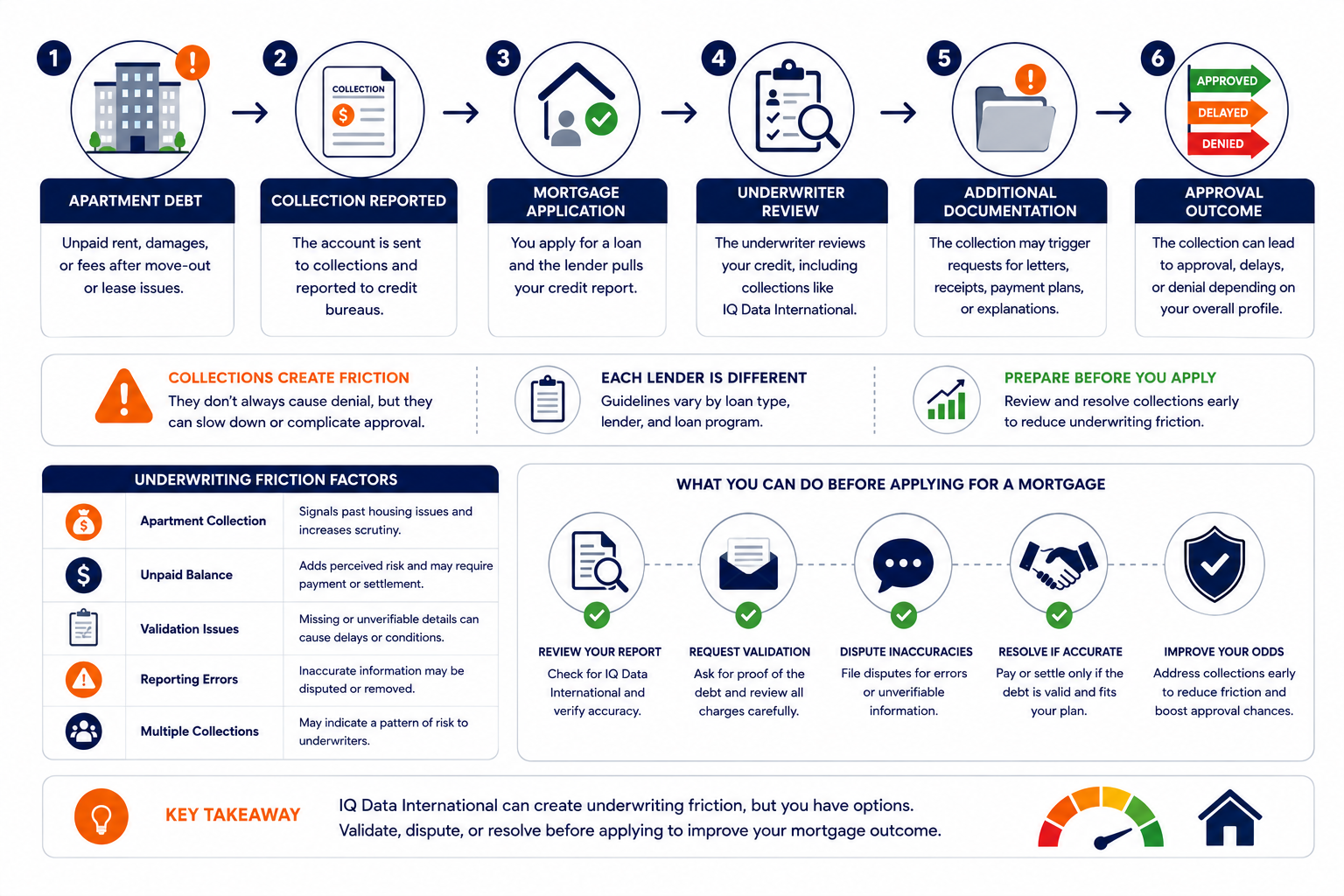
Why Mortgage Lenders Care About Collection Accounts
Mortgage lenders evaluate collections as evidence of how you handle financial obligations. An unpaid collection signals the lender that you have walked away from a debt before. For the underwriter, the question is not just whether it hurt your score. The question is whether it reveals something about how you might handle mortgage payments if money gets tight.
Collections create uncertainty. Underwriters do not like uncertainty. Their job is to evaluate risk , and any unresolved obligation in your credit history is a question mark they need to answer before recommending approval.
What makes an apartment collection uniquely uncomfortable for underwriters is the type of debt it represents. A credit card collection means you stopped paying a revolving debt. That is bad. An apartment collection means you stopped paying rent , or you left housing costs unresolved. That hits directly at the question the underwriter is trying to answer: will this person pay their mortgage?
The two questions are not the same. Mortgage underwriters treat housing payment history as a separate risk category. A single apartment collection can receive more scrutiny than multiple credit card collections of similar size.
Why IQ Data International Appears on Credit Reports
IQ Data International appears on credit reports because they purchased or were assigned an unpaid apartment-related balance from a former landlord or property management company. They exclusively serve the multi-family housing industry. The debt typically involves unpaid rent, move-out cleaning fees, lease termination charges, or utility balances. Many consumers dispute whether the charges are accurate , IQ Data has 350+ CFPB complaints, most centered on inaccurate reporting and failure to validate charges with itemized documentation.
IQ Data International Inc. was founded in 2003 and operates from Everett, Washington. The company also operates under the name RentCollect Global at the same address with the same ownership , which means consumers may see either name on their credit report for the same underlying debt.
The most important thing to know about IQ Data's collection model: they sometimes report to credit bureaus before ever notifying the consumer. Multiple BBB complaints from 2024 and 2025 describe consumers discovering an IQ Data collection on their credit report without ever receiving a letter, call, or any prior communication.
This practice is called debt parking. Under CFPB Regulation F , effective November 2021 , reporting a debt to credit bureaus without first attempting to communicate with the consumer is explicitly prohibited. If IQ Data reported your account without prior notice, that may constitute an active Regulation F violation, giving you specific dispute rights beyond standard FCRA claims.
How IQ Data International Creates Underwriting Friction
Underwriting friction from an IQ Data collection typically appears in three forms: additional documentation requests, conditions attached to approval, or outright denial depending on the loan type and lender. The apartment-specific nature of the debt is what makes the friction different from other collections. Underwriters treat prior housing obligations as direct predictors of mortgage payment behavior , a different and heavier weighting than general consumer debt.
Friction takes several forms during underwriting.
Letter of explanation. The underwriter may accept the collection but require a written explanation of what happened, why the debt remains unpaid, and evidence it is disputed or in resolution.
Required payoff before closing. Many lenders set collection thresholds. An unpaid apartment collection over a certain balance triggers a mandatory payoff condition before the loan closes. The lender sets this number based on their own overlays , which may be stricter than FHA or Fannie Mae guidelines.
DTI calculation inclusion. If the underwriter determines the collection balance must be counted in your debt-to-income ratio, your qualifying income thresholds change. A $1,700 IQ Data balance at a minimum monthly payment estimate can affect how much house you can afford even before closing.
Manual underwriting trigger. Automated underwriting systems may pass a file. Then a human underwriter sees the apartment collection and places the file in manual review , which takes longer, requires more documentation, and carries a higher risk of denial.
Can Apartment Collections Stop Mortgage Approval
Apartment collections do not automatically block every loan. The outcome depends on the loan type, the collection balance, whether it is paid or unpaid, and the specific lender's policies. FHA gives individual lenders wide discretion , and many require apartment collections to be paid. Conventional loans may exclude individual small collections from DTI, but lender overlays can be stricter. The safest position is always to address the collection before applying.
FHA guidelines do not technically require collection accounts to be paid. But individual FHA-approved lenders set their own overlays. Most FHA lenders require apartment collections to be paid or in an active payment plan before closing. An unpaid IQ Data balance over $1,000 almost always triggers a payoff condition at FHA lenders. The underwriter may also factor the collection into residual income calculations.
Fannie Mae guidelines allow individual non-medical collections under $2,000 to be excluded from DTI calculations , but the collection still appears in the file. The underwriter still sees it. Many conventional lenders apply their own overlays requiring explanation or payoff regardless of the guideline threshold. Multiple collections, or an apartment collection alongside a derogatory mortgage history, increase the friction significantly.
VA and USDA underwriters have more discretion than FHA. The presence of a collection alone does not block approval. The underwriter evaluates the overall credit picture , whether the collection is isolated, whether other payment history is strong, and whether the borrower provides a credible explanation. An apartment collection still raises a housing history question, but a strong compensating file can overcome it.
Every lender publishes guidelines that may be stricter than what the loan programs technically require. A lender may require all collections paid, regardless of whether Fannie Mae would allow exclusions. Overlays are the most common reason a borrower passes the guideline test but still gets a conditional denial. Shop multiple lenders if one applies an overlay that blocks your file.
As NerdWallet's 2026 FHA loan requirements guide confirms, each FHA-approved lender sets its own standards beyond the FHA minimums , including how they treat collection accounts. The FHA guideline is not the ceiling; it is the floor. Individual lenders routinely require more.
How to Remove IQ Data International From Your Credit Report
Get your reports at AnnualCreditReport.com. Find the IQ Data account on each bureau that shows it. Note the original delinquency date, the reported balance, and whether the original landlord or property management company also shows a separate charge-off entry. Both appearing together may represent a duplicate negative entry , disputable as a reporting inaccuracy.
Free | Do this first on every pathUnder CFPB Regulation F (effective November 2021), collectors must attempt to communicate with the consumer before reporting a debt to credit bureaus. If IQ Data placed the account on your report without any prior letter, call, or email, that is debt parking , a potential Regulation F violation. Document when you first saw the account on your report. Compare that date against any communication you received from IQ Data. If reporting preceded communication, file a CFPB complaint immediately alongside your dispute.
Debt parking = CFPB Regulation F violation | File complaint at consumerfinance.govFind your original lease agreement and any move-out checklist you signed. Look for the itemized final account statement from the property management company. If you completed a walk-through, find those records. These documents establish what you actually agreed to pay , and what charges appeared after the fact or without your agreement. If the balance IQ Data reports differs from what the property management sent you, you have the beginning of a documentation dispute.
Your records vs their records | Gaps support the disputeRequest complete validation within 30 days of first contact. Specifically demand: the original lease agreement, itemized move-out charges with actual invoices for each item, contractor bills or receipts for cleaning and repair costs, proof that the apartment paid each contractor, documentation that charges match the lease terms and local law standards, and the chain of assignment from the property management company to IQ Data. Photos and a general ledger are not sufficient validation , and multiple BBB complaints confirm this is exactly what IQ Data typically sends.
Certified mail only | 30-day FDCPA validation window from first contactWhen IQ Data responds , typically with photos and a ledger , compare their response against what you requested. Itemized invoices with actual dollar amounts for each line item? Missing. Contractor receipts showing money actually paid? Not there. Proof that cleaning fees match lease termination standards? Absent. Any gap between what was requested and what was provided supports an FCRA dispute with the bureaus. File the dispute citing specific missing documentation items rather than a general denial.
Missing documentation = grounds for bureau dispute + possible removalSubmit separate disputes to Equifax, Experian, and TransUnion. Include your validation request, IQ Data's incomplete response, your original lease documentation, and any discrepancies between what IQ Data reports and your records. Each bureau has 30 days to investigate. If IQ Data cannot substantiate the balance with complete documentation during that window, the bureau must remove or correct the entry.
Each bureau separately | 30-day investigation window | Keep everythingFor the full framework on what collectors must provide when you request validation , and what incomplete responses look like legally , the guide on when debt collectors must prove you owe covers the documentation standards in detail.
What If the Apartment Charges Are Wrong
Disputed apartment charges are one of the most common reasons IQ Data accounts appear on credit reports inaccurately. Inflated cleaning fees, charges for pre-existing damage, fees for items the lease did not authorize, and balances that appear different from the property management's final accounting all represent disputable inaccuracies. You do not need to prove the charges are entirely wrong , you need to show the documentation does not support the reported charges.
This section is personal for a lot of readers.
You left the apartment in good condition. The landlord charged you for cleaning that was unnecessary or inflated. They kept your deposit and sent the remaining "balance" to IQ Data. Now a $900 dispute from a move-out three years ago is blocking your mortgage.
Here is what the law actually requires. Under the FDCPA, IQ Data must be able to validate that the debt is accurate , not just that the original landlord claimed it. Validation includes documentation of actual costs incurred. Photos of the apartment do not prove cleaning costs. A ledger showing a balance does not prove that balance is authorized by the lease or by state security deposit law.
If your balance increased while your dispute was open, document that immediately. BBB complaints describe IQ Data adding fees while accounts are under review. Increasing a balance during an active dispute without authorization may violate the FDCPA's prohibition on collecting amounts not authorized by the original agreement. Document the original balance and the current balance with dated screenshots.
What Happens If IQ Data International Cannot Validate the Debt
If IQ Data cannot validate the debt with complete documentation, they must stop collection activity , no more reporting updates, no more collection letters. You then dispute with the bureaus citing insufficient validation. Bureaus have 30 days to investigate. If IQ Data cannot verify the specific account information during that window, the bureau must remove or correct the entry. Many IQ Data accounts do not survive this process because the itemized documentation simply does not exist.
The validation gap is structural with IQ Data. They collect from apartment communities that send final accounting documents , sometimes years after the move-out. The original invoices, contractor bills, and receipts may no longer be available. IQ Data receives a balance from the property management company and passes that number along without verifying the underlying cost documentation.
When you request specific documentation , itemized invoices, actual contractor receipts, proof the apartment paid each charge , IQ Data frequently cannot produce it because the property management company never provided it in the first place.
The Experian guide on how collections affect credit scores notes that collection accounts drop scores significantly and remain on credit reports for up to seven years. As Money's IQ Data International removal guide confirms, experiences of insufficient validation responses entitle consumers to potential damages of $1,000 per FDCPA infraction when the collector fails to follow proper verification procedures.
Should You Pay, Settle, or Dispute IQ Data International
| Your Situation | Best First Step | What to Expect |
|---|---|---|
| Charges appear inflated or undocumented | Validation request first | Force itemized documentation. Use gaps to dispute with bureaus for potential removal without payment. |
| IQ Data reported without prior notice to you | CFPB Regulation F complaint | Debt parking violation. File CFPB complaint + bureau dispute simultaneously. |
| Balance on report differs from property management records | FCRA inaccuracy dispute | Document the discrepancy. Dispute with bureaus citing specific balance error. |
| Balance is accurate and debt is legitimate | Negotiate pay-for-delete in writing | Get written confirmation IQ Data removes all three bureau entries before paying. |
| Mortgage closing requires resolution | Case-specific , verify what lender needs | Confirm whether lender needs payoff, payment plan, or just written explanation. Pay-for-delete if required. |
| Original delinquency is more than 7 years ago | Obsolete debt dispute | Account must be removed regardless of balance accuracy. File FCRA obsolete debt dispute with each bureau. |
Can Paying IQ Data International Improve Mortgage Approval
Paying IQ Data changes the account status from unpaid to paid , the entry stays on the report. A paid collection does not significantly improve the credit score in the short term. What payment does accomplish is satisfying an underwriter's requirement that the debt is resolved before closing. That is different from improving the score. If an FHA lender requires the collection to be paid before closing, paying accomplishes that specific goal , but not score improvement.
The misconception: I pay the collection and my score goes up and the mortgage goes through.
The reality: paying a collection may satisfy the lender's condition, but the account stays on the report and the score impact remains. A paid apartment collection still signals a prior housing delinquency to the next underwriter who reviews your file.
The better outcome: dispute the account and get it removed. A removed collection does not appear on any underwriter's review. It does not signal housing risk. It does not trigger conditions. It is gone.
If removal is not possible and payment is required by your lender, the mandatory step before paying is getting a written pay-for-delete agreement , confirmation in writing that IQ Data will remove the tradeline from all three bureaus upon receipt of payment. Without that agreement, the paid entry remains on the report.
Best Strategy Before Applying for a Mortgage
The best strategy is to identify and address IQ Data collections 90-180 days before applying for a mortgage , not after submitting an application. Disputes take 30-45 days per bureau. If the first dispute does not produce removal, a second round takes another 30-45 days. Running that process while a mortgage application sits open creates pressure that leads to rushed payment decisions that may not be necessary.
Most borrowers do this backwards.
They apply for a mortgage. The pre-approval credit pull finds the IQ Data account. The loan officer puts the file on hold and tells the borrower to resolve it. Now the borrower is under time pressure , interest rate locks, closing dates, earnest money deposits. That pressure produces bad decisions: paying without a pay-for-delete, paying before validating whether the charges are accurate, or agreeing to settlement terms that do not produce bureau deletion.
The right order: pull your own credit reports 90-180 days before you plan to apply. Find every collection account. Work the validation and dispute process without time pressure. If IQ Data responds with incomplete documentation, you have time to dispute and await the bureau response before anyone locks a rate or negotiates a contract.
If disputes succeed, the collection is removed before the lender ever sees it. If disputes partially succeed, you know exactly what you are working with , and you can negotiate pay-for-delete from a position of knowledge rather than desperation.
Can IQ Data International hurt mortgage approval?
Yes. An IQ Data collection signals unpaid apartment debt , which underwriters treat as housing risk, not just credit risk. FHA lenders often require resolution before closing. Conventional lenders may pass smaller balances but may still require explanation. The apartment-specific nature of the debt creates more scrutiny than a general consumer debt collection of the same balance. Address it before applying, not during, to avoid being forced into rushed payment decisions under closing timeline pressure.
How long does IQ Data International stay on a credit report?
Seven years from the original delinquency date , when you first fell behind on the apartment payment. Not from when IQ Data purchased the account. Not from when they first reported it. If IQ Data shows a newer date than the actual original delinquency, dispute it as re-aging under the FCRA. If the original delinquency is more than seven years ago, dispute the entire account as obsolete , it must be removed regardless of balance accuracy.
Can IQ Data International sue me?
Yes , within the statute of limitations for the underlying debt in your state. The statute of limitations for most apartment debt (treated as a written contract or open account) ranges from 3-6 years depending on state law. If the debt is within that window and IQ Data has documentation, a lawsuit is possible. If past the statute of limitations, they cannot win a lawsuit , though they can still attempt to collect and report to bureaus. Unlike RJM Acquisitions, IQ Data does not specialize in time-barred debt as a business model, so the lawsuit risk depends on the age of the specific account.
What documentation should I request from IQ Data International?
Request: (1) the original lease agreement, (2) itemized final accounting from the property management company with specific dollar amounts for each charge, (3) actual invoices or receipts from contractors for cleaning and repair work, (4) proof the property management paid each contractor for the claimed work, (5) documentation that each charge complies with the lease terms and applicable state security deposit laws, and (6) the complete chain of assignment from the original property management company to IQ Data. Photos of the apartment and a general ledger showing a balance total are not sufficient validation of any specific charge.
Should I dispute or settle IQ Data before a mortgage application?
Dispute first. Send a validation request and force IQ Data to produce itemized documentation. Many accounts do not survive this process because the specific invoices and receipts do not exist. If dispute produces removal, the problem is solved before the lender ever sees it. If dispute does not produce removal and the debt is valid, negotiate a pay-for-delete agreement in writing before paying anything , so that payment produces deletion rather than just a "paid" status marker that still appears in underwriting. The entire 90-180 day process before application gives you maximum time and minimum pressure to make the right decision.
-
Does Breaking a Lease Affect Your Credit? Most IQ Data collections start with a lease end , early termination, disputed move-out charges, or a final balance the property management sends to collections. This covers exactly what happens to your credit when a lease breaks, what the apartment can and cannot legally charge, what documentation you should gather before returning keys, and how the collection process begins , so you can document your position before IQ Data ever places anything on your report.
-
Can RJM Acquisitions Be Removed From Your Credit Report? RJM Acquisitions and IQ Data International both use credit bureau reporting as their primary collection tool. This covers the full removal framework for RJM , validation strategy, the zombie debt angle, the FTC investigation history, and when bureau disputes work versus when settlement is necessary. The dispute process is the same; the documentation requirements differ based on what each collector specializes in.
-
How to Remove Portfolio Recovery Associates From Your Credit Report Portfolio Recovery Associates is the largest debt buyer in the removal cluster. The full dispute framework , validation requests, bureau disputes, settlement vs dispute comparison, FDCPA counterclaims, and pay-for-delete negotiation , applies directly to IQ Data as well. This covers the most documented collector removal process in the ASAP blog, using the same strategy that works across the debt buyer category.