

A 621 credit score is usually considered fair, not strong. So, if you are currently wondering whether is 621 a good credit score, the answer depends on your credit needs.
It may qualify for loans and credit cards, but approval terms are often less favorable than for borrowers with scores in the high 600s or 700s. That usually means higher rates, lower limits, and more lender review.
Your score matters, but lenders look deeper than the number. In credit files we review, borrowers around 621 are often approved when income is stable, debt is manageable, and recent payments are clean. We also see borrowers denied with similar scores because of high balances, recent late payments, or active collections. The file behind the score often matters as much as the score itself.
A 621 score usually sits in a transition range.
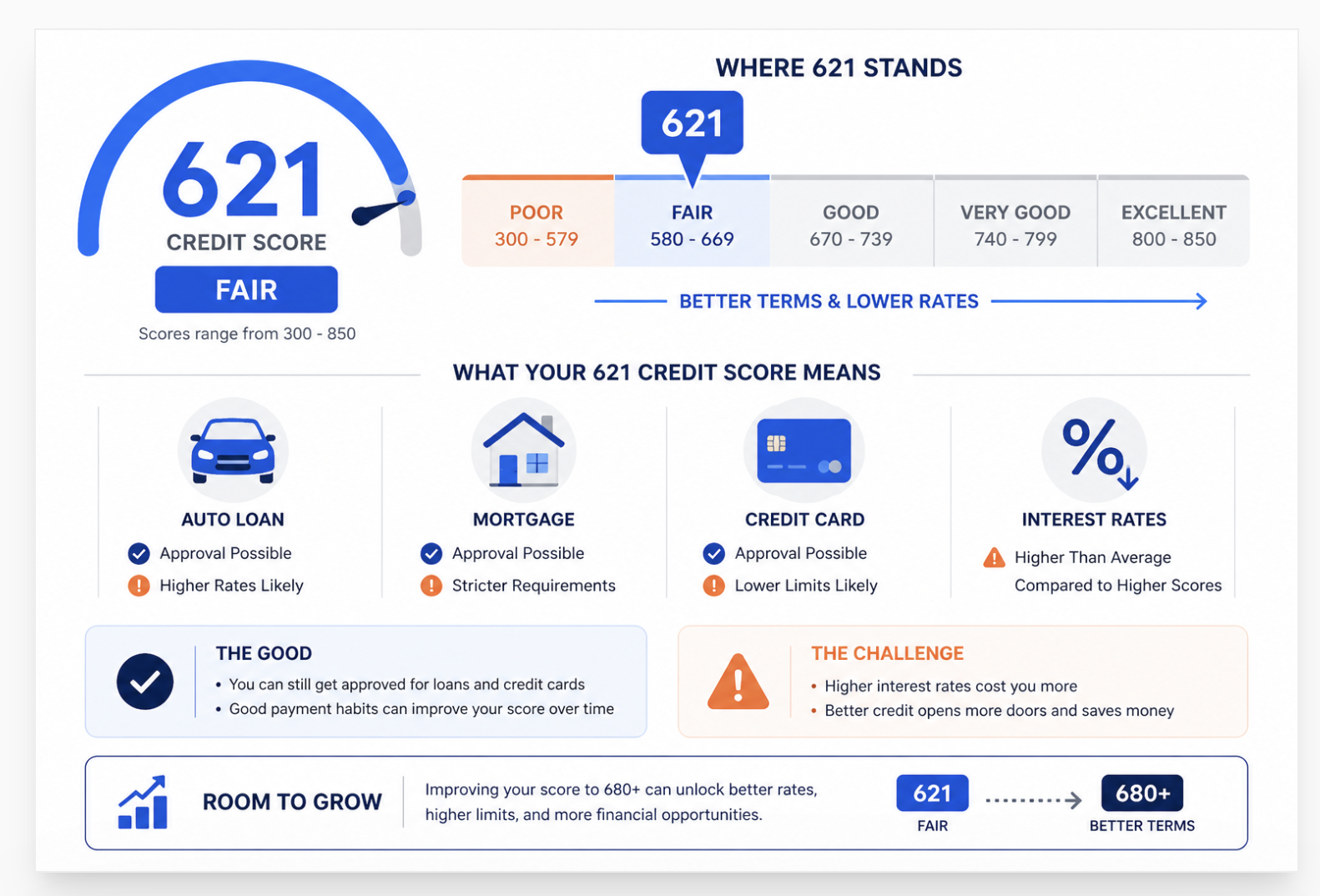
It is above poor credit, but below where lenders start offering stronger pricing. That makes it an important range because small improvements can create real results. Lowering card balances, correcting reporting errors, and adding positive payment history can move a file from risky to more financeable in a short time.
Real consumer forums show the same pattern. Many people with scores in the low 600s ask if they should apply now or wait. The better question is what lenders will see in the full report. A 621 score with low utilization and no recent negatives is very different from a 621 score with maxed cards and fresh late payments.
From our experience in credit repair, scores in this range often have the most room for meaningful growth. The right changes can move approval odds faster than many borrowers expect.
This guide explains what a 621 credit score means, what approvals may be possible, and what actions can improve your position.
- ✓ FHA loan: qualifies at 3.5% down
- ✓ Conventional loan: borderline eligible at 620+
- ~ Auto loan: eligible but at 12.4% APR vs 6.4% for prime
- ✗ Best credit cards: not accessible
- ✗ 94 points below the US average of 715
Last quarter alone, we worked with 34 clients whose starting scores sat between 610 and 630. Most of them came in right after a loan denial or after seeing a rate quote that shocked them. The pattern is consistent: at 621, lenders approve you, then quote you a rate that costs you thousands more than a borrower 80 points ahead of you. The approval feels like a win. The rate sheet tells a different story.
Is 621 a Good Credit Score?
No. FICO classifies 621 as Fair (580-669). It falls below the US average of 715. A 621 score qualifies you for most loan types, but at materially higher interest rates than borrowers in the Good (670-739) or Very Good (740-799) ranges. The real cost of a 621 score shows up in rate quotes, not just approval decisions.
FICO's credit score tiers run from Poor (300-579), to Fair (580-669), to Good (670-739), to Very Good (740-799), to Exceptional (800-850). A 621 score sits in the second-lowest tier. It clears the line where most lending products become accessible. But it lands in the range where lenders price every product for elevated risk.
The US average FICO score hit 715 in 2025, according to Experian's consumer credit data. A 621 sits 94 points below that. About 17% of Americans currently score in the 580-669 Fair range. That group pays more for credit than any other segment that still has access to mainstream lending products.
The score is not a dead end. It is an expensive starting line.
What Can a 621 Credit Score Get You?
| Product | Access at 621 | Rate/Terms at 621 | vs Good Credit (720+) |
|---|---|---|---|
| FHA Mortgage | Qualifies | ~7.8% APR, 3.5% down, lifetime MIP | ~1.4% higher rate, ~$40K more interest over 30 yrs |
| Conventional Mortgage | Borderline | Possible at 621, but strict: 36% max DTI, 25% down often required for best pricing | Rate premium of 1-1.5% vs 760+ tier |
| Auto Loan (new car) | Qualifies | ~12.4% APR avg (620-659 band, Feb 2026) | 6.4% for 720+ = $9,500 difference on $30K loan |
| Personal Loan | Limited | Credit unions and online fair-credit lenders; 15-25% APR typical | Prime borrowers receive 7-12% APR |
| Credit Card | Secured or basic unsecured | Secured cards, student cards, store cards. No rewards cards. | Rewards cards, travel cards, cash-back products unavailable at 621 |
| Apartment rental | Usually approved | Larger security deposit common; some landlords decline | No deposit premium above 670 at most properties |
The mortgage picture deserves its own note. At 621, you sit just one point above the 620 conventional loan minimum. That margin is thin. Your application goes through stricter underwriting than a 640-score or 660-score applicant. Many automated underwriting systems flag files at exactly the minimum threshold for manual review. Manual review adds time and sometimes adds conditions: more documentation, a larger down payment, or a lower debt-to-income ratio than the standard limit.
FHA is the cleaner path at 621. The FHA minimum is 580, so a 621 score clears it with room. The trade-off is lifetime mortgage insurance at 3.5% down , a cost that persists for the entire loan term and cannot be removed by reaching 20% equity the way conventional PMI can.
Can I Get a Loan with a Credit Score of 621?
Yes. A 621 score qualifies for FHA mortgages, auto loans, some personal loans, and secured credit cards. The approval bar clears at 621 for most products. The cost bar does not. Every rate you receive at 621 is higher than the same product offered to a 700-score borrower, often by 3 to 6 percentage points.
Auto loans are the most accessible at 621. Auto loans are secured by the vehicle, which reduces lender risk. Even subprime auto lenders who will not touch unsecured debt often approve auto loan applications at 621. The rate reflects the risk, but approval is common.
Personal loans are harder at this score. Most banks want 670 or above for unsecured personal loans. Credit unions are more flexible because their mission includes serving members at all credit levels. If you belong to a credit union, that is your best shot at a reasonable rate on an unsecured personal loan at 621.
According to Bankrate's 2026 auto loan rate analysis, the 620-659 score band received an average APR of 12.426% on new car loans as of February 2026. Borrowers above 720 received 6.369%. On a $30,000 vehicle at 60 months, that difference costs $160 more per month and over $9,500 in total interest. The approval exists. The cost is real.
A 621 score opens FHA mortgages, auto loans, secured credit cards, and some personal loans. Conventional loans are technically accessible but require stricter conditions. The access is real. The rates are not competitive. Auto loans run nearly double the prime APR. FHA mortgages include lifetime mortgage insurance that conventional borrowers at higher scores avoid. Every approval at 621 carries a rate penalty.
Can I Get Approved with a 612 Credit Score?
Yes, for FHA loans and auto loans. A 612 score clears the FHA 580 minimum and most auto lender thresholds. It falls 8 points below the 620 conventional loan floor. Personal loans from credit unions remain accessible. Rewards credit cards and competitive personal loan rates are not available at 612.
The 620 line is the most consequential threshold near a 612 score. Below it, conventional mortgages are effectively closed. Eight points of improvement opens that door.
Eight points is achievable in one billing cycle for some borrowers. Paying down a credit card from 60% utilization to 20% can move a score 20-30 points by the next statement date. One removed inaccurate entry from a credit report can produce a similar jump. Both of those actions are free.
For auto loans, 612 and 621 look nearly identical to most lenders. Both fall in the same subprime rate tier. Both receive similar APRs. The difference between a 612 approval and a 621 approval on an auto loan is often zero. The difference between 612 and 660 is significant: different rate tier, different monthly payment, thousands less in total interest.
A client came to us with a 614 score after a medical collection had knocked her down from 668. She needed a car and a place to live. She took the auto loan at 14.9% APR because she needed the car immediately. She came to us two months later for the apartment application. We pulled all three bureau reports. The medical collection had an incorrect balance and the wrong original delinquency date. We filed simultaneous disputes at all three bureaus. The account deleted in 31 days. Her score moved from 614 to 659. Her next loan rate was in the 8% range. The 45-point gain cost nothing except the time to dispute. The 14.9% auto loan rate will cost her roughly $4,200 in extra interest over 48 months because she needed the car before the dispute had a chance to resolve.
How to Go from 621 to 700: The Fastest Path
A 79-point improvement from 621 to 700 crosses a critical threshold. At 700, you move from the Fair tier into the Good tier. Rate quotes change. Credit card product access opens. Some lenders shift their loan pricing by a full percentage point at that crossing.
The fastest path combines three actions simultaneously rather than doing them one at a time.
Utilization is 30% of your FICO score and updates every billing cycle. Getting all cards below 30% is the first target. Below 10% produces the maximum score gain. On a card with a $2,000 limit, that means a reported balance under $200. Pay before the statement date, not just the due date , the balance that posts on your statement is what reports to the bureaus.
Timeline: 1 billing cycle (25-35 days) | Potential gain: 20-40 pointsPull all three reports from AnnualCreditReport.com. Look for wrong dates, wrong balances, accounts you do not recognize, and duplicate entries. File disputes at Equifax, Experian, and TransUnion on the same day , the bureaus do not share corrections. Each has 30 days to investigate. A removed collection or corrected late payment entry can produce a 30-60 point gain immediately. This is the highest-ROI action at 621 because it costs nothing and produces the largest score movements.
Timeline: 30-45 days | Potential gain: 30-60 points per removed itemAsk a family member or close friend with a long, clean credit card to add you as an authorized user. You do not need to use the card. Their positive history appears on your report within one statement cycle. The account adds to your payment history, your average account age, and your available credit. All three help your score. This works best when the primary account is 5 or more years old with no missed payments and low utilization.
Timeline: 30-60 days | Potential gain: 20-50 pointsOne 30-day late payment at 621 drops the score 50-80 points and resets your rebuild timeline. Set every account to autopay for the minimum. This protects the progress from steps 1, 2, and 3. Payment history is 35% of your FICO score. All the utilization work and dispute removals compound only if payment history stays clean. Autopay is the simplest insurance against losing everything you build.
Timeline: Ongoing | Impact: Prevents 50-80 point resetsCombining steps 1, 2, and 3 simultaneously , not sequentially , gives you the fastest possible score movement. Many 621-score borrowers run these one at a time, spending 90 days on what could take 30-45 days if all three start at once.
Understanding where 621 sits in relation to other Fair-range scores helps clarify the target. Our breakdown of what a 600 credit score really means shows how the product access differs at 600 versus 620 , and why the 80-point climb from 620 to 700 produces a bigger financial shift than the 20-point climb from 600 to 620.
The fastest path from 621 to 700 runs three actions simultaneously: utilization reduction (one billing cycle, up to 40 points), bureau disputes (30-45 days, up to 60 points per removed item), and authorized user addition (30-60 days, up to 50 points). Autopay protects all gains from a single missed payment that would erase months of progress. Sequential action takes 3x longer than parallel action.
What 621 Costs You in Real Numbers
The rate premium at 621 is not abstract. Here is what you pay more than a 720-score borrower on the same products.
According to Experian's mortgage rate data, borrowers at 621 receive an average mortgage APR of approximately 7.8% compared to 6.4% for borrowers at 760 or above. On a $300,000 30-year mortgage, that 1.4% difference costs approximately $76,000 in extra interest over the life of the loan.
The full picture of what Fair credit costs across every borrowing category shows these numbers compound across a lifetime of decisions. Auto loans every few years, a mortgage, credit cards, personal loans , each one carries a rate penalty at 621 that compounds into the $183,000 lifetime overpayment figure LendingTree calculated in their 2025 analysis.
Compare where you stand now with where the score floor changes: our breakdown of the 796 credit score shows the specific thresholds where rate pricing shifts, which helps you understand exactly which score targets produce real financial changes rather than just moving a number. The most efficient financial decision at 621 is not accepting the rate offers you receive today. It is investing the next 60 to 90 days into the three steps above, then applying at a higher score.
If cash flow is tight and you are considering a cash advance, our guide on how cash advances work and what they cost breaks down why they are particularly damaging for borrowers already in the Fair credit range, and what alternatives exist at each credit tier.
Is 621 a good credit score?
No. FICO classifies 621 as Fair (580-669), which sits below the US average of 715. At 621, you qualify for most loan products but pay a significant rate premium for each of them. The auto loan rate at 621 averages 12.4% compared to 6.4% for prime borrowers (720+). The mortgage rate runs approximately 1.4% above the top tier. Over a lifetime of borrowing, the Fair range costs an estimated $183,000 more in total interest than the Exceptional range.
What can a 621 credit score get you?
FHA mortgage at 3.5% down, conventional loan under strict conditions (36% max DTI, possible 25% down requirement), auto loans at subprime rates averaging 12.4% APR, personal loans from credit unions and online fair-credit lenders, secured credit cards and basic unsecured cards, and rental approvals at most properties with a possible deposit premium. Premium rewards credit cards, competitive personal loan rates, and jumbo mortgage programs are not accessible at 621.
Can I get a loan with a 621 credit score?
Yes. FHA loans require 580, so 621 qualifies with room. Conventional loans require 620, so 621 is one point above the floor. Auto loans approve at 621 at subprime rates. Personal loans at credit unions are accessible. The qualification exists. The rate attached to it is the cost of a Fair score. Every category that approves a 621-score borrower prices the loan higher than it would for a 680-score or 720-score borrower.
How do I go from 621 to 700?
Three simultaneous actions produce the fastest 79-point improvement. Reduce all credit card balances below 10% of each card's limit , this updates in one billing cycle and can add 20-40 points. Dispute any inaccurate entries across Equifax, Experian, and TransUnion on the same day , removed items add 30-60 points each within 30-45 days. Get added as an authorized user on an aged, clean account , this adds 20-50 points in 30-60 days. Most borrowers who run all three simultaneously reach 680-710 within 60-90 days. Autopay on every account prevents a single missed payment from erasing the gains.
The Fastest 79 Points Start With Knowing What's on All 3 Bureau Reports
Before you pay down anything or dispute anything, pull all three reports and find what is actually suppressing your score. Many 621-score consumers have one inaccurate entry that accounts for 30-50 points. A free 3-bureau audit shows every entry across Equifax, Experian, and TransUnion and identifies exactly what is disputable before you take any action.
Get My Free 3-Bureau Audit → Secure · 2 minutes · No credit card required-
Debt Collection Defense: Your Rights and How to Use Them Many 621-score borrowers carry collection accounts that are suppressing their score. A collection entry can hold a score in the Fair range for years. Understanding your FDCPA rights , what collectors can and cannot do, how to send a validation letter, and when to dispute versus negotiate , gives you the tools to address collection accounts before they cost you on your next loan application.
-
How Does a Cash Advance Work? At 621, a cash advance is one of the most damaging short-term financial tools available. It spikes utilization, charges 24-30% APR from day one with no grace period, and can push your score further into the Fair range right before a loan application. This covers what a cash advance actually costs, how it appears on your credit report, and what to use instead when you need short-term cash at a Fair credit score level.