

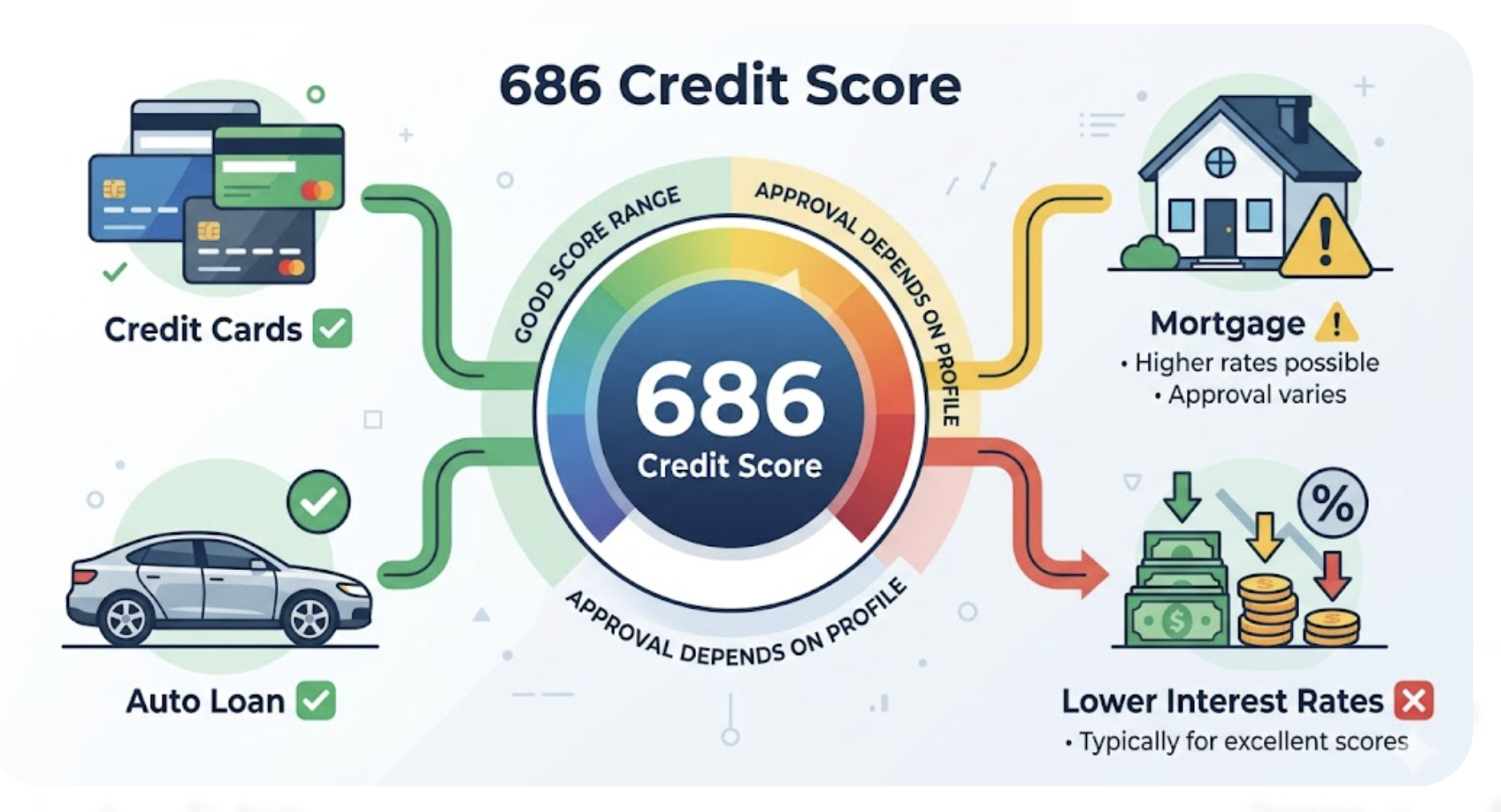
A 686 credit score is generally considered good, but approval outcomes depend on how lenders evaluate risk, not just the score itself. While this score falls within an acceptable range, it does not guarantee approval or the best terms.
Lenders use scoring systems such as the FICO Score and VantageScore to assess creditworthiness. A 686 score is often placed in the “good” category, but lenders also review payment history, debt levels, and recent activity. Because of this, a borrower with a 686 score may qualify for credit cards, auto loans, or mortgages, but interest rates and limits depend on the full credit profile.
Credit Score Education · 686 FICO Score · Mortgages · Auto Loans · Credit Cards · Approval Odds
Updated April 2026 · Data: Experian State of Credit 2025, myFICO loan savings calculator February 2026, Fannie Mae DTI guidelines, The Mortgage Reports rate data 2025, Bankrate auto loan averages Q4 2025
People ask "is 686 a good credit score" because they want to know what it gets them. The simple answer is that 686 qualifies you for most mainstream loan products. A conventional mortgage requires 620. FHA requires 580. Most auto lenders work with 686 without issue. The issue at 686 is not eligibility. It is cost. Every rate tier above 686 reduces the total interest you pay on every loan you take out, and the next meaningful tier starts at 720.
Is 686 a Good Credit Score?
The FICO scale runs from 300 to 850. The full range and what each tier means for borrowing is covered in our credit score ranges guide, but the short version for 686 is this: you are in a tier where most lenders will approve you, where rates are reasonable but not the best available, and where a 34-point improvement to 720 produces meaningful, measurable savings across mortgages and auto loans.
Not every source agrees on where "good" starts. FICO puts the floor at 670. WalletHub sets its own threshold at 700, which is why some sites call 686 "fair." For practical purposes the FICO definition is what matters, since 90% of top lenders use FICO scores. At 686 you are in the good range by the standard that actually determines your loan options.
That experience is common. Many people at 686 are not there because of late payments or collections. They are there because revolving balances are too high relative to credit limits. Utilization is the most movable factor in the FICO formula, and it recalculates every month. A paydown that happens this billing cycle shows up on next month's score.
What Can You Get Approved For With a 686 Credit Score?
Starting with mortgages: a conventional loan requires a 620 minimum credit score and FHA requires 580. At 686 you clear both without issue. The real constraint for a mortgage at 686 is not whether you get approved. It is the Fannie Mae DTI cap. Borrowers below 720 face a debt-to-income ceiling of 36%, while borrowers above 720 can go up to 45%. If you have student loans, a car payment, or other monthly obligations, that gap determines how much house you can qualify for. It can be the difference between a $280,000 loan and a $350,000 loan on the same income.
On rate: a borrower with a 680 score on a $300,000 30-year fixed mortgage pays roughly $64 more per month than a borrower at 760, according to The Mortgage Reports' analysis of myFICO rate data. Over 30 years that is $23,040. The best mortgage rates in the market today require a score of 740 to 780. At 686 you are approved, but you are 54 to 94 points away from those pricing tiers.
For auto loans, the rate difference is sharper and faster to feel. On a car purchase at 686 you land in the 660-689 pricing tier. On student loans, 686 actually works in your favor: approximately 70% of student loan borrowers have scores below 700.
That thread underscores something important: 686 is a score many people spend years working toward. If you are already at 686, you have cleared a threshold that a large portion of mortgage applicants are still trying to reach. The next target is 720, and unlike the climb from 580 to 680, getting from 686 to 720 is often achievable in months, not years, if the primary factor is utilization.
What Auto Loan Rate Will I Get With a 686 Credit Score?
The rate table below shows where 686 lands relative to the tiers above and below it. The 686 row is highlighted. These figures come from the myFICO loan savings calculator using February 2026 data:
| Score range | New car APR | Used car APR | Interest on $40k new car (60 mo.) |
|---|---|---|---|
| 720 and above | 6.37% | 9.36% | ~$6,700 |
| 690-719 | 7.82% | 10.48% | ~$8,400 |
| 660-689 (686 is here) | 9.74% | 12.10% | ~$10,700 |
| 620-659 | 12.18% | 15.86% | ~$13,700 |
What the table does not show is that dealers are allowed to mark up the rate the lender offers, sometimes by 1 to 2 percentage points. A borrower at 686 who gets a 9.74% base rate from a captive lender might be quoted 11% or 12% at the finance desk. Getting pre-approved through a credit union or Capital One Auto Navigator before visiting a dealership gives you a rate benchmark and removes the dealer's ability to hide what you were actually approved for. This applies regardless of your score, but it matters more in the 660-689 tier because the base rate is already elevated.
That exchange illustrates something the data confirms: a 686 resulting from high utilization is not the same problem as a 686 resulting from a collection or a late payment. Utilization fixes quickly. The path back to 720 from a utilization-driven 686 can take two billing cycles. The path back from a serious derogatory item takes much longer.
Is 686 a Good Credit Score to Buy a House?
One thing most homebuyers do not know until they are in the process: the mortgage score a lender pulls is not the same as the FICO Score 8 shown on your credit card app or Credit Karma. Mortgage lenders use FICO Score 2 from Equifax, FICO Score 4 from TransUnion, and FICO Score 5 from Experian. These are older models that can score your file 20 to 50 points lower than your generic FICO 8. Someone who sees a 715 on their banking app might pull a 686 mortgage middle score at the lender. If a mortgage is the goal, check your actual mortgage scores at myFICO.com before applying.
On the subject of where FICO's mortgage tiers actually matter, the 680 to 719 range sits just below the two thresholds that change pricing most significantly. At 720, Fannie Mae's DTI ceiling lifts from 36% to 45%. At 740, you reach the standard floor for the most competitive published rate pricing in the market. And since May 2023, 780 is the benchmark for the absolute best rate tier. At 686, you are approved, but you are positioned several pricing steps below the rates advertised online and in the news.
How Far Is 686 From a Good Credit Score — and What Changes at 700 and 720?
The myFICO community treats these thresholds as practical targets. Members preparing for a mortgage consistently set 680 as the minimum for a lender to treat them seriously, 700 as the target for better personal loan access, and 720 as the meaningful shift for rate pricing. From 686 to 720 is 34 points. For someone held at 686 by utilization, that gap is a billing cycle problem. For someone with a collection or a late payment active on their report, it requires a longer timeline and a different approach.
To understand which specific factors are holding your score at 686, the breakdown of how credit scores are calculated shows the exact weight FICO gives to each of the five factors — payment history (35%), utilization (30%), length of history (15%), credit mix (10%), and new inquiries (10%). Most people at 686 lose points in the utilization bucket. Once utilization is resolved, the next blocker is usually an aging negative item, and the fix there is time plus accurate reporting.
For context on the full score range and what it actually takes to reach 800 or above, the maximum credit score guide covers the specific behaviors that separate a 686 from a 780 and what a realistic timeline looks like from each starting point.
How to Raise Your 686 Credit Score to 700
Before doing anything else, pull your free reports from AnnualCreditReport.com and read them. Not every 686 is the same. Some are held there by a single collection that may be removable. Some are held there by a 45% utilization on one card. The action plan is different depending on which factors are suppressing the score, and the report shows you exactly where you stand.
The four steps with the most direct impact at 686:
- Dispute any inaccurate entry under FCRA Section 611. Wrong dates of first delinquency, inflated balances, accounts you do not recognize — any of these are disputable. The bureau has 30 days to investigate. If the furnisher cannot verify the entry, it must be removed. One successful dispute on a meaningful negative item can move 686 to 700 in a single cycle.
- Pay credit card balances below 10% of each limit before the statement closing date. Utilization recalculates every month when your lender reports to the bureaus. The reporting date is the statement close date, not the due date. Paying on the due date does nothing for the score if the statement already reported a high balance. Pay before close.
- Stop all new credit applications for 90 days. Hard inquiries subtract 2 to 5 points each and stay on your report for two years. New accounts also lower your average account age. When you are 14 points from 700, both of those effects slow the climb. Let what you have age and report positively.
- Confirm every account is on auto-pay for at least the minimum. Payment history is 35% of your FICO score. A 30-day late mark at 686 produces a significant drop. You are not rebuilding from deep credit damage at this score — you are fine-tuning. One missed payment interrupts months of progress. Eliminate that risk mechanically.
Most people in the myFICO community who document the jump from mid-680s to 700 achieve it within 3 to 6 months when utilization is the primary factor. The speed depends on how quickly card balances can be paid down and how rapidly the bureaus update. When a negative item is the primary factor, the timeline depends on its age and whether it can be disputed or negotiated.
Find Out Exactly What's Holding Your Score at 686
A free 3-bureau audit shows you every entry across Experian, TransUnion, and Equifax. Inaccurate dates, inflated balances, and unverifiable collection entries are all disputable under the FCRA. One removal can be the difference between 686 and 700.
Get My Free Credit Audit → Secure · 2 minutes · No credit card requiredFrequently Asked Questions About a 686 Credit Score
Is 686 a good credit score?
686 is inside FICO's good range, which runs from 670 to 739. The national average in 2025 is 715. At 686 you qualify for most loans, but you will not receive the most competitive rates on mortgages or auto loans. Those are reserved for borrowers at 720 to 740 or above. Whether 686 is good enough depends on what you are applying for and how much the rate difference costs you across the loan term.
What can I get approved for with a 686 credit score?
Conventional mortgages (620 minimum), FHA mortgages (580 minimum), auto loans from most lenders, personal loans, and most unsecured credit cards. About 30% of first mortgages go to borrowers below 700 according to 2025 Equifax data. The 686 score rarely blocks approval outright. It determines which rate tier you land in and, for mortgages, which DTI ceiling applies.
Is 686 a good credit score to buy a house?
686 clears both the FHA minimum (580) and the conventional minimum (620), so approval is realistic. The rate impact is real: a borrower at 680 pays roughly $64 more per month than a borrower at 760 on the same $300,000 30-year loan, which is about $23,040 over the loan life. Fannie Mae also caps your debt-to-income ratio at 36% with a score below 720, versus 45% for scores above 720.
How do I raise my 686 credit score to 700?
Pay credit card balances below 10% of each card's limit before the statement closing date. This recalculates within one billing cycle. Dispute any inaccurate entries on your report under the FCRA. Results arrive in 30 to 45 days. Stop new credit applications for 90 days to prevent inquiry-related drops. Most people at 686 are held there by high revolving balances. Addressing utilization alone often moves the score to 700 within two billing cycles.
What auto loan rate will I get with a 686 credit score?
The 660-689 tier averaged 9.74% APR on new car loans in February 2026 according to myFICO. The tier above (690-719) averaged 7.82% and the top tier (720+) averaged 6.37%. On a $40,000 car over 60 months, the interest cost in the 686 tier is roughly $10,700 versus $6,700 in the 720+ tier. The difference is about $4,000 in additional interest for the same vehicle.
How far is 686 from a good credit score?
686 is already inside the good range, which starts at 670. The very good tier that unlocks the most competitive rates begins at 740, so 686 is 54 points from that threshold. The national average is 715, placing 686 about 29 points below average. Reducing credit card utilization is the fastest way to close that gap.
-
Is It Easier to Lease or Finance a Car? At 686 you are inside auto loan territory but near the lease approval boundary. This covers the exact score tiers that separate lease-eligible from finance-only borrowers, with real APR data by tier.
-
What Is the Lowest Credit Score? The full breakdown of what a sub-580 score means in loan terms, and the comparison that puts 686 in context relative to borrowers still in the fair and poor ranges.
-
Which Credit Score Do Landlords Use? (FICO vs VantageScore) If you are renting with a 686, this explains which bureau landlords pull, why your Credit Karma score can look different from what a landlord sees, and how 686 compares to what most Houston properties require.
-
myFICO: What's In Your FICO Score? The official source for FICO's five scoring factors and their weights. The loan savings calculator on myFICO was used to pull the February 2026 auto loan APR figures by credit score tier cited throughout this article.
-
The Mortgage Reports: Mortgage Rates by Credit Score (Updated 2026) Source for the $64 monthly payment difference and $23,040 lifetime interest gap between 680 and 760 scores on a $300,000 30-year mortgage, and Fannie Mae's DTI guidelines by score tier.
-
Bankrate: Average Auto Loan Interest Rates by Credit Score (Updated April 2026) Bankrate's reporting of Experian's Q4 2025 automotive finance data, including the average new car loan rate of 6.37% and used car rate of 11.26%, with full tier breakdown from super-prime to deep subprime.
Closing
A 686 credit score is considered good, but approval and terms depend on the full credit profile and lender criteria. Understanding what lenders evaluate beyond the score helps determine what you can get approved for and how to improve outcomes.