

Most people assume paying off debt before applying for a mortgage is always the right move.
Sometimes it is.
Sometimes it isn't.
I've seen borrowers spend thousands paying off debt only to discover it had very little impact on their mortgage approval. We at ASAP Credit Repair USA also seen borrowers improve their approval odds simply by paying down the right accounts.
The difference comes down to understanding how mortgage lenders evaluate debt.
Mortgage underwriters do not treat every debt the same.
Some debts create major approval friction.
Others barely move the needle.
Before using your savings to pay everything off, it helps to know which debts deserve your attention first.
The Smart Way to Handle Debt Before Applying for a Mortgage
Paying off debt before applying for a mortgage can improve approval odds, reduce your debt-to-income ratio, and strengthen your credit profile. However, not every debt should be paid off first.
Mortgage lenders often care more about credit card balances, collections, and overall financial stability than simply having zero debt.
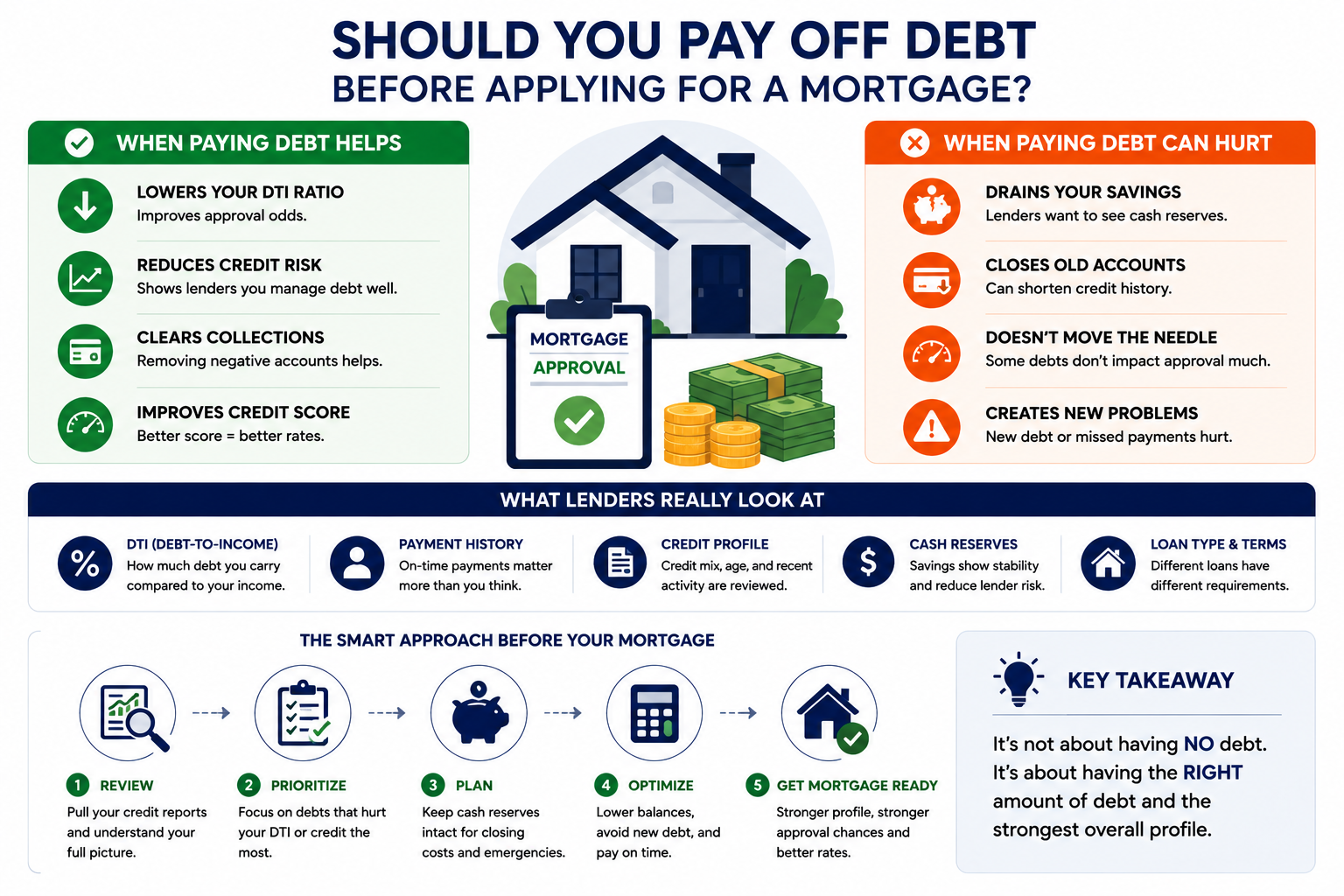
What Mortgage Lenders Actually Look at When They Review Your Debt
Mortgage lenders do not care how much total debt you have. They care how much your monthly debt payments consume of your gross monthly income. That ratio , the debt-to-income ratio, or DTI , is the primary debt-related approval factor. A borrower with $80,000 in student loans paying $200/month looks better to a lender than a borrower with $30,000 in credit card debt paying $900/month in minimums.
This is the most important thing to understand before making any debt payoff decision before a mortgage.
The lender does not see your balances. They see your monthly payments. Two borrowers can have the same total debt load but completely different DTI ratios depending on how those debts are structured.
The DTI formula is simple:
Example: $1,800/month in debt payments on $5,000 gross income = 36% DTI. Each debt payment eliminated directly reduces this number.
Every monthly payment you eliminate improves the DTI. A $300/month credit card minimum eliminated from a file with $5,000/month income is a 6% DTI improvement. That can be the difference between approval and denial.
As Experian confirms, reducing DTI before applying involves eliminating monthly payment obligations , the payment amount matters far more than the total balance owed.
When Paying Off Debt Before a Mortgage Helps
Paying off debt helps mortgage approval when: the monthly payment eliminated produces meaningful DTI improvement, the payoff does not drain cash reserves below the 3-month mortgage payment threshold, and the debt type positively affects the credit score (credit card utilization reduction) alongside the DTI improvement. These conditions apply most strongly to credit card debt and small high-payment installment accounts.
- Credit card balances near their limits. A maxed-out credit card with a $400 minimum payment suppresses the credit score (high utilization) AND inflates DTI simultaneously. Paying it down serves both goals at once. It is the highest-ROI debt payoff action before a mortgage application.
- Small installment loans with large payments and few months remaining. A car loan with 8 payments left at $380/month. The total remaining balance is small ($3,040). Paying it off eliminates $380/month from the DTI calculation. Lenders count any debt with 10 or fewer remaining payments differently in DTI calculations under some guidelines , confirm with the specific lender.
- Collections that the mortgage lender specifically requires resolved. FHA lenders frequently require collections over $1,000 to be paid or in a payment plan before closing. If the target loan type requires it, pay it , but negotiate pay-for-delete first so the bureau entry is removed simultaneously.
- Personal loans with high monthly payments relative to the remaining balance. A $5,000 personal loan at 22% APR with 24 months remaining is costing $258/month. Paying it off eliminates that DTI drag and saves $1,192 in interest.
When Paying Off Debt Before a Mortgage Can Hurt
Paying off debt hurts mortgage prospects when it depletes cash reserves. Lenders value 3-6 months of mortgage payment in savings as a compensating factor that can offset higher DTI. A borrower who spends $20,000 to pay off loans and ends up with $4,000 remaining may actually have a harder file than before the payoffs , because reserves fell while DTI only improved marginally.
- Large auto loans with long remaining terms. A $25,000 car loan with 48 months remaining at $520/month. Paying it off requires $22,000+ in cash. That DTI improvement ($520/month eliminated) is meaningful , but the cash depletion creates new risk. Compare: keeping the loan (higher DTI) vs paying it off (lower reserves). A lender may approve the higher DTI file with strong reserves more easily than the lower DTI file with minimal savings.
- Student loans. Income-driven repayment plans can keep the required monthly payment low. Paying off student loan balances (often $20,000-$80,000) consumes enormous reserves for a monthly payment reduction that may be achievable more cheaply through income-driven repayment plan enrollment.
- Old paid-off installment accounts. Closing paid accounts reduces available credit history and may affect average account age. Do not close accounts after paying them off.
- Medical debt before confirming lender requirements. Most conventional lenders following Fannie Mae guidelines exclude medical collections from DTI calculations and treat them more leniently. Paying medical debt before confirming the specific loan type's treatment may produce no benefit while depleting reserves.
Which Debt Should You Pay Off First Before a Mortgage
- Credit cards above 30% utilization. Reduces DTI AND improves credit score. Dual benefit makes this the highest-value payoff.
- Short-term installment loans. Under 10-12 payments remaining. Eliminate the monthly payment for small remaining balance.
- Collections over $1,000. FHA lenders often require resolution. Negotiate pay-for-delete before paying.
- Auto loans mid-term. Large payoff amount. Calculate reserves impact before deciding.
- Personal loans with moderate payments. Run the math: monthly payment eliminated vs reserves depleted.
- Small medical collections. Check whether your target loan type counts them in DTI before paying.
- Student loans with income-driven payments. Enroll in an IDR plan to lower the monthly payment without depleting savings.
- Long-term auto loans with large balances. The cash needed exceeds the DTI benefit for most files.
- Collections near 7-year removal window. Let them age off. Paying won't help, and the entry comes off automatically.
How Credit Card Debt Affects Mortgage Approval
Credit card debt affects mortgage approval in two ways simultaneously. First: the minimum monthly payment counts in the DTI calculation. Every dollar of minimum payment directly reduces the mortgage payment the borrower can support. Second: high balances relative to credit limits raise utilization, which suppresses the credit score and increases the rate tier. Paying down credit card balances is the single highest-impact pre-mortgage debt action available , it improves both DTI and the score at the same time.
The utilization angle matters as much as the DTI angle.
A borrower carrying $8,500 on a $10,000 limit card has 85% utilization. That suppresses the score and pushes the rate into a higher LLPA tier. The same borrower at $1,000 on the same card (10% utilization) may score 50-80 points higher , accessing a better rate tier and saving $20,000-$40,000 over the mortgage term. The credit card paydown produces two benefits: DTI improvement (monthly minimum eliminated) and score improvement (utilization reduced). No other debt type produces both effects simultaneously.
The guide on how available credit affects credit scores covers the utilization mechanics in detail , including why the improvement shows up in the score within 30 days and why paying before the statement closes produces the fastest result.
Do Student Loans Prevent Mortgage Approval
Student loans count in the DTI calculation , but paying them off rarely makes sense before a mortgage because the total balance is typically large relative to the monthly payment eliminated. A $45,000 student loan at $350/month income-driven payment. Paying it off requires $45,000 in cash. That cash depletion produces one benefit ($350/month DTI reduction) while eliminating reserves the underwriter values as a compensating factor. The smarter move: enroll in an income-driven repayment plan to minimize the monthly payment while preserving savings.
- Income-driven repayment (IDR) plans. IDR plans can lower student loan payments significantly , sometimes to $0 for low-income borrowers. Fannie Mae guidelines use the actual IDR payment shown on the credit report in DTI calculations. Enrolling in IDR 60-90 days before applying can reduce the monthly payment that counts against DTI.
- Loans in deferment. Some lenders calculate 1% of the outstanding balance as the assumed payment for deferred student loans. A $30,000 deferred loan = $300/month assumed payment even if not currently paying. Exiting deferment and entering an IDR plan with a lower actual payment may produce better DTI math.
- When paying student loans makes sense. If the remaining balance is small (under $5,000) and the payment is $150/month, and paying it off leaves reserves intact , the DTI improvement may justify the payoff. Run the numbers.
How Much Debt Is Too Much for a Mortgage
Lenders do not set a maximum debt balance. They set a maximum DTI ratio. The 2024 NAR report shows 48% of mortgage denials cite DTI as the primary reason. The DTI thresholds: conventional loans prefer under 36%, allow up to 45%, and some files reach 50% through automated underwriting with compensating factors. FHA allows up to 56.9% through automated underwriting. The math: if your monthly debt payments plus the new mortgage payment exceed 43-45% of gross monthly income, the file needs either debt reduction or compensating factors to qualify.
| DTI Range | Approval Position | Loan Types Available |
|---|---|---|
| Under 36% | Strong , preferred for conventional | Conventional, FHA, VA, USDA , full options |
| 36-43% | Good , within standard guidelines | Most programs available with normal underwriting |
| 43-50% | Elevated , compensating factors needed | FHA and conventional with strong credit (720+) and/or reserves |
| 50-57% | High , automated underwriting + strong compensating factors | FHA automated underwriting with reserves, low LTV, or high credit score |
| Above 57% | Very high , most programs unavailable | Limited; may need to reduce debt before applying |
As U.S. Bank confirms, the DTI ratio is what underwriters use to ensure the loan falls within the risk threshold their guidelines require , and nearly half of all mortgage denials come from this single factor.
Should You Use Savings to Pay Off Debt Before a Mortgage
Only if the reserves that remain after the payoff are sufficient. Three to six months of mortgage payment reserves is the target that satisfies most lender requirements for this compensating factor. Spending savings to pay debt that brings DTI from 46% to 40% , but drops reserves from $30,000 to $12,000 , may or may not produce better approval odds depending on the specific loan program and lender. Run both scenarios before depleting reserves.
Collections and Mortgage Approval , A Special Case
Collections are the one debt category where the advice differs from all other debt types. Unlike auto loans and student loans, collections create underwriting friction independent of the DTI calculation. An underwriter who sees three active collections asks a specific question: does this borrower pay their obligations? That question affects approval independently of the score and DTI numbers. Address collections before other debt types , but always dispute and attempt deletion before paying.
The mortgage-specific collection strategy:
- Step 1: Identify which collections the specific lender requires resolved. FHA lenders often require collections over $1,000 to be paid or in a payment plan. Conventional lenders may ignore smaller collections under Fannie Mae guidelines. Know the requirement before taking action.
- Step 2: Dispute inaccurate collections before paying. Collections with wrong dates, wrong balances, or documentation gaps can sometimes be deleted through FCRA dispute. A deleted collection improves both the score and the underwriting picture without requiring payment.
- Step 3: For valid required collections, negotiate pay-for-delete before paying. A pay-for-delete agreement means payment produces bureau removal , satisfying the lender condition AND improving the score simultaneously.
The 90-Day Debt Strategy Before Applying for a Mortgage
The most effective pre-mortgage debt strategy runs 90 days before the application. Month 1: pay down credit card balances to under 10% utilization and calculate the DTI impact. Month 2: dispute any collection inaccuracies and let bureau investigation windows close. Month 3: pull final credit reports, confirm DTI, verify reserves are intact, and apply. This sequence maximizes score improvement, DTI reduction, and reserve preservation simultaneously.
| Timeline | Action | Why This Order |
|---|---|---|
| 90 days out | Pull all 3 bureau reports. Calculate current DTI. List every monthly debt payment. | Baseline before any decisions. Identify which debts produce the most DTI improvement per dollar spent. |
| 80-90 days out | Pay credit cards to under 10% utilization. Pay off any installment loans with under 12 payments remaining. | Utilization score improvement shows in 30 days. DTI improvement is immediate. |
| 60-90 days out | File FCRA disputes on inaccurate collection accounts. Send debt validation requests. | Bureau investigation windows run 30 days. Dispute outcomes post before application. |
| 30-60 days out | Confirm reserve levels. Calculate DTI after payoffs. Run scenario with loan officer. | Know the file state before application. Address any remaining gaps. |
| Application day | Submit with current credit profile. Avoid new credit applications or large purchases in the 30 days prior. | No new hard inquiries. No new debt. Score and DTI stable from the 90-day effort. |
As NerdWallet's mortgage DTI guide confirms, reducing monthly debt obligations before applying is one of the most effective ways to improve mortgage approval odds , but the calculation must include what reserves remain after any payoff, not just the DTI change.
Does paying off debt before a mortgage improve approval odds?
It depends on which debt and how much cash remains after paying it. Paying down credit cards improves both DTI (monthly minimums eliminated) and credit score (lower utilization) , the best dual benefit available. Paying off large installment debt (auto loans, student loans) may improve DTI but deplete reserves that underwriters count as compensating factors. The rule of thumb: if paying the debt would reduce reserves below 3 months of the future mortgage payment, calculate both scenarios before deciding.
Can paying off a car loan hurt mortgage approval?
Indirectly, yes. Paying off a car loan improves DTI by eliminating the monthly payment. But if paying the loan depletes savings significantly, the reserves drop. Underwriters use 3-6 months of mortgage payment reserves as a compensating factor that can offset higher DTI ratios. A file with 48% DTI and $25,000 in reserves may get approved through FHA automated underwriting. The same file with 42% DTI but only $4,000 remaining after the car loan payoff may not , because the reserves compensating factor is gone.
How does credit card debt affect a mortgage application?
Two ways: the minimum payment counts in DTI, and high balances relative to limits suppress the credit score through utilization. Paying down credit card balances before applying addresses both simultaneously. Reduce each card to under 30% of its limit , under 10% for maximum score benefit. Pay before the statement closes so the lower balance reports to the bureaus. Score improvement from utilization reduction shows within 30 days. The DTI improvement is immediate when minimum payments drop or are eliminated.
Is it better to pay off debt or save for a larger down payment before a mortgage?
Usually both serve different purposes and the decision is not binary. A larger down payment reduces the loan-to-value ratio (important for PMI and rate pricing) and serves as a reserve signal to underwriters. High-rate revolving debt paydown improves both DTI and score. The priority order for most borrowers: (1) pay down credit cards to under 30% utilization, (2) maintain the down payment target, (3) evaluate whether any remaining high-payment debt elimination is worth the reserve cost. A loan officer can run the numbers for the specific file.
-
Should You Use a Personal Loan to Pay Off Collections? Collections are a special debt category in mortgage preparation , they create underwriting friction independent of DTI. This covers the full strategy: when a consolidation loan makes sense for collections, why paying collections doesn't automatically improve the score, the dispute-before-paying framework that produces better outcomes, and what mortgage underwriters specifically look for when collections appear in a file targeted for approval.
-
How Available Credit Can Raise Your Credit Score Faster Than You Think Paying down credit card debt is the highest-priority pre-mortgage debt action because it improves both DTI and credit score simultaneously. This covers the utilization mechanics that make credit card paydown so powerful , why the score updates within 30 days, why the improvement is non-linear (crossing below 10% produces the largest gain), and how a single credit card paydown before the statement close can add 30-50 points before the mortgage application goes in.
-
What Mortgage Rate Can You Get With a 630 Credit Score? Debt management before a mortgage is not just about approval , it is about what the approval costs. This shows the exact rate difference between credit score tiers, the LLPA pricing structure, and why a 40-point score improvement from credit card paydown (utilization reduction) can save $25,000-$40,000 over the life of the loan. The connection between pre-mortgage debt strategy and lifetime interest cost is made concrete with current May 2026 rate data.