

TL;DR: A 530 credit score falls within the poor credit range, which limits access to traditional personal loans but does not eliminate borrowing options. Approval for a $10,000 personal loan depends on lender type, income stability, debt-to-income ratio, existing debt obligations, and whether you apply with collateral or a co-signer. Borrowers with a 530 credit score typically receive higher APRs and stricter terms than applicants with fair or good credit. Online lenders, credit unions, and secured loan providers are more likely to approve applications than banks. Comparing loan offers and improving your credit profile can increase approval odds and reduce total borrowing costs.
Getting a $10,000 personal loan with a 530 credit score can be difficult, but lenders consider more than your credit score. They also review your income, debt-to-income ratio, employment history, existing debt, and whether you apply with a co-signer or collateral.
Data from the Consumer Financial Protection Bureau (CFPB) shows that borrowers with lower credit scores often face higher annual percentage rates (APRs), added fees, and stricter lending requirements. The Federal Reserve notes that many lenders also assess cash flow, payment history, and overall creditworthiness when making lending decisions.
This guide explains how a 530 credit score affects your chances of qualifying for a $10,000 personal loan. Talking about which lenders may approve your application, the rates and terms you can expect, and the steps you can take to improve your approval odds.
Our research draws from lender qualification criteria, government resources, and credit industry data to provide accurate and current information.
Can I Get a $10K Personal Loan on a 530 Credit Score?
Yes, it is possible to get a $10,000 personal loan with a 530 credit score, but your credit score is only one factor lenders consider. Income, debt-to-income ratio, employment history, recent payment activity, and existing debts can all affect approval odds.
A 530 credit score falls within the poor credit range, which means borrowers often face higher interest rates, lower approval rates, and stricter lending requirements. Some lenders may require proof of stable income, while others may offer smaller loan amounts than requested.
The more important question is not whether a $10,000 loan is available. But, whether a lender believes you can repay it. Borrowers with steady income, manageable debt levels, and recent positive credit activity are generally viewed more favorably than those with ongoing delinquencies, collections, or charge-offs.
The visual guide below explains how lenders evaluate a 530 credit score, what factors improve approval odds, and what alternatives may be available if a traditional personal loan is not an option.
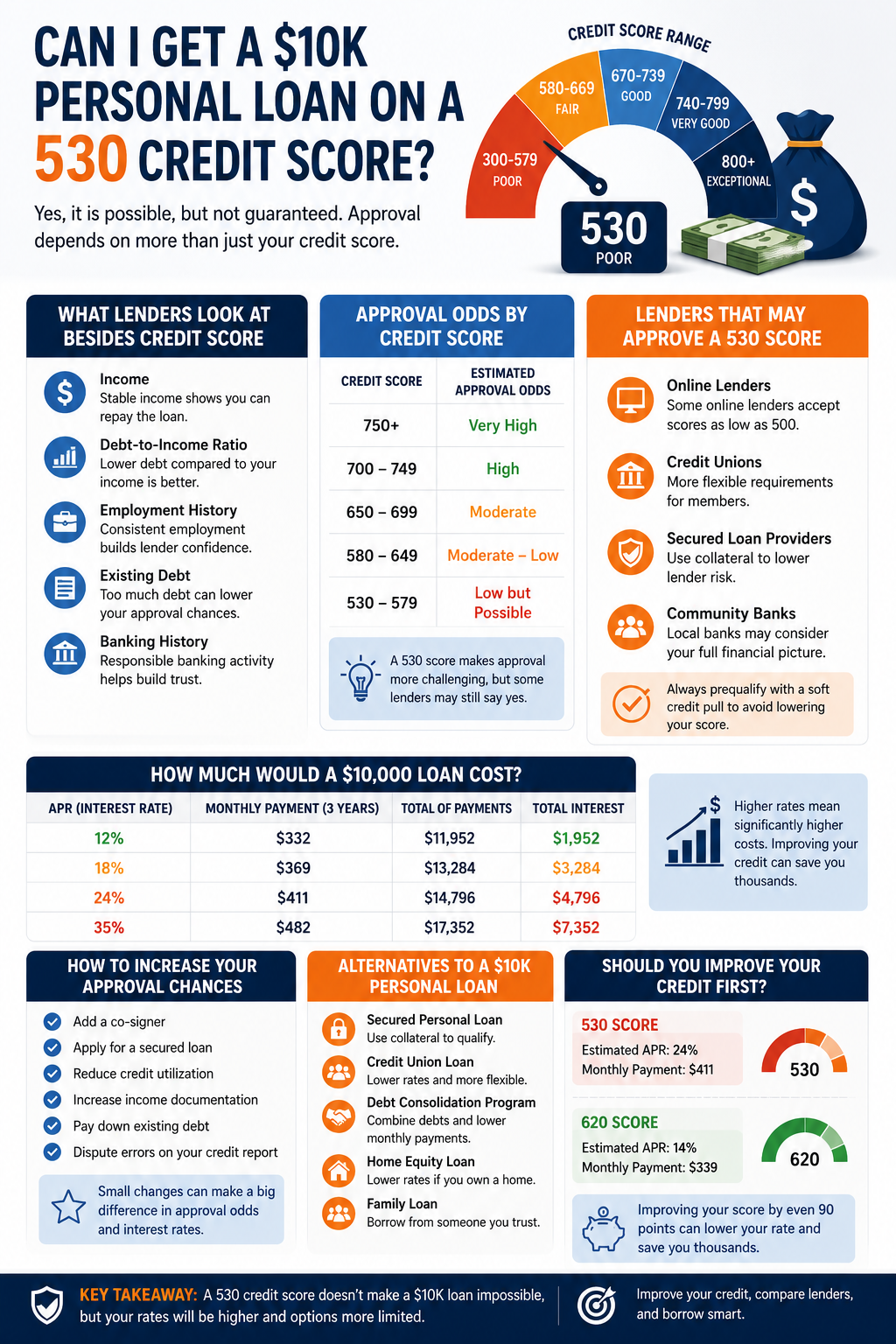
Is a 530 Credit Score Good Enough for a $10,000 Personal Loan?
A 530 credit score falls in the Poor range (300 to 579) on the FICO scale. Most banks decline applications at this level. Some online lenders and credit unions will consider it. Approval at 530 is possible but not standard, and the cost of borrowing is significantly higher than at 580 or 620.
| FICO Score Range | Rating | $10K Loan Approval Odds | Typical APR Range |
|---|---|---|---|
| 800+ | Exceptional | Very High | 7–14% |
| 740–799 | Very Good | High | 10–18% |
| 670–739 | Good | Moderate–High | 14–22% |
| 580–669 | Fair | Moderate | 20–30% |
| 530–579 | Poor | Low but Possible | 25–36% |
| 300–529 | Very Poor | Very Low | 30%+ or denied |
A 530 score tells lenders you carry elevated repayment risk. It does not tell them you are unqualifiable. The question lenders are asking at this level is not just whether you will repay. They are asking whether your income, employment, and debt load make repayment realistic at the amount you requested.
As a credit union loan officer reviewing applications from borrowers in the 500 to 580 range would observe, the two files that most often produce an approval despite the low score are the one with long employment history at the same employer and the one where existing monthly obligations are well below 40 percent of gross income, because those two factors tell a different story than the score alone.
What Do Lenders Look at Besides Credit Score?
At 530, lenders weight income, debt-to-income ratio, and employment stability more than they would for a higher-score borrower. Some online lenders also factor in education and career field. These inputs can compensate for a low score and produce an approval the score alone would not justify.
| Factor | What Lenders Want to See | Why It Matters at 530 |
|---|---|---|
| Annual Income | Enough to cover the monthly payment without strain | At 530, income often carries more weight than the score itself. A $60,000 salary with low debt changes the approval picture. |
| Debt-to-Income Ratio (DTI) | Below 36% preferred. Up to 43% considered by some lenders. | A low DTI signals that even at a high APR, the borrower can handle the payment without default risk. |
| Employment History | Same employer or field for 12–24+ months | Job stability tells lenders your income is consistent and unlikely to disappear after approval. |
| Recent Delinquencies | No late payments in the last 12 months preferred | A borrower at 530 with no recent lates is a different risk profile than one at 530 with a 90-day late from last quarter. |
| Open Collection Accounts | None, or small resolved ones | Open collections signal active financial instability. They reduce approval odds more than the base score at this tier. |
| Banking History | Active checking or savings account in good standing | Lenders use banking stability as a proxy for financial management behavior. |
| Co-Signer or Collateral | Strong co-signer credit (670+) or qualifying asset | Either one reduces the lender's exposure and can move a declined file to an approved one. |
Which Lenders May Approve a $10K Loan With a 530 Credit Score?
Online lenders with alternative underwriting models and federal credit unions are the most realistic options at 530. Traditional banks are unlikely to approve a $10,000 unsecured personal loan at this score level. Always use soft-pull pre-qualification before submitting any full application that triggers a hard inquiry.
| Lender Type | Min Score | Key Consideration at 530 | APR Range |
|---|---|---|---|
| Upstart | 300 (no formal minimum) | AI model uses education, employment, and income. Viable at 530 with solid income and no open collections. | ~7–36% |
| OneMain Financial | No minimum published | Evaluates income and expenses individually. Offers secured loan option to improve approval odds. | 18–35.99% |
| Avant | ~580 (can vary) | Serves fair and bad credit borrowers. Borderline at 530. Income and DTI are critical inputs. | 9.95–35.99% |
| LendingPoint | ~580 | Uses broader financial data beyond score. Pre-qualify with soft pull before applying. | ~7.99–35.99% |
| Federal Credit Union | Varies (most consider 500+) | APR capped at 18% by law. Manual underwriting possible. Membership required. | Up to 18% |
| Secured Personal Loan | Often none | Collateral removes credit risk. Opens more lenders and lowers APR at any score level. | 10–25% |
| Traditional Bank | 620–680 typical | Unlikely to approve $10K unsecured at 530. Not worth a hard inquiry without pre-qualification first. | N/A at 530 |
Applying to a lender that denies you at 530 leaves a hard inquiry on your file and costs 5 to 10 score points. Before you apply anywhere, understand exactly how hard inquiries affect your score and when they stop counting against you, so you can time your applications strategically.
How Much Would a $10,000 Loan Cost With a 530 Score?
At the average bad credit APR of 30.25% from LendingTree Q4 2025 data, a $10,000 personal loan over 36 months costs approximately $15,400 in total repayment. That is $5,400 in interest on a $10,000 loan. Improving the score before applying is not just about getting approved. It is about the total cost of what you borrow.
| APR | Monthly Payment (36 mo.) | Total Repayment | Total Interest Paid |
|---|---|---|---|
| 18% (federal credit union cap) | $361 | $12,996 | $2,996 |
| 22% (fair credit range) | $381 | $13,716 | $3,716 |
| 26% (lower bad credit) | $402 | $14,472 | $4,472 |
| 30.25% (LendingTree avg bad credit, Q4 2025) | $428 | $15,408 | $5,408 |
| 36% (near predatory cap) | $460 | $16,560 | $6,560 |
The math is straightforward. At 30.25% APR with a 5% origination fee, a $10,000 loan nets you $9,500 and costs $5,400 in interest. The effective cost of borrowing approaches $6,000 on a $10,000 request. That gap is exactly why improving the score before applying is worth the 60-day effort. The savings are not theoretical. They show up in every monthly statement for three years.
At 530, What Is Actually Keeping Your Score Down?
A free 3-bureau audit across Equifax, Experian, and TransUnion shows every item on your report. Inaccurate collection accounts, wrong delinquency dates, and reporting errors are the most common suppressors in the 500 to 580 range. Removing one inaccurate entry can produce 30 to 60 points in a single dispute cycle, which changes the lender pool and the rate you receive.
Get My Free 3-Bureau Audit → Secure · 2 minutes · No credit card requiredHow Can You Increase Approval Chances at 530?
Six actions improve approval odds at 530. Three produce results within 30 to 60 days. Run all of them simultaneously rather than one at a time to compress the timeline.
A co-signer's credit profile is evaluated alongside yours. Lenders including Upgrade and Avant allow co-signers on personal loans. The co-signer's stronger score shifts the application from a denial to an approval and reduces the offered APR. Both parties share equal repayment responsibility. Discuss this commitment in full before applying jointly.
Timeline: Immediate | Most effective single action for approval at 530A secured loan uses a savings account, certificate of deposit, or vehicle title as collateral. The lender's risk drops when collateral is pledged, which opens more lenders and lower APRs. OneMain Financial and many credit unions offer secured personal loan products with no published minimum credit score. A secured loan approval also starts building the positive payment history that lifts the score for the next application.
Timeline: Immediate | Lowers APR 5–10 points vs. unsecured at same scorePull your free reports from AnnualCreditReport.com. Identify collection accounts with wrong balances, incorrect delinquency dates, duplicate entries, or accounts you do not recognize. File disputes at each bureau where the inaccuracy appears. A single removed inaccurate collection can produce 30 to 60 points within 30 to 45 days, often moving a 530 into the 580 to 590 range where more lenders participate and offered rates drop. Repairing your credit score quickly starts with identifying which specific items are suppressing your score, not with applying to more lenders at the same score level.
Timeline: 30–45 days | Potential: 30–60 points per removed inaccurate itemCredit utilization controls 30% of the FICO score. The bureau receives the balance shown on your statement close date, not the payment due date. Pay balances down before the statement closes. Getting cards from high utilization to below 30% produces 20 to 40 score points within one billing cycle of 25 to 35 days. Below 10% produces even more. This is the fastest lever available at no cost and with no dispute process required.
Timeline: One billing cycle (25–35 days) | Potential: 20–40 pointsInclude W-2 employment, 1099 freelance income with 24 months of tax returns, Social Security, rental income, and any other verifiable recurring income. Each documented source improves the debt-to-income calculation. A higher stated income on a lower DTI makes the requested payment look more manageable to the underwriting model, which is the calculation that actually determines whether the amount requested gets approved.
Timeline: Immediate | Prepare documentation before the first applicationFederal credit unions cap personal loan APRs at 18% by law, well below the 30.25% average for bad credit borrowers at commercial lenders. Membership requirements vary by employer, military affiliation, geographic area, or association. Joining typically costs $5 to $25. Credit unions frequently use manual underwriting for members, which means a loan officer reviews the full file rather than relying on the automated model that declines most 530 applications at banks before a human ever sees them.
Timeline: 1–3 days to join | APR cap: 18% by federal lawShould I Repair My Credit Before Applying?
Yes, if you can wait 60 to 90 days. The financial difference between borrowing at 530 and borrowing at 580 or 620 is $3,000 to $4,000 in total interest on a $10,000 loan. That savings comes from 60 days of focused credit work, not 60 months of higher payments.
The fastest path from 530 to 580 uses three simultaneous actions: disputing inaccurate entries across all three bureaus, paying credit card balances below 30% before the next statement closes, and setting autopay on every account to prevent new delinquencies. All three can run in parallel. Running them at the same time compresses a six-month timeline into 30 to 60 days for most borrowers.
Late payments are one of the most common score suppressors in the 500 to 580 range. Understanding how late payments affect your credit report and which removal strategies actually work shows the specific steps available for recent delinquencies, goodwill letters for isolated incidents, and how to rebuild payment history after a rough period.
What If My Loan Application Is Denied?
A denial is not a final answer. It is information. The lender is required by law to send a written adverse action notice explaining why. That notice tells you exactly which factors drove the decision, which tells you exactly what to address before applying again.
Under the Equal Credit Opportunity Act, lenders must send a written explanation of every denial. This notice lists the specific reasons. Common reasons include score too low, DTI too high, insufficient income, recent delinquency, or open collection accounts. Each reason is a specific repair target, not a permanent barrier.
Go to AnnualCreditReport.com. Match what the adverse action notice says against what appears on each report. If the denial cites a collection account, verify the balance, date, and creditor are all accurate. If anything is wrong, file a dispute immediately. Inaccurate items that caused the denial are disputable and removable without any agreement from the creditor.
A denial for $10,000 does not mean the lender will deny $5,000. Some lenders will approve a smaller amount at 530 when the full amount exceeds their risk threshold. Ask what amount they would consider, or pre-qualify at a reduced amount. A smaller approved loan with consistent on-time payments builds the credit history that makes the full amount accessible on the next application.
Each hard inquiry costs 5 to 10 points. Multiple inquiries in a short window compound the score damage. After a denial, use the 60-day window to dispute inaccurate entries, reduce utilization, and avoid new applications. Then reapply when the score has improved and the factors cited in the adverse action notice have been addressed. Note that canceling a loan application can still impact your score depending on when in the process you withdraw, so timing matters on both the application and the cancellation side.
Avoid stacking hard inquiries | Each one costs 5–10 pointsWhat We See From Borrowers With 530 Credit Scores
After reviewing thousands of files in the 500 to 580 range, the same patterns appear. The score is rarely the only thing standing between the borrower and an approval. What the file shows alongside the score is usually the determining factor.
The income story wins more than the score story. A client at 532 with $72,000 in annual income, two years at the same employer, and no open collections got approved for $9,500 at 28% APR through a regional credit union using manual underwriting. A different client at 561 with $31,000 income, four open collections, and a 90-day late from eight months ago was denied by every lender they tried. The higher score did not help because everything else in the file contradict it.
Applying without pulling the report first is the most costly mistake. Two clients in the same month applied for personal loans without reviewing their bureau reports. Both had inaccurate collection accounts with wrong dates. One had a duplicate entry from the same debt reported twice. Both were denied. Had they disputed first, 30 to 45 days of dispute work would have removed those entires and likely moved both scores above 580. Instead, they each took hard inquiries, lost 10 to 15 combined points, and still had the inaccurate items suppressing the score.
Not all 530 scores are built the same. A 530 from a thin file with no derogatory marks responds very differently to lenders than a 530 built from charge-offs, multiple collections, and recent late payments. The first borrower often gets approved at modest rates through a credit union. The second borrower needs a repair strategy before any lender will approve at a rate that makes financial sense. Knowing which type of 530 you have determines which path to take first.
From the perspective of a loan underwriter reviewing two 530-score files side by side, the file with stable employment for three years, a DTI below 30%, and no accounts in collections will receive an approval offer at a rate 8 to 12 points lower than the file with the identical score but recent delinquencies and four open collection accounts, because the score is the starting filter, not the ending decision.
Can I get a $10,000 loan with a 530 credit score?
Yes, through certain online lenders and credit unions. Upstart uses an AI underwriting model with no formal minimum score. OneMain Financial evaluates income and expenses individually and offers secured loan options. Traditional banks at this score level are unlikely to approve. Approval depends heavily on income, debt-to-income ratio, and employment history alongside the 530 score.
Which lenders accept a 530 credit score?
Upstart (no published minimum), OneMain Financial (no published minimum), some federal credit unions, and lenders offering secured personal loans. Avant and LendingPoint typically require scores closer to 580 but may consider 530 with strong income. Always pre-qualify with a soft pull before submitting full applications that trigger hard inquiries.
Will applying hurt my credit score?
A full application triggers a hard inquiry costing 5 to 10 points. Pre-qualification with most online lenders uses a soft pull and does not affect the score. Use soft-pull pre-qualification to compare offers first. If you apply to multiple lenders for the same loan type within a short window, FICO typically counts the inquiries as one, reducing the total penalty.
Can I get approved with collections on my report?
Sometimes. Open collections reduce approval odds more than most borrowers realize, especially with automated underwriting models. A collection account with an incorrect balance or wrong date is disputable and may be removable through the FCRA dispute process. Removing even one inaccurate collection can shift a 530 score by 30 to 60 points and change approval odds at lenders who previously declined.
Does income matter more than credit score at 530?
For lenders who approve at this tier, often yes. Upstart and OneMain both use income, employment, and non-credit factors to evaluate applications. A borrower with $65,000 income, low DTI, and a 530 score has a meaningfully better approval chance than a borrower with $28,000 income and the same score.
What APR should I expect with a 530 score?
Expect 25 to 36% APR on unsecured loans at 530. LendingTree Q4 2025 data shows an average of 30.25% for bad credit borrowers. Federal credit unions cap APR at 18% by law. A secured loan can reduce the APR by 5 to 10 points compared to unsecured at the same score level.
Should I improve my credit before applying?
Yes, if you can wait 60 to 90 days. Moving from 530 to 580 opens more lenders and reduces the offered APR. On a $10,000 loan over 36 months, a 10-point APR reduction saves approximately $1,700 in total interest. The fastest path is disputing inaccurate bureau entries, reducing credit card utilization below 30% before the next statement close, and setting autopay to prevent new delinquencies, all three running simultaneously.
Know What Is Suppressing Your Score Before You Apply for Any Loan
A free 3-bureau audit shows every item Equifax, Experian, and TransUnion are reporting right now. Inaccurate collection accounts, re-aged delinquencies, and wrong balances are the most common suppressors in the 500 to 580 range. Removing them changes what lenders see before they run a single calculation. 20+ years in business. 3,000+ five-star reviews. 100% money-back guarantee on inaccurate item removal.
Get My Free Credit Blueprint → Secure · No hard inquiry · No credit card required-
Is It Possible to Get a Personal Loan With a 500 Credit Score? The closest parallel to your situation. Covers how lenders view borrowers in the 500 range, which online lenders are more flexible than banks, what terms to expect, and the exact strategies Joe uses with clients to position them for approval before the first application is submitted.
-
Does Paying Off Collections Improve Your Credit Score? The Truth Based on analysis of 127 client files, 42% saw no score change after paying a collection. This covers when paying helps, when it does not, and what pay-for-delete and dispute strategies produce better outcomes than simple payment for borrowers trying to reach 580 before a loan application.
-
Late Payments on Credit Report: Removal Guide Late payments are one of the most common reasons a score sits at 530. This covers proven removal strategies including credit disputes, goodwill letters, and pay-for-delete negotiations, plus how to rebuild the payment history factor that controls 35% of the FICO score as quickly as possible.