

What Is Considered a Good FICO Score in 2026?
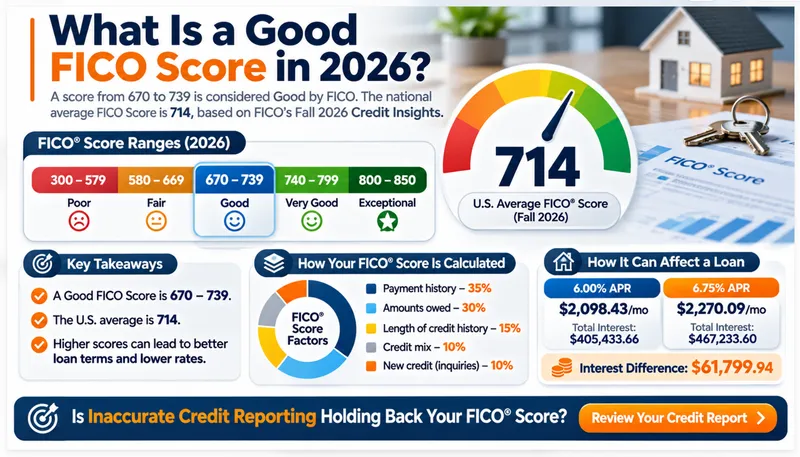
What is considered a good FICO score in 2026? A FICO Score between 670 and 739 falls within the Good credit category, while scores of 740 or higher qualify as Very Good or Exceptional. According to FICO's Fall 2026 Credit Insights report, the average U.S. FICO Score is 714, based on April 2026 data. That places the typical American consumer within the Good range, but below the 740 threshold associated with the next credit score category.
A good FICO Score does not guarantee loan approval or the lowest available interest rate. Lenders also evaluate income, debt-to-income ratio, payment history, and the type of financing requested. FICO identifies payment history as approximately 35% of a typical score calculation, followed by amounts owed at 30%. Together, these categories account for roughly 65% of the standard scoring framework, making on-time payments and credit utilization important factors in maintaining strong credit.
The financial impact of borrowing terms can be substantial. On a hypothetical $350,000 mortgage over 30 years, a 6.00% interest rate produces a monthly principal-and-interest payment of approximately $2,098, compared with $2,270 at 6.75%. That difference adds up to approximately $61,800 in additional interest over the full loan term. These rates are illustrative, not offers tied to specific FICO Scores.
This guide explains the five FICO Score ranges, how lenders interpret them in 2026, and which credit habits can help consumers improve their scores.
What Is Considered a Good FICO Score in 2026?
What is considered a good FICO score? On FICO's standard base scale, 670 to 739 is Good, 740 to 799 is Very Good, and 800 to 850 is Exceptional. Those labels describe risk categories, not approvals.
The harder question is whether your Good score is good enough. A 700 FICO Score is officially Good, but it does not automatically earn the lowest mortgage rate, the best auto financing offer, or every premium credit card.
FICO's Fall 2026 Credit Insights report, published August 25, 2026, puts the U.S. average at 714. That figure held flat from October 2025 to April 2026, and it sits inside the Good range.
The score a lender uses depends on the credit bureau, the scoring model, and the credit product. The free score on your banking app is often a different model from the one a lender pulls.
This article gives you the official ranges and what they mean for mortgages, auto loans, and credit cards. It also explains why your scores differ, how mortgage scoring changed in 2026, and how to find what holds your score back.
What Is Considered a Good FICO Score in 2026?
A standard base FICO Score of 670 to 739 is Good. A score of 740 to 799 is Very Good, and 800 to 850 is Exceptional. These are scoring categories, not approval rules: each lender sets its own cutoffs, and the category does not guarantee approval or a specific rate.
What Are the FICO Score Ranges?
Base FICO Scores run from 300 to 850 in five categories: Poor (300 to 579), Fair (580 to 669), Good (670 to 739), Very Good (740 to 799), and Exceptional (800 to 850). Industry-specific scores, such as auto and bankcard scores, run from 250 to 900.
| FICO Score | Category | General Lender Interpretation | Practical Next Step |
|---|---|---|---|
| 300 to 579 | Poor | Highest credit risk on FICO's scale | Pull all three reports, check accuracy, bring accounts current |
| 580 to 669 | Fair | Below the 714 national average; lenders price for added risk | Find what is holding the score back, then fix or dispute it |
| 670 to 739 | Good | Acceptable risk to most lenders; each lender sets its own tiers | Ask what the next pricing tier requires |
| 740 to 799 | Very Good | Lower risk; stronger offers | Compare lenders and confirm other underwriting factors |
| 800 to 850 | Exceptional | Lowest risk on the scale | Shop for the best terms; score is rarely the limit |
Is 670 a Good FICO Score?
Yes. A 670 is the lower boundary of the Good category, so one point lower lands in Fair. See our guide to a 670 credit score for details.
Is 700 a Good FICO Score?
Yes, 700 is Good. Rates and approvals still depend on income, debt, and the product you want.
Is 740 a Good FICO Score?
740 is better than Good: it opens the Very Good category. The step from 739 to 740 changes the label, and your lender decides whether it changes your price.
Is 800 an Excellent FICO Score?
800 to 850 is officially Exceptional, FICO's top category. Our 750 credit score guide covers the Very Good range.
What Is the Average FICO Score in 2026?
FICO's Fall 2026 Credit Insights report, published August 25, 2026, puts the U.S. average FICO Score at 714 as of April 2026. That is unchanged since October 2025 and falls in the Good category.
FICO's release says the average is flat from October 2025 to April 2026 and down one point from a year earlier. Experian reports a different number, 713, from September 2025 data in an analysis published March 30, 2026. The two figures measure different dates, so use FICO's 714 as the current benchmark.
An average is a benchmark, not an approval threshold. A 714 does not mean lenders approve at 714, and it does not mean they deny at 713.
Is a Good FICO Score Enough to Get Approved for a Loan?
No. A Good score meets many lenders' credit requirement, but underwriting also weighs income, debt-to-income ratio, employment, existing debt, down payment, loan-to-value ratio, and product rules. Each product also uses its own score model, which is why a Good score still gets declined or priced higher.
If your score is Good and your offer is still worse than expected, work through the diagnosis in this order. Each step names a different cause.
- Check the model. The lender pulled a mortgage, auto, or bankcard score that differs from the score you saw.
- Check the bureau. Each bureau holds slightly different data, so each produces a different score.
- Check the other factors. Debt-to-income ratio, down payment, and loan-to-value drive approvals and pricing alongside the score.
- Check the notice. A lender that denies you or gives less favorable terms based on a credit report names the agency and, in many cases, discloses the score it used.
| Product | Score Lenders Commonly Use | Other Factors | Why a Good Score Still Falls Short |
|---|---|---|---|
| Mortgage | Classic FICO or VantageScore 4.0 for loans sold to Fannie Mae and Freddie Mac | Income, debt-to-income ratio, down payment, loan-to-value ratio, property type | Pricing and eligibility depend on the full loan file, not the score alone |
| Auto loan | FICO Auto Score, per myFICO | Down payment, loan term, vehicle, income | Lender risk tiers differ, so the same score lands in different tiers |
| Credit card | FICO Bankcard Score and other issuer models | Income, utilization, existing accounts, recent applications | Premium cards set their own requirements |
| Personal loan | FICO Score 8 is often used, per myFICO | Income, debt-to-income ratio, loan amount and term | Each lender weighs its own mix of factors |
What Is a Good FICO Score to Buy a House in 2026?
For loans sold to Fannie Mae and Freddie Mac, FHFA's page (updated October 2, 2026) says Classic FICO remains an approved model. VantageScore 4.0 became available to all approved lenders on September 9, 2026, and FICO 10T is approved but not currently eligible for delivery.
Do not assume a 620 score qualifies you everywhere. Fannie Mae's Selling Guide (B3-5.1-01) says no minimum score is required for Desktop Underwriter casefiles, while manually underwritten loans carry a 620 minimum for fixed-rate loans and 640 for adjustable-rate loans. Lenders also add their own overlays.
FHA and VA loans follow separate underwriting frameworks, and no program guarantees approval at a specific score. Read our guides on pre-mortgage approval and denial at closing and why a correct report still gets denied.
What Is a Good FICO Score for a Car Loan?
A Good FICO category does not map to the same auto-loan risk tier at every lender. Lenders also weigh the down payment, loan term, and vehicle, and many use a FICO Auto Score, which runs on a 250 to 900 scale.
See our breakdown of the credit score needed to buy a car.
What Is a Good FICO Score for a Credit Card?
Card issuers use bankcard models such as the FICO Bankcard Score, and they weigh income, utilization, existing accounts, and recent applications. A Good score does not guarantee approval for any card.
Our post on why card applications fail even with good credit covers the other causes.
Score-to-Borrowing Decision Matrix
| FICO Score | Official Category | Best Next Question |
|---|---|---|
| 580 to 669 | Fair | Is my credit report accurate, and what is holding my score back? |
| 670 to 699 | Good | Does my lender's pricing improve at a higher score? |
| 700 to 739 | Good | Am I eligible for better terms, or are other underwriting factors limiting my offer? |
| 740 to 799 | Very Good | Does my lender offer better pricing at another score threshold? |
| 800 to 850 | Exceptional | Am I already eligible for the lender's best credit-based pricing? |
Does a Higher FICO Score Mean a Lower Interest Rate?
Generally yes. Lenders use risk-based pricing, so borrowers with stronger credit profiles receive lower rates on average. A higher score does not guarantee the lowest advertised rate, because income, debt, down payment, and loan terms also set the price.
The table below compares two hypothetical borrowers on the same loan. The APRs are illustrative and are not current lender offers.
| Item | Borrower A | Borrower B |
|---|---|---|
| Loan amount | $350,000 | $350,000 |
| Loan term | 30 years | 30 years |
| Illustrative APR | 6.00% | 6.75% |
| Monthly payment | $2,098.43 | $2,270.09 |
| Total interest | $405,433.66 | $467,233.60 |
| Difference | About $171.67 more per month and $61,799.94 more in total interest for Borrower B | |
Lenders set their own pricing tiers, and they price on the whole file. If a lender offers you materially less favorable terms based on a credit report, the FTC explains that it generally must send a risk-based pricing notice or a credit score disclosure notice.
Why Do You Have Different FICO Scores?
Your scores differ for three reasons: each credit bureau holds different information, lenders use different scoring model versions, and scores generate on different dates. Industry-specific FICO Scores also use a 250 to 900 range instead of the base 300 to 850.
- Different bureau data. Equifax, Experian, and TransUnion receive different updates from your creditors.
- Different model versions. FICO Score 8, 9, 10, and 10T weigh the same file differently.
- Different dates. A balance that updates after a statement closes changes the next score.
| Model | What Sets It Apart | Range |
|---|---|---|
| FICO Score 8 | The most widely used version; personal, student, and retail lenders often look at it | 300 to 850 |
| FICO Score 9 | Ignores paid third-party collections, gives unpaid medical collections less weight, and counts reported rental history | 300 to 850 |
| FICO Score 10 | Same design as earlier models, updated for trends such as the increasing use of personal loans | 300 to 850 |
| FICO Score 10T | Adds trended bureau data, which looks at balances and limits over 24 months or longer | 300 to 850 |
| FICO Auto Scores | Industry-specific scores used in most auto financing evaluations | 250 to 900 |
| FICO Bankcard Scores | Industry-specific scores for credit card decisions | 250 to 900 |
| Classic mortgage FICO | FICO Score 2 (Experian), 5 (Equifax), and 4 (TransUnion), per myFICO. Fannie Mae and Freddie Mac still accept Classic FICO. | 300 to 850 |
FICO Score vs. VantageScore: What's the Difference in 2026?
FICO and VantageScore are separate scoring model families with different algorithms, versions, treatment of credit data, and lender adoption. A free VantageScore from an app often differs from the FICO Score a lender uses. In 2026, mortgage lenders delivering loans to Fannie Mae and Freddie Mac use either one.
Both families score 300 to 850 on their base scales, but a 700 on one does not equal a 700 on the other. The categories and the underlying math differ.
The mortgage change matters most here. FHFA says VantageScore 4.0 became available to all approved lenders on September 9, 2026, while Classic FICO remains approved and FICO 10T is not yet eligible for delivery. Your free score is a useful trend signal, but it is often not the score your lender pulls.
What Factors Determine Whether You Have a Good FICO Score?
FICO publishes five general factors: payment history (35%), amounts owed (30%), length of credit history (15%), new credit (10%), and credit mix (10%). These are educational proportions, and the importance of each varies from one person to another.
| Factor | General Weight | What Drives It |
|---|---|---|
| Payment history | 35% | Late payments, collections, accounts reported delinquent |
| Amounts owed | 30% | Revolving utilization and account balances |
| Length of credit history | 15% | Age of your oldest and average accounts |
| New credit | 10% | Recent applications and newly opened accounts |
| Credit mix | 10% | The types of accounts you hold |
Here is a hypothetical that separates two causes. A card has a $10,000 limit and a $4,500 balance, so utilization is 45%. That is a real balance, and paying it down is the fix.
Now suppose your statement shows a $1,500 balance, but the report shows $4,500. Utilization reads 45% instead of 15%, and the problem is an inaccurate reported balance, which a dispute addresses.
Our guide to how a FICO score works covers each factor in more detail.
How to Improve Your FICO Score From Fair to Good
Start with your credit reports and fix what is wrong before you change anything else: dispute genuine errors, bring delinquent accounts current, lower revolving balances, and keep every payment on time. Your starting profile decides which steps matter most. No fixed point gain or timeline exists.
- Obtain your credit reports. All three bureaus provide free weekly reports at AnnualCreditReport.com.
- Review balances and payment histories. Compare each account to your statements.
- Identify inaccurate information. Mark every entry that does not match your records.
- Dispute genuine reporting errors. File with the bureau and the furnisher, with evidence.
- Bring delinquent accounts current where feasible. Accurate delinquencies recover through repayment and time.
- Reduce revolving balances. Lower reported balances improve utilization.
- Maintain on-time payments. Payment history carries the most weight.
- Avoid unnecessary credit applications. A hard inquiry typically lowers a FICO Score by less than five points, according to myFICO.
- Monitor changes. Scores update as lenders report new information.
How Long Does It Take to Reach a Good FICO Score?
No universal timeline exists. A correction of inaccurate information follows the dispute process, while improvement through repayment follows your payment behavior over months.
Two examples show the difference, with no promised outcomes. A wrong late payment responds to a dispute, and the bureau has 30 days to reinvestigate, or 45 days with new information. High card balances respond to repayment, and the score moves as each issuer reports a lower balance.
Score Improvement Checklist by Profile
- ✓High balances: list every revolving balance and limit, pay down the highest-utilization card first, and avoid new purchases on it
- ✓Late payments: confirm each one against your records, dispute any that are wrong, and bring accurate ones current
- ✓Reporting errors: document each error, send the dispute with evidence, and recheck the report after the investigation
What Is Holding Your Score Back?
| What You Find | Your Next Step |
|---|---|
| High utilization | Review balances and repayment |
| Incorrect late payment | Gather records and dispute |
| Thin credit file | Build an accurate positive credit history |
| Recent hard inquiries | Avoid unnecessary applications |
| Accurate delinquency | Address repayment and recovery |
What If Your FICO Score Is Low Because of Credit Report Errors?
Scores calculate from credit report data, so inaccurate data produces an inaccurate score. Incorrect late payments, duplicate accounts, wrong balances, accounts belonging to another consumer, wrong statuses, and identity theft accounts all lower scores. The Fair Credit Reporting Act gives you the right to dispute them.
Document each error with statements, payment confirmations, and identity records. Then file a dispute with the credit bureau and the company that reported the information. Our guides on disputing credit report errors and the TransUnion dispute process show how.
Accurate negative information is not removable just because it lowers a score. The FTC puts the reporting period at seven years for most items, and a dispute does not change that.
Should You Pay for Credit Repair to Get a Good FICO Score?
Only if you have a reporting-accuracy problem and want help with the disputes. You have the right to dispute inaccuracies yourself for free. Credit repair addresses report accuracy, and it does not guarantee a score increase or a Good FICO Score.
The FTC states that disputing mistakes on your credit report is free. A service saves time on follow-up, but it does not give you a right you lack.
Separate reporting errors from legitimate problems. A high balance you owe or a payment you missed is accurate, and repayment fixes it.
Federal law (15 U.S.C. 1679b) bars a credit repair company from charging before it fully performs the service.
Is Inaccurate Credit Reporting Holding Back Your FICO Score?
A lower score does not always mean your credit report is accurate. Review your reports for incorrect balances, payment histories, and accounts before applying for your next loan.
Review My Credit Report → Secure · 2 minutes · No credit card requiredFrequently Asked Questions About Good FICO Scores
What is considered a good FICO score in 2026?
A base FICO Score from 670 to 739 is Good, and 740 to 799 is Very Good. Scores of 800 to 850 are Exceptional. FICO's Fall 2026 report puts the national average at 714, and lenders still set their own approval and pricing tiers.
Is 700 a good FICO score?
A 700 falls in the Good range of 670 to 739 and sits 14 points below the 714 national average. It meets the credit requirement for many products. Pricing still depends on income, debt, down payment, and the lender's own tiers.
Is 670 a good credit score?
A 670 is the lowest score in FICO's Good category, and 669 falls in Fair. Many lenders approve scores in this range, but each sets its own cutoffs and prices. It sits below the 714 national average, so rates are often less favorable than at higher scores.
Is 750 a good FICO score?
A 750 is Very Good, which spans 740 to 799, and sits 36 points above the 714 national average. A score in this range supports strong offers. The lender still weighs income, debt-to-income ratio, and the product before it sets your rate.
Is 800 an excellent FICO score?
FICO's category for 800 to 850 is Exceptional, its top tier. A score at 800 is as high as the category goes. You do not need an 850 for the best rates, since lenders use pricing tiers, and your income and debt still decide the final offer.
What is the average FICO score in 2026?
FICO's Fall 2026 report, released August 25, 2026, puts the national average at 714 as of April 2026. That is flat since October 2025 and down one point from a year earlier. Experian's separate 713 reflects September 2025 data published March 30, 2026.
What FICO score do mortgage lenders use in 2026?
Lenders selling to Fannie Mae and Freddie Mac use Classic FICO or VantageScore 4.0. FHFA says VantageScore 4.0 became available to all approved lenders on September 9, 2026. FICO Score 10T is approved but not yet eligible for delivery, and each loan uses one approved model.
What FICO score do car dealerships use?
Many auto lenders use a FICO Auto Score, which myFICO describes as the industry-specific score used in most auto financing evaluations. Auto scores run from 250 to 900, not 300 to 850. Dealerships work with several lenders, and each lender sets its own risk tiers.
Is FICO Score 8 still used in 2026?
Yes. myFICO calls FICO Score 8 the most widely used version, and personal, student, and retail lenders often look at it. Mortgage lenders use a different set of Classic FICO models, and card and auto lenders often use industry-specific scores based on newer versions.
Is FICO Score 10T used for mortgages in 2026?
Not yet for loans sold to Fannie Mae and Freddie Mac. FHFA approved FICO 10T, but its page, updated October 2, 2026, says it is not currently eligible for delivery. Lenders currently use Classic FICO or VantageScore 4.0, and FHFA plans to issue guidance once 10T becomes available.
Why is my FICO Score different from Credit Karma?
Credit Karma commonly shows a VantageScore, which is a different model family from FICO. Even two FICO Scores differ when they use different bureaus, model versions, or dates. A free score is a useful trend signal, but a lender often pulls another model.
What is the fastest legitimate way to improve a FICO Score?
It depends on your profile. A report error responds to a dispute, and bureaus have 30 days to reinvestigate. High balances respond to repayment as issuers report lower balances, and no source supports a guaranteed point gain or any fixed timeline for either.
Does checking your own FICO Score lower it?
No. According to myFICO, viewing your own score or report is a soft inquiry and does not affect your FICO Scores. A hard inquiry from a credit application typically lowers a FICO Score by less than five points, and it affects the score for one year.
Do you need an 850 FICO Score to get the best rates?
No. Lenders price in tiers, so scores above a tier cutoff often earn the same rate. Income, debt-to-income ratio, down payment, and loan terms also set the price, so ask where the lender's top tier begins and what it requires beyond the score.
A Good score opens the door, and the rest of the file sets the price. Check the model, check the report, and fix what is wrong before you apply.
-
FICO Score Explained: How It Works in 2026 The five factors and the model versions.
-
Credit Score Range Explained: 300 to 850 Guide Score ranges across scoring models.
-
Credit Report Correct but Denied? 7 Reasons Why What lenders weigh beyond the accuracy of your report.
-
How to File a TransUnion Dispute & Fix Credit Report Errors The dispute steps once you spot an inaccurate entry.
- FICO — FICO Score Credit Insights Report: Average FICO Score Holds Steady at 714 (August 25, 2026)
- myFICO — What is a FICO Score and why is it important?
- myFICO — FICO Score types and versions
- myFICO — What is in your credit score
- myFICO — Do credit inquiries lower your FICO Score?
- Federal Housing Finance Agency — Credit Scores (updated October 2, 2026)
- Fannie Mae — Selling Guide B3-5.1-01, General Requirements for Credit Scores
- Freddie Mac — Credit Score Models and Reports Initiative
- Experian — What is the average credit score in the U.S. (March 30, 2026)
- Federal Trade Commission — Adverse action and risk-based pricing notices
- Federal Trade Commission — Fixing Your Credit FAQs
- 15 U.S.C. § 1679b — Credit Repair Organizations Act, prohibited practices
- AnnualCreditReport.com — Free credit reports