

Why do credit repair costs vary? Consumers researching credit repair often find monthly fees ranging from less than $50 to more than $300. The difference is not always about results.
In many cases, pricing reflects the level of service, dispute volume, technology, client support, and resources provided by the company.
According to Consumer Financial Protection Bureau complaint data, credit reporting issues remain one of the most common consumer finance concerns. As more consumers seek help improving their credit profiles, companies have adopted different pricing models ranging from low-cost automated services to highly personalized programs.
Understanding what drives credit repair pricing can help consumers compare providers, avoid misleading offers, and determine whether a service provides value for their specific situation.
Why Credit Repair Costs Vary: What You're Really Paying For
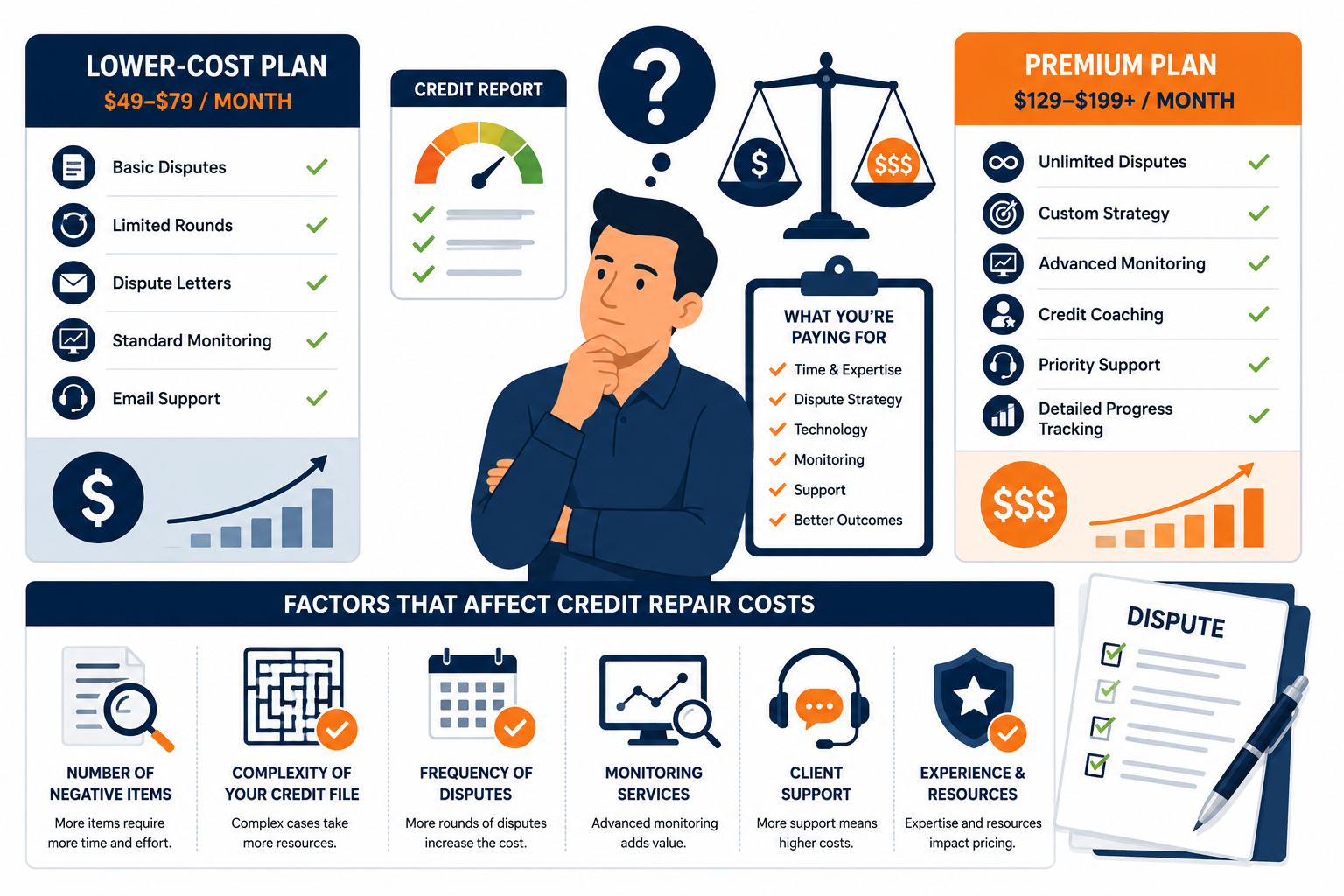
Credit repair costs vary because companies offer different levels of service, dispute volume, client support, technology, legal resources, and account monitoring. Lower-cost services often provide limited dispute activity. Higher-priced programs include personalized strategies, credit coaching, and more extensive case management.
"After 20 years running a credit repair company, I can tell you the price a company charges don't always tell you what they'll do for your file. I've seen consumers pay $200 a month for software-generated letters with no human ever looking at their report. I've also seen $79 programs where a specialist worked through every account on all three bureaus for months. The number that matters isn't the monthly fee. It's the number of negative items on the report and whether the company has a real plan to address each one."
Why Do Credit Repair Companies Charge Different Prices
Companies charge different prices because they build different operations. A low-cost service automates most of the dispute process through software. A higher-priced program staffs human reviewers, legal advisors, and case managers who work through the file by hand. Business overhead, staffing, legal access, software licensing, and client support capacity all factor into what a company charges each month.
The credit repair market has no standard pricing. The Credit Repair Organizations Act (CROA) sets legal requirements , written contracts, no upfront fees, three-day cancellation rights , but it sets no price floor or ceiling.
That leaves consumers comparing programs that look similar on paper but deliver very different levels of attention. Two companies can both say "unlimited disputes." One sends the same template letter to all three bureaus on a schedule. The other reviews each account, identifies the specific inaccuracy, and writes a targeted challenge with supporting documentation. Both call it unlimited disputes. The process behind the word is where the price difference lives.
Automation vs Human Review
Automated credit repair uses software to generate dispute letters based on information the consumer enters during signup. Letters go out on a fixed schedule. No advisor looks at the file. This model scales to thousands of clients at low overhead, which is why the price stays low.
Human-reviewed programs assign a case manager or credit specialist to the file. That person reads each account, identifies what is disputable, decides which type of challenge letter fits, and tracks the bureau response before deciding the next step. That model costs more to run, and the price reflects it.
The Biggest Factors That Affect Credit Repair Costs
Five factors drive what a company charges and how much work the file actually requires: the number of negative items across all three bureaus, the type of accounts involved (collection from debt buyer versus late payment from original creditor), how often disputes go out each month, whether credit monitoring is included, and the level of advisor support provided during the process.
- Number of negative items. A file with twelve collection accounts across all three bureaus requires more rounds of disputes, more follow-up letters, and more tracking than a file with two inaccurate late payments. Some companies recieve a flat monthly fee regardless of volume. Others tier pricing by complexity.
- Type of accounts. Collection accounts from debt buyers often require FDCPA validation requests in addition to FCRA bureau disputes. That is two seperate processes running at the same time. Programs that manage both charge more than those that only send bureau disputes.
- Dispute frequency. Some programs dispute once per month. Others dispute multiple times per cycle as bureau responses come back. More frequent dispute cycles cost more to manage but can shorten the timeline.
- Credit monitoring. Monitoring across all three bureaus requires a data subscription. Programs that include it pass that cost into the monthly fee. Those that don't may charge it separately or leave the consumer to track changes independently.
- Client support access. A program with a dedicated advisor available by phone or message costs more to staff than one with only email-based support or a client portal with no direct contact.
Cheap Credit Repair vs Premium Credit Repair
The price difference is real. So is what the price difference reflects. This isn't about which company is better. It's about which level of service matches the specific problem in the file.
- Software-generated letters
- Fixed dispute cap per month
- No human file review
- No advisor contact
- Best for: 1-2 simple errors
- Advisor assigned to the file
- Unlimited targeted disputes
- FDCPA validation requests
- Credit monitoring included
- Best for: moderate file complexity
- Dedicated case manager
- Multi-round dispute strategy
- Goodwill letters + validation
- Active follow-up every cycle
- Best for: high-complexity files with multiple collections, identity theft, or mixed file errors
"The most common mistake I see is someone with eight collection accounts on their report signing up for a $49 automated program because it seemed like enough. Six months later, nothing moved. Not because the program was a scam. Because the program wasn't built to handle that volume of work. The file needed a strategy and a person looking at it, not a letter generator running on a schedule. Definately do the math on what you actually need before choosing based on price alone."
Does More Expensive Credit Repair Produce Better Results
Not automatically. A higher monthly fee produces better results only when the additional services it includes are relevant to the specific file. A $149 program with credit monitoring, goodwill letters, and a dedicated advisor adds value for a complex file. For a file with one inaccurate late payment, those extras don't change the dispute outcome. The match between what the program provides and what the file requires determines results , not the price tier alone.
Price cannot guarantee a score increase. No company legally can , CROA prohibits guaranteeing specific outcomes. What price buys is the level of service applied to the dispute process. That service produces results only when the credit file contains inaccurate or unverifiable items the dispute process can address.
A file with accurate-only negative items , recent late payments, a legitimate bankruptcy, a repossession from last year , produces the same result at $49 or $199: minimal change from the dispute process alone. Accurate items don't delete. Time and positive payment history are what move those files.
Understanding whether credit repair is worth the cost for a specific file type , including when the ROI on a paid program is clear and when it isn't , is the question that should come before comparing program prices.
Attorney-Based Credit Repair vs Standard Credit Repair
Attorney-based credit repair programs charge more because they include legal oversight. An attorney reviews the file, directs the dispute strategy, and has the authority to pursue FCRA litigation when a bureau or creditor violates the law after a dispute. Standard programs manage the dispute process through CROA-registered specialists with no legal representation. Both use the same FCRA dispute rights. The attorney adds legal remedies , statutory damages, court filings , that standard programs cannot access.
Most credit repair files don't require legal action. The FCRA dispute process resolves the majority of reporting errors, unverifiable collection accounts, and documentation gaps without a lawsuit. Attorney oversight becomes valuable when a bureau re-inserts a deleted item, when identity theft produces accounts disputes couldn't remove, or when a creditor knowingly provided false information after a documented dispute.
Attorney-based programs typically run $100 to $200+ per month. The premium reflects the attorney's time, the legal liability oversight, and the ability to file FCRA claims when warranted. For files involving these specific situations, that premium produces access to remedies the standard process cannot.
The full breakdown of when attorney involvement in credit repair is and isn't necessary , including the specific FCRA violation types that make legal representation worth the added cost , covers the decision in detail.
Common Credit Repair Pricing Models
| Pricing Model | How It Works | Typical Cost | Best For |
|---|---|---|---|
| Monthly subscription | Flat fee per month regardless of items disputed or removed | $49-$300+/month + setup fee. Automated programs near the low end. Full-service human-reviewed programs (like ASAP Credit Repair at ~$251) toward the higher end. | Files with multiple items requiring ongoing dispute management |
| Pay-per-deletion | Fee charged only when a negative item is successfully removed | $25-$150 per deleted item | Files with a small number of targeted items to remove |
| Flat fee program | One-time fee for a defined scope of work | $200-$600 total | Simple files with a clear, limited number of issues |
| Performance-based | Fee tied to score improvement milestones | Varies , less common | Consumers who want payment tied to measurable outcomes |
As Money's 2026 credit repair review confirms, credit repair agencies typically charge between $50 to $150 per month depending on the plan, with setup fees at a similar rate. The CFPB's December 2025 action against Lexington Law and CreditRepair.com for illegal telemarketing practices is a reminder that CROA compliance and regulatory history matter when selecting a provider.
What is included in each service determines the value , not the price. A free credit report review from ASAP Credit Repair identifies what is on the file, how many items are disputable, and which program level matches the actual work required.
Get My Free Credit Report Review →What We Commonly See During Credit Reviews at ASAP
One of the most consistent observations from 20 years of reviewing credit files: the consumer's assumptions about what needs to happen rarely match the file's actual profile.
Some consumers arrive certain they need attorney involvement. The file shows two outdated collections from debt buyers who cannot validate, and a wrong date on a late payment. Standard dispute process handles all three within 90 days. No attorney needed. They were about to pay a premium for a service the file didn't require.
Other consumers show up having spent four months with a $49 automated program on a file with fourteen collection accounts, three of which report on all three bureaus under different names. Nothing moved. The program wasn't built for that volume. They needed active case management from the first month.
The price of a program matters less than whether the program matches the complexity of the file. That match is something a three-bureau review identifies in 30 minutes , before any money changes hands.
What we see most often in files where cost becomes a concern:
- Consumers on low-cost programs with complex files who see no progress after 90 days and assume credit repair doesn't work, when the actual problem was the wrong service tier for the file.
- Consumers on premium programs with two-item files who are paying for monitoring, coaching, and advisor access that adds no dispute value for their situation.
- Files where the consumer paid for credit repair before addressing utilization. High utilization isn't disputable. It responds to balance paydown. A credit repair program running alongside 80% card utilization works against itself , the score improvement from dispute wins gets partially offset by the utilization signal.
Questions to Ask Before Hiring a Credit Repair Company
As Bankrate's April 2026 credit repair review confirms, the pricing spread across reputable companies runs from $49.99 (Credit Firm, unlimited disputes) to $119+ (premium Sky Blue plans) , with service scope explaining most of that range rather than company reputation alone.
How to Determine Whether Credit Repair Is Worth the Cost
Credit repair produces the clearest ROI when: a mortgage or major loan is 3 to 6 months away and score improvement changes the rate tier, multiple disputable items exist that a dispute process can remove, or identity theft damage requires coordinated action across bureaus. The ROI calculation: if a score improvement saves $80 per month on mortgage interest, a six-month program at $100/month pays back within 7 months and saves more than $28,000 over 30 years.
The break-even math on credit repair investment works when the financial outcome it enables produces savings that exceed the program cost. A mortgage rate improvement is the most concrete example , crossing from one LLPA tier to the next saves meaningful money every month for 30 years on a standard loan.
Credit repair doesn't produce ROI when negative items are all accurate and recent. The dispute process cannot remove correctly reported late payments, legitimate bankruptcies, or valid charge-offs. A program running on that type of file produces no score change regardless of price or duration.
The guide to what credit repair involves and how the process works lays out what the FCRA dispute process can and cannot do , a baseline understanding that makes the cost-vs-value decision clearer before any company evaluation begins.
And as CNBC Select's 2026 credit repair company review confirms, reputable programs across all price tiers operate under CROA and deliver different service levels , the decision is matching the right service scope to the right file, not simply choosing the highest-rated company at the highest price.
How much should credit repair cost?
The right amount is what the file's complexity justifies. A file with one or two disputable items doesn't require a $149/month program. A file with multiple collection accounts on all three bureaus may not get results from a $49 automated service. The average range for legitimate CROA-registered programs is $50 to $150 per month plus a setup fee. Programs at either extreme of that range serve different file types. The goal is matching service scope to file complexity, not finding the cheapest or most expensive option available.
Are low-cost credit repair services effective?
For simple files, yes. A file with one inaccurate late payment and no collection accounts may resolve through an automated program at $49/month within two or three dispute cycles. For files with multiple collection accounts from debt buyers, mixed file errors, or identity theft, automated low-cost programs frequently produce no results , not because they're fraudulent, but because the file requires a more active, targeted approach than automation provides. File complexity is what determines whether a lower-cost or higher-cost program is appropriate.
-
Travel Planning and Credit Score Protection Credit repair cost decisions often connect to specific financial goals , and travel financing is one context where credit score improvement produces measurable savings on travel cards, rewards programs, and personal loans used for large trips. This covers how credit score protection fits into travel financial planning and what credit-related steps to take before applying for travel-related financing.
-
Can Credit Repair Remove Late Payments? Late payments are one of the most common reasons consumers seek credit repair , and understanding what the dispute process can and cannot do with them directly affects the cost-vs-value calculation. This covers when late payments dispute through the FCRA, when goodwill letters are the better tool, and when neither strategy produces removal because the payment history is accurate and recent. Knowing this before hiring any program saves money on programs that can't address the specific problem.
-
When Do You Need a Lawyer for Credit Repair? Attorney-based credit repair programs charge more because they include legal oversight and the ability to pursue FCRA litigation. This covers the specific situations where that premium is justified , repeated re-insertion of deleted items, identity theft that dispute alone couldn't resolve, FDCPA violations by debt collectors , and when a standard CROA-registered program addresses the file without legal representation. The decision between standard and attorney-based pricing starts with knowing whether legal remedies apply to the specific situation.