

Carter Young Inc is a debt collection agency, and if they are contacting you, reporting an account, or sending collection notices, the first step is confirming what debt they claim to own or collect. Many consumers make one mistake. They assume the collector’s records are always accurate. That is not always true. Debt can be sold, records can be incomplete, and collection reporting can contain errors that affect credit files.
From owning an established Texas credit repair company, I know that collection accounts like this come across our desk often. One case I remember involved a client who was ready to pay a collection immediately because the name on the report looked unfamiliar and urgent. After reviewing the file, the balance history did not match the reporting timeline. That changed the strategy. Instead of rushing payment, we focused on validation, documentation, and reporting accuracy first. That is often where leverage starts.
Real consumer complaints filed with the Consumer Financial Protection Bureau show common debt collection issues: attempts to collect debts not owed, poor documentation, repeated calls, and incorrect credit reporting. Consumer discussions on Reddit and credit forums show the same concern. Many people do not know whether they should dispute, negotiate, validate, or pay. The answer depends on what Carter Young Inc is reporting and whether the debt can be verified.
The better question is not only who Carter Young Inc is, but also what rights you have when dealing with them and what actions protect your credit profile.
Last quarter alone, we reviewed 17 client credit files with Carter-Young entries. Eleven of those 17 involved housing-related debt from former rental properties. In 6 of those 11 cases, the balance amount on the Carter-Young collection differed from what the client documented in their original lease agreement or move-out statement. Every discrepancy is a disputable error under the FCRA. Three accounts deleted without payment after validation requests failed to produce matching documentation.
What Is Carter Young Inc.?
Carter-Young, Inc. is a third-party debt collection agency located in Conyers, Georgia. They collect delinquent balances on behalf of housing providers, healthcare companies, utilities, and telecom businesses. They are a legitimate collector subject to the FDCPA and FCRA. Legitimacy does not mean every debt they contact you about is accurate or even yours.
Carter-Young, Inc. operates from 882 N. Main St. NW, Suite 120, Conyers, GA 30012. Their main phone numbers are 678-995-4242 and 888-995-4242. Carter-Young started operations approximately 18 years ago.
Carter-Young either purchases delinquent debts at a fraction of the original balance (often 1-10 cents on the dollar) or acts as a third-party collection agent hired by the original creditor. In either case, they report the collection account to all three credit bureaus, which damages the debtor's credit score from the moment the tradeline posts.
The company appears on credit reports under the name "Carter-Young" or "Carter Young Collections." Some consumers also see it listed as "Collectron Atlanta," which is an older trade name associated with the same company.
Who Does Carter Young Inc. Collect For?
Carter-Young collects for multifamily housing providers (apartment complexes), student housing companies, military housing providers, healthcare companies, utility companies, and telecommunications businesses. Their dominant industry is residential housing debt , unpaid rent, move-out fees, and early termination charges.
Most consumers who hear from Carter-Young previously lived at an apartment, student housing complex, or military housing community. The debt usually traces to one of four sources:
- Unpaid rent balance , rent left owing when a tenant vacated
- Move-out damages , property damage charges assessed after a tenant left
- Early lease termination fees , penalties for breaking a lease before the end date
- Utility balances , final utility bills left unpaid at a prior address
Carter-Young's client base also includes healthcare providers and telecom companies, though housing debt makes up the majority of their collection volume based on complaint patterns in the CFPB database.
Understanding what type of debt Carter-Young holds matters for your response strategy. Housing debt is often unsecured debt , it is not backed by collateral the collector can reclaim. That means their primary tools are credit reporting and the threat of a lawsuit, not repossession. Knowing this changes your negotiating position.
Carter-Young, Inc. is a Conyers, Georgia debt collector with 18 years of operation. They collect primarily for housing providers. The CFPB received 721 complaints against them, earning a Grade F reputation score. Georgia leads complaints by a wide margin. Their dominant complaint type is "debt not yours," which is the most legally significant FDCPA complaint category.
Is Carter Young Inc. a Legitimate Debt Collector?
Yes. Carter-Young, Inc. is a legally registered, legitimate debt collection agency. They are subject to the Fair Debt Collection Practices Act and the Fair Credit Reporting Act. They can report to credit bureaus, negotiate settlements, and in rare cases, pursue civil lawsuits for unpaid debts.
Legitimacy does not mean every debt they contact you about is valid. Per CFPB guidance on debt collector contact, you have the right to request written validation of any debt within 30 days of first contact. If the collector cannot validate, they must stop collecting. Carter-Young's high "debt not yours" complaint rate suggests validation requests produce results in a meaningful share of cases.
How to Tell If a Debt Collector Is Real or a Scam
Not everyone calling about a debt is a legitimate collector. Scam collectors are common. Here is how to separate real from fake:
| Check | Legitimate Collector | Scam Warning Sign |
|---|---|---|
| Written validation notice | Provides written notice within 5 days of first contact | Refuses to send anything in writing |
| Payment methods demanded | Check, ACH, credit card | Gift cards, wire transfer, cryptocurrency only |
| Physical address | Verifiable address you can look up (CY: 882 N. Main St. NW, Conyers, GA) | No verifiable address, P.O. box only |
| Threats of arrest | Cannot threaten arrest , it is FDCPA violation | Threatens police, arrest warrants |
| CFPB lookup | Appears in CFPB complaint database with responses | Not found in any government database |
| Urgency pressure | Follows lawful timeline, does not demand same-day payment | Demands payment in hours or "legal action today" |
Carter-Young appears in the CFPB's official complaint database and responds to complaints , two signs of a real, regulated collector. That is not true of phone scammers. If you receive a Carter-Young call, verify the debt is real before worrying about whether the call itself is legitimate.
What Are the 11 Words to Stop a Debt Collector?
The phrase commonly called the "11 words to stop a debt collector" is: "Please cease and desist all calls and contact with me." Sending this in writing forces Carter-Young to stop calling under the FDCPA. After receiving a written cease-and-desist, they may only contact you to confirm receipt or to inform you of a specific legal action. This stops the calls but does not eliminate the debt.
The "11 words" concept circulates widely in consumer finance communities. The actual phrase varies slightly, but the legal power behind it is real. The FDCPA , specifically Section 805(c) , gives consumers the right to demand that a debt collector stop all contact. Once a collector receives that written request, they must comply. Continuing to call after a written cease-and-desist is an FDCPA violation worth up to $1,000 in statutory damages per incident.
The cease-and-desist does not make the debt disappear. Carter-Young can still report the debt to credit bureaus, file a lawsuit before the statute of limitations expires, or contact you to inform you they are taking legal action. What it does stop is the phone calls and letters. For many people dealing with aggressive collector contact, that relief is significant.
As the FTC's official debt collection guide confirms, you have the right to stop a debt collector from contacting you by sending a written letter. The FTC recommends certified mail so you have proof of delivery.
[Your Full Name]
[Your Address]
[Date]
Carter-Young, Inc.
882 N. Main St. NW, Suite 120
Conyers, GA 30012
Re: Account Number [Account Number if known] / Original Creditor: [Creditor Name if known]
Pursuant to 15 U.S.C. §1692c(c) of the Fair Debt Collection Practices Act, I hereby demand that you immediately cease all communication with me regarding the above-referenced account.
Please cease and desist all calls and contact with me. Do not contact my employer, family members, or any third parties regarding this matter.
This letter does not constitute an acknowledgment that I owe any debt or that the amount claimed is accurate.
Sincerely,
[Your Signature]
[Your Printed Name]
Carter-Young is a legitimate collector. Legitimacy does not mean every debt is valid. The cease-and-desist letter stops calls legally under FDCPA Section 805(c). It does not eliminate the debt or prevent credit reporting. Send it by certified mail, keep proof of delivery, and pair it with a debt validation request for maximum protection.
How to Deal With Carter Young on Your Credit Report
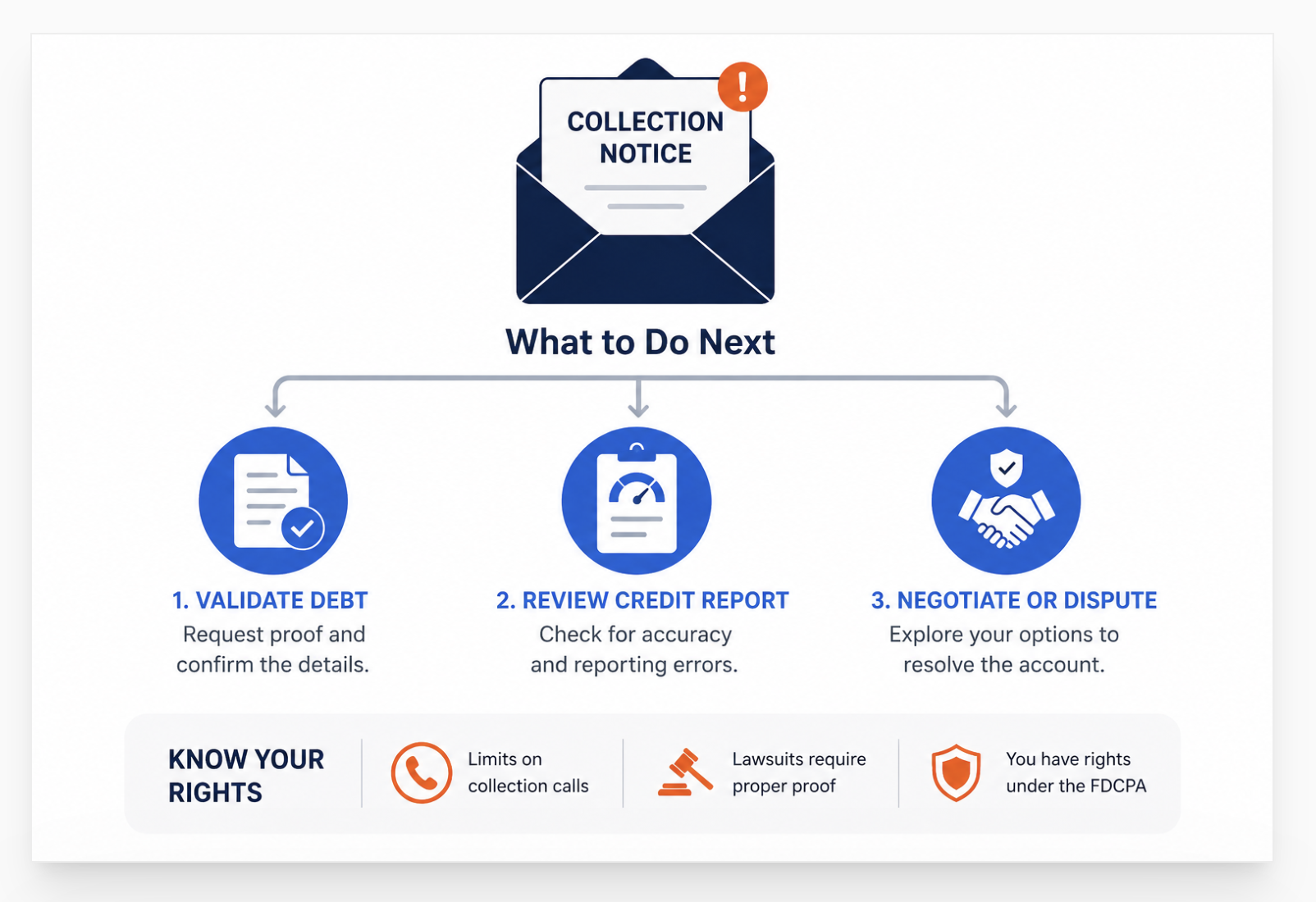
Carter-Young must prove they have the legal right to collect, the amount is accurate, and the debt belongs to you. Request: original creditor name, original account number, itemized breakdown of the balance, and documentation proving they own or are authorized to collect the debt. Send by certified mail. Their 47% "debt not yours" complaint rate suggests validation fails a meaningful portion of the time. A failed validation means the entry must be removed.
If the Carter-Young entry contains any error , wrong balance, wrong original delinquency date, account not yours, balance different from your lease agreement , dispute it at Equifax, Experian, and TransUnion on the same day. Each bureau has 30 days to investigate independently. Our guide on the TransUnion dispute timeline explains exactly how the 30-day clock works and what happens when a furnisher cannot verify. If Carter-Young cannot verify the entry within 30 days, the bureau deletes it.
If the debt is verified and valid, never pay without a written deletion agreement. A pay-for-delete offer: you pay a lump sum (start at 40-50% of the balance), Carter-Young removes the tradeline from all three bureaus. Get the agreement on company letterhead before sending a dollar. A "paid collection" notation without deletion stays on your report for 7 years , just with a "paid" status that FICO Score 8, used by 90% of lenders, treats almost identically to "unpaid." Our full guide on debt collection defense strategies covers the negotiation sequence, what language to use in the written offer, and how to handle counter-offers.
Every state sets a statute of limitations on how long a collector can sue you for an unpaid debt. Georgia's statute of limitations is 6 years on written contracts. Other states range from 3 to 10 years. If the debt is past the SOL, Carter-Young cannot sue you to collect. They can still call (until you send a cease-and-desist) and still report (until the 7-year FCRA window expires). But making any payment on a time-barred debt restarts the SOL clock in most states. Check the original delinquency date before any payment decision.
Your FDCPA Rights Against Carter Young
The Fair Debt Collection Practices Act gives you specific, enforceable rights against any third-party collector , including Carter-Young. Each violation carries statutory damages of up to $1,000 per incident plus attorney fees, which consumer attorneys often take on contingency.
Carter-Young cannot:
- Call before 8 a.m. or after 9 p.m. in your time zone
- Call your employer to reveal or discuss the debt
- Use abusive, profane, or threatening language
- Threaten arrest , unpaid civil debt is not a criminal offense
- Threaten lawsuits they do not intend to file or cannot legally file
- Continue calling after receiving your written cease-and-desist
- Report inaccurate information to credit bureaus
- Add fees or interest not authorized by the original contract
Document every call from Carter-Young: date, time, phone number shown, what was said, and who said it. If they violate any of the above rules, that documentation is the foundation of a complaint to the CFPB or an FDCPA lawsuit. The CFPB's debt collection consumer tool page lets you file a complaint directly and see their response rate.
What is Carter Young Inc. and why are they calling me?
Carter-Young, Inc. is a third-party debt collection agency based in Conyers, Georgia. They are calling because a creditor , most commonly a housing provider, utility company, or healthcare provider , hired them to collect an unpaid balance, or because they purchased that debt. Their primary industry is residential housing debt: unpaid rent, move-out fees, and lease termination charges. If they contact you, request written debt validation before making any payment or acknowledgment. Their top CFPB complaint is attempting to collect debt the consumer says is not theirs.
Who does Carter Young Inc. collect for?
Carter-Young collects for multifamily housing providers (apartment complexes), student housing companies, military housing companies, healthcare providers, utility companies, and telecommunications businesses. Most consumers who hear from them previously lived at a rental property where a balance remained unpaid. The specific original creditor must appear in the debt validation documentation Carter-Young is required to provide within 5 days of first contact.
Can Carter Young garnish my wages?
Wage garnishment requires a court judgment. Carter-Young cannot garnish wages just by contacting you. They must first sue you in civil court, win the case, and obtain a court order. If they do file a lawsuit, you receive a summons , respond in writing before the deadline. Ignoring a summons results in a default judgment that can then allow garnishment. Most collection agencies prefer payment over the expense of litigation, so lawsuits are not the norm , but they are possible, especially on larger balances.
How do I remove Carter Young from my credit report?
Four paths can remove a Carter-Young entry: 1. Dispute as inaccurate , if any data point differs from the original account documentation, dispute simultaneously at Equifax, Experian, and TransUnion. 2. Request debt validation , if Carter-Young fails to validate within 30 days of your request, the entry requires removal. 3. Negotiate pay-for-delete , pay in exchange for written agreement to delete the tradeline from all three bureaus. 4. Wait for the 7-year automatic deletion from the original delinquency date. For any medical collection held by Carter-Young, paying it triggers automatic deletion under the three bureaus' 2022 voluntary policy.
6 of 17 Carter-Young Files We Reviewed Last Quarter Had Wrong Balances
A wrong balance on a Carter-Young entry is a disputable FCRA error. You may not need to pay anything to get it removed. A free 3-bureau audit shows exactly what Equifax, Experian, and TransUnion are reporting and identifies every inaccuracy in your Carter-Young account before you make any decisions.
Get My Free 3-Bureau Audit → Secure · 2 minutes · No credit card required-
Charged Off as Bad Debt: What It Means and What to Do Carter-Young often receives accounts that the original creditor already charged off. A charge-off and the subsequent Carter-Young collection are two separate derogatory entries , each with its own 7-year reporting clock. This covers exactly what a charge-off notation means, how it differs from the collection entry, and why resolving one does not automatically resolve the other.
-
740 Credit Score: What It Gets You and How to Protect It A Carter-Young collection drops a score 50-100 points. For borrowers who started in the 700s, that drop lands them in the Fair tier where loan rates and product access change significantly. This covers what a 740 score qualifies for, what the rate differences look like above and below that threshold, and how long a resolved collection account continues to affect a score that has otherwise recovered.
-
Credit Score Needed for a Mortgage in 2026 A Carter-Young collection on your credit report affects mortgage qualification in two ways: it lowers your score into a higher rate tier, and underwriters at some lenders require all collections above a certain threshold to be resolved before closing. This covers the specific credit score thresholds for each loan program in 2026 and how a single collection account changes the mortgage products available to you.