

Getting a credit card as an international student without an SSN is challenging. But, you still have to know that it's not impossible.
Many students arrive in the United States with no American credit history, no Social Security Number, and no idea how U.S. credit works. Traditional banks often reject those applications automatically.
The best news is some issuers now evaluate international students differently. Instead of relying only on SSNs and U.S. credit files, they may review passport information, visa status, enrollment records, banking activity, or ITIN documentation.
The real goal is not just getting approved. It is starting a U.S. credit profile early so future approvals for apartments, auto loans, and better credit cards become easier later.
Credit Card for International Students Without SSN
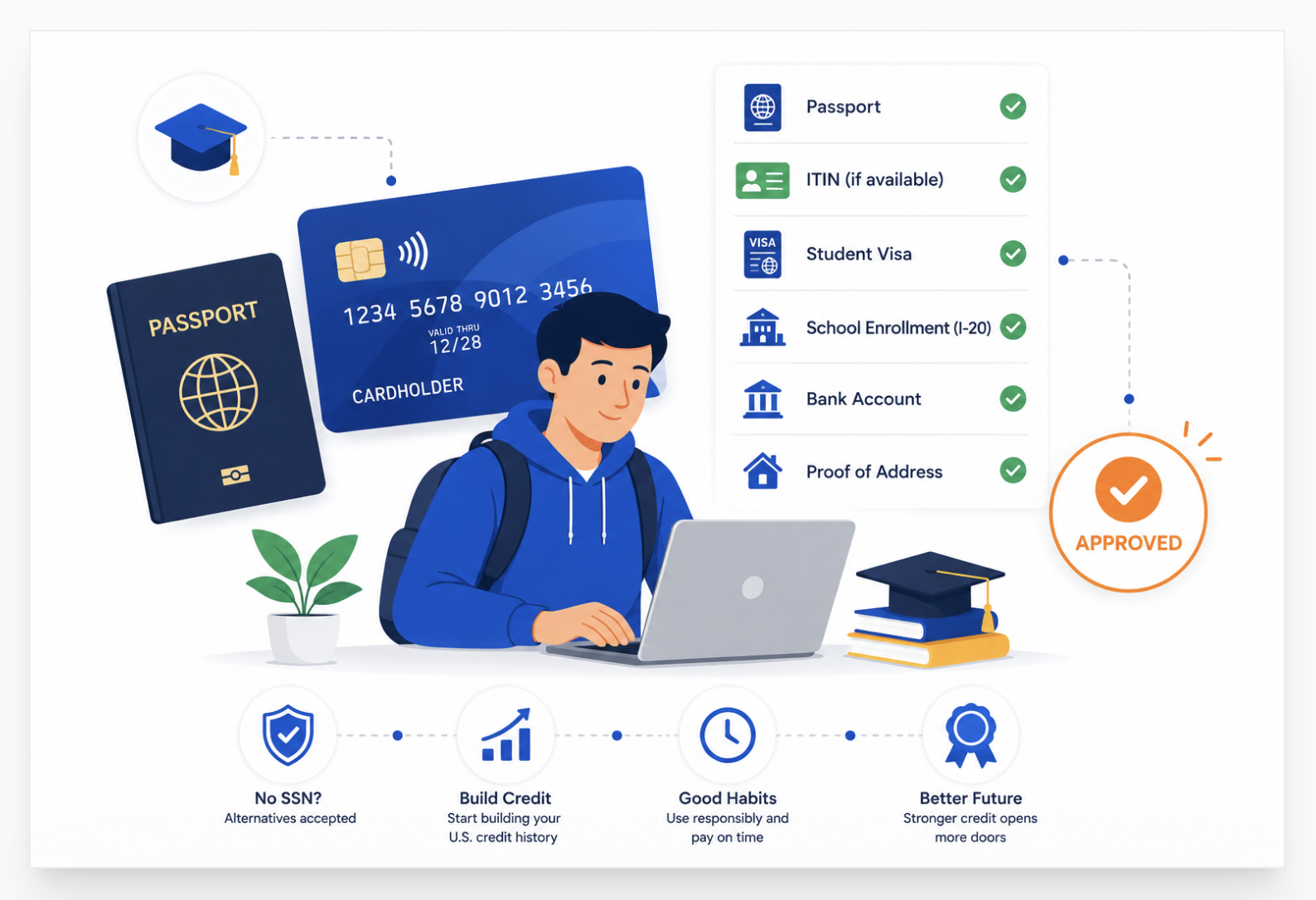
What Documents Can Replace an SSN
An ITIN (Individual Taxpayer Identification Number) is the most widely accepted SSN replacement for credit card applications. Some issuers also accept a passport, student visa, I-20 form, proof of enrollment, and a U.S. bank account. Acceptance varies by issuer. Not every bank accepts all of these alternatives.
Most students assume you need an SSN to get a credit card in the U.S. That is not accurate.
Several major issuers accept alternative documents. The key is knowing which issuer accepts what, and applying to the right one for your situation.
The ITIN is the single most powerful document in this situation. It gives you a tax identity in the U.S. It links your payment activity to a formal file. And it lets you apply to most major issuers , not just the handful that accept passport-only applications.
Apply for an ITIN through IRS Form W-7. The process takes 6-11 weeks. Start it as soon as you arrive. Do not wait until you need the card. By the time the ITIN arrives, you are ready to apply.
Best Credit Card Options for International Students Without SSN
These are the options that actually work in 2026. Each has different document requirements and approval thresholds.
| Card | SSN Required? | Accepts ITIN? | Passport Only? | Annual Fee | Builds Credit? |
|---|---|---|---|---|---|
| Capital One Savor Student | No | Yes | No | $0 | All 3 bureaus |
| Chase Freedom Rise | No | Yes | No | $0 | All 3 bureaus |
| Discover it Student Chrome | No | Yes | No | $0 | All 3 bureaus |
| Firstcard (Secured) | No | Yes | Yes | $0 | All 3 bureaus |
| Zolve Classic | No | Optional | Yes | $0 | All 3 bureaus |
| Bank of America Travel Rewards Student | No | Yes | No | $0 | All 3 bureaus |
| American Express (via Nova Credit) | No | Yes | No | Varies | All 3 bureaus |
Which Card Should You Start With
If you have an ITIN, start with Capital One Savor Student or Chase Freedom Rise. Both report to all three bureaus. Both have $0 annual fees. Both have paths to credit limit increases within 6 months.
If you do not have an ITIN yet, start with Firstcard or Zolve. Both accept passport plus I-20. Both report to the bureaus. You can always upgrade to a major bank card once your ITIN arrives and your credit file has 6 months of history.
According to NerdWallet's 2026 analysis of credit cards available without an SSN, the Chase Freedom Rise now explicitly accepts ITIN applications and requires no prior credit history. Approval odds improve when the applicant holds a Chase savings account with at least $250.
Do You Need an ITIN to Apply
No. Some issuers accept a passport and student visa without an ITIN. But having an ITIN significantly improves approval odds at major issuers. An ITIN also makes it easier to link your credit activity across products and builds a more complete tax and financial identity in the U.S. Apply for the ITIN as early as possible , the 6-11 week wait is the only bottleneck.
Firstcard and Zolve accept applications using only a passport and I-20. No ITIN needed. But these are specialist platforms with lower limits and fewer long-term upgrade paths.
Major banks , Capital One, Chase, Discover , require an ITIN. These cards carry stronger approval odds for future credit products, higher limits as history builds, and broader reporting relationships that mortgage lenders and auto lenders recognize.
The ITIN also matters beyond the credit card. It lets you file taxes on scholarship income, open certain bank accounts, and eventually apply for an SSN if you become work-eligible. It is not just a credit tool. It is the foundation of a U.S. financial identity.
How International Students Build Credit in the U.S
The line above tells the whole story. Start the card at month one. Pay in full before the statement closes. The score appears at month six. By month twelve, a 700+ score is achievable with clean behavior.
Here is the specific sequence that produces that result:
One card is enough to start. The account begins aging from the day it opens. Aging is 15% of the FICO score and cannot be rushed. Every month the account stays open is a month of credit history that counts. Starting later means delaying that clock.
Utilization is 30% of the FICO score. A $500 limit card should carry no more than $50 in charges when the statement closes. Pay the full balance before the statement close date , not the due date. The balance on the statement is what the bureau receives. Low utilization reports as low risk.
Building strong payment history early is the single most important credit action available. Autopay set to the full statement balance eliminates the risk of a missed payment, which costs 60-110 points. Payment history is 35% of the FICO score. One missed payment can erase months of progress.
Most free apps (Credit Karma, Experian app) show VantageScore. Your card issuer may show FICO. Both are useful for tracking direction. At month six, a first FICO score appears if the card reported each of the six months. A 580-620 range is common at this stage with clean behavior.
A second account , a credit builder loan or a second student card , adds credit mix and another line of payment history. It also increases total available credit, which lowers utilization percentage. Do not open multiple accounts at once. Each new account generates a hard inquiry and temporarily reduces the average account age.
According to WalletHub's 2026 analysis of credit cards for applicants without an SSN, the most effective credit-building behavior for students without a credit history is consistent on-time payments combined with low utilization across the first 12 months. Both factors together produce faster score growth than either factor alone.
Common Reasons Applications Get Denied
Many students apply and get denied. Then apply again. Each denial adds a hard inquiry. Multiple inquiries in a short period signal risk to lenders and make the next approval harder.
Here is what actually causes denials, and what to do instead:
The pattern I see in client files: a student applies to four cards in their first week. All four deny. Four hard inquiries appear on a file with zero credit history. The next issuer sees a thin file plus four recent denials. That combination is harder to overcome than starting with one well-chosen application.
This connects directly to understanding how credit profiles are evaluated by different lenders. A specialist or credit review before applying identifies which issuer fits the specific profile rather than applying to any card and generating denials. The student who researches first applies once. The student who guesses applies multiple times and gets multiple denials on a thin file.
Best Starter Strategy for New International Students
Here is the exact sequence. Follow it in order.
Week one: Open a U.S. checking account. Most major banks accept passport plus visa for international students. HSBC, Bank of America, and Chase all have international student programs. Having a bank account in good standing for 90+ days improves approval odds on card applications.
Month one: Submit IRS Form W-7 for your ITIN. Download the form from irs.gov. The university's international student office can help with the supporting documents. Mail the packet via certified mail. The wait is 6-11 weeks.
While waiting for the ITIN: If you need a card immediately, apply to Firstcard or Zolve using your passport and I-20. These cards accept international students without an ITIN. Use the card lightly , one small recurring charge , and pay in full every month. This starts your credit clock before the ITIN arrives.
When the ITIN arrives: Apply to Capital One Savor Student or Chase Freedom Rise. These are the two strongest ITIN-accepting student cards in 2026. Both report to all three bureaus. Both have no annual fee. Both have paths to credit limit increases within six months of responsible use. Knowing which scores lenders use when evaluating future applications , a mortgage, an auto loan, a lease , helps you understand why building across all three bureaus now matters more than short-term convenience.
Month six: Check your FICO score. If it is 620 or above, you qualify for a wider range of products. If it is below 600, review your utilization , that is almost always the cause for a student with no negative history.
Month twelve: Evaluate adding a second product. A credit builder loan from a credit union adds installment history to complement the revolving history your credit card creates. Both together build a stronger credit mix than either alone.
One more thing worth knowing. If an old debt from your home country or a U.S. account from a prior stay surfaces in your file and gets sent to collections, it can disrupt the credit-building plan even if you do everything right going forward. Understanding how to handle those situations , including how to negotiate with collectors before a debt appears on your report , matters for anyone building a credit file from scratch. Our breakdown of how to settle debt without resetting the reporting clock covers exactly that scenario for students who discover an old account during their credit journey.
Per Wise's international student credit card guide, students who start with a structured approach , one card, consistent payments, low balances , reach credit independence significantly faster than those who try multiple products simultaneously without a plan. The math is simple. Start clean. Stay consistent. The score follows.
Can international students get a credit card without an SSN?
Yes. Capital One, Chase, and Discover accept ITIN instead of SSN. Firstcard and Zolve accept a passport and I-20 with no ITIN required. American Express uses Nova Credit to import foreign credit history from select countries. The right card depends on what documentation you have available when you apply.
How long does it take an international student to build a credit score?
Six months of open account history generates a first FICO score. A student who opens a card in month one and pays on time each month sees a scoreable file by month six. Scores in the 620-680 range are achievable at month six with clean behavior and low utilization. A 700+ score is achievable within 12-18 months of consistent positive account management.
What is an ITIN and how do international students get one?
An Individual Taxpayer Identification Number (ITIN) is a tax processing number issued by the IRS to individuals who do not qualify for an SSN. International students apply using IRS Form W-7 with supporting identity documents , passport, visa, and one document proving foreign status. The process takes 6-11 weeks. The university's international student services office can assist with the application. Submit the W-7 as early as possible after arrival. The ITIN is the most important step for accessing major bank credit products.
Will a credit card from Firstcard or Zolve help build credit?
Yes. Both Firstcard and Zolve report payment activity to all three major credit bureaus. On-time payments on either card build payment history , the largest factor in your FICO score at 35%. The credit-building mechanism is the same as any other credit card. The only difference is the lower documentation barrier at application. Use either card the same way you would use a major bank card: small charges, full payoff before the statement closes, every month.
Building U.S. Credit From Scratch? Know Your Starting Point.
Before applying for any credit card as an international student, understand what each bureau reports on your file , even if it is nothing yet. A free 3-bureau audit shows your exact starting position across Equifax, Experian, and TransUnion so you can track your progress from month one.
Get My Free 3-Bureau Audit → Secure · 2 minutes · No credit card required-
Unsubsidized vs Subsidized Loans , What Every Student Should Know Many international students finance education through loans alongside building credit. This covers the key differences between loan types, how each affects your overall debt-to-income profile, and why loan repayment behavior starting from day one builds the same payment history that your credit card is building simultaneously.
-
What Is a Fair Credit Score and What Does It Mean Most international students reach the Fair tier (580-669) within 6-12 months of their first credit card. This covers what a Fair score means for future applications , apartments, auto loans, phone plans , and the specific actions that move a score from Fair into the Good tier where approval odds and rate terms improve significantly.
-
How to Dispute a Credit Report Error A credit report error at any of the three bureaus , wrong balance, wrong date, or an account that is not yours , can suppress the score an international student is actively building. This covers the FCRA dispute process, what documentation produces successful removals, and how to file simultaneously at all three bureaus to protect the profile from any single bureau's error.
Takeaway: Can International Students Get a Credit Card Without an SSN?
Yes, international students can get a credit card without a Social Security Number (SSN). Some banks and fintech companies accept alternative identification such as an ITIN, passport, visa documentation, school enrollment verification, or foreign credit history when evaluating applications.