
Should I pay my credit card before the statement date? Yes, especially if you want your credit report to show a lower balance.
Credit card issuers generally report account balances around the end of each billing cycle. Paying before that cutoff reduces your reported credit utilization, which can affect your FICO Score. But there's one detail many cardholders miss: your statement closing date and payment due date serve two different purposes.
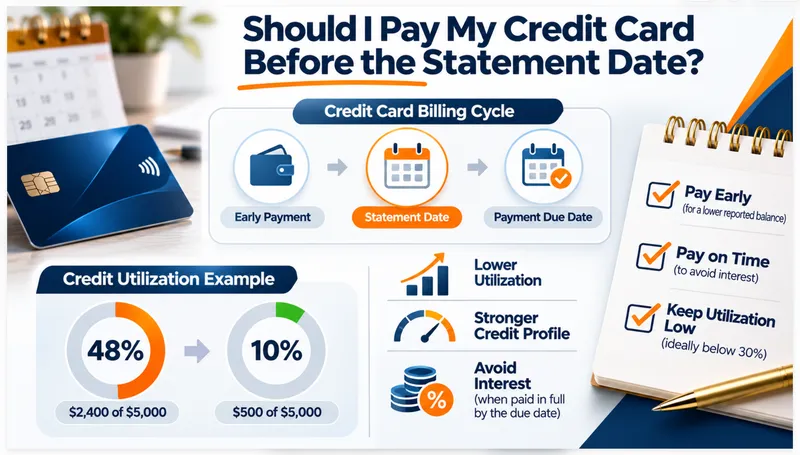
Consider someone with a $5,000 credit limit and a $2,400 balance. Their credit utilization stands at 48%. If they pay $1,900 before the statement closes, their remaining balance drops to $500, or 10%. According to myFICO, amounts owed account for 30% of a typical FICO Score calculation. Lower reported utilization generally helps, although no payment guarantees a specific score increase.
Here's where confusion starts. You can pay your credit card in full every month and still see a balance on your credit report. That's because your issuer reports account information on its own schedule, not necessarily when you make a payment.
This guide explains when to pay before the statement date, how much to pay, and why your credit report might still show a balance after you've paid. You'll also learn how to avoid interest, protect your payment history, and identify reporting errors worth disputing.
Should I Pay My Credit Card Before the Statement Date?
Should I pay my credit card before the statement date? Yes, if you want a lower balance on your credit report. myFICO states that card issuers generally report the balance you owe when your statement closes, so a payment made before that date shrinks the number the bureaus see.
Paying early does not replace the due date. Experian explains that reporting schedules vary by lender, and the CFPB says you owe no purchase interest only if you pay your balance in full by the due date. You need both dates working for you, and the steps below show how.
The math is simple. A $2,400 balance on a $5,000 limit shows 48% utilization. Pay $1,900 before the statement closes, and the report shows $500, or 10%.
This guide explains the four billing dates, how much to pay, whether to pay twice a month, and what to do when your report still shows the wrong balance.
- Should you pay before the statement date?
- Statement date vs. due date
- Does early payment improve your score?
- How much to pay before the statement closes
- Before the statement date or the due date?
- Paying twice a month
- Does early payment avoid interest?
- Should you leave a small balance?
- When your payment does not appear
- FAQ
- Pay before the statement closes to lower the balance your issuer reports.
- Pay by the due date to avoid a late payment and keep your grace period.
- The 30% figure is a guideline. myFICO states the data shows no score drop at 30%, and lower is better.
- A balance that has not updated is not an error. Reporting schedules vary by issuer.
Should You Pay Your Credit Card Before the Statement Date?
Paying your credit card before the statement date lowers the balance reported to credit bureaus and reduces credit utilization. Most issuers report balances around the end of the billing cycle, although reporting dates vary. You must still pay the required amount by the due date, and paying the full statement balance preserves an applicable purchase grace period.
Pay early when a lower reported balance matters to you. That applies in the weeks before you apply for a mortgage, an auto loan, or a new card, because lenders read the balances on your report.
Skip the early payment when your score is not the goal. If you already pay the full statement balance by the due date every month, you owe no purchase interest, and the early payment changes only the number on your report.
Statement Date vs. Payment Due Date: What's the Difference?
The statement date closes your billing cycle and sets your statement balance. The payment due date is the deadline for your required payment. Experian lists billing cycles of 28 to 31 days, and the CFPB requires issuers to deliver your bill at least 21 days before the due date.
Four terms control the timing. Each one does a different job, so mixing them up leads to late payments or a report that looks wrong.
| Term | What It Means | Why It Matters |
|---|---|---|
| Statement closing date | Last day of the billing cycle | Determines the statement balance |
| Credit reporting date | Date the issuer sends account details to a bureau | Determines which balance appears on your report |
| Payment due date | Deadline for the required payment | Determines whether your payment is on time |
| Grace period | Interest-free window on eligible purchases when conditions are met | Determines whether you owe purchase interest |
Does Paying Before the Statement Date Improve Your Credit Score?
Paying before the statement date lowers your reported utilization, and lower utilization is better for your FICO Score. The payment guarantees no specific point gain. Amounts owed carry 30% of a FICO Score, according to myFICO, and your full credit profile decides the result.
Credit utilization is your reported balance divided by your credit limit. Scoring models read the balance on your report, not the balance you owe today. myFICO also states that utilization is measured on each card and across all cards combined.
The 30% figure is a guideline, not a cutoff. myFICO states that some experts recommend keeping utilization below 30%, that the data shows no score drop once a ratio passes 30%, and that a lower ratio is better. Treat 30% as a starting point, not a pass mark.
| Reported Balance | Credit Limit | Utilization |
|---|---|---|
| $4,000 | $5,000 | 80% |
| $2,500 | $5,000 | 50% |
| $1,500 | $5,000 | 30% |
| $500 | $5,000 | 10% |
| $250 | $5,000 | 5% |
A reported balance is not the same as unpaid debt. A balance on your report does not mean you pay interest on it. You pay the statement in full, and the report still shows the figure from the closing date.
Our guide to how FICO Scores are calculated breaks down the five factors, and the credit utilization guide covers per-card and overall ratios. For where your score lands, read understanding your credit score range.
How Much Should You Pay Before the Statement Closes?
Pay enough to bring your balance to the utilization you want reported, and pay it early enough to post before the statement closes. A $5,000 limit with a $2,400 balance sits at 48%. A $1,900 payment cuts that to $500, or 10%.
Start with your target. myFICO suggests keeping utilization below 10% to build and maintain a good score, and many people choose 30% as a first goal. Multiply your limit by your target percentage, then subtract that amount from your balance to find your payment.
Your payment must post before the closing date, not merely start on it. Posting time varies by bank and payment method, so check your issuer's cutoff and pay a few days ahead.
Is It Better to Pay Before the Statement Date or Due Date?
Pay before the statement date for lower reported utilization, and pay by the due date to meet your payment obligation. The two payments do different jobs, so the best approach uses both. The early payment lowers the reported balance, and the due-date payment clears the rest.
Your goal decides the timing. The table matches each goal to one action.
| Your Goal | Recommended Action |
|---|---|
| Lower reported utilization | Pay down the balance before the issuer's reporting cutoff |
| Avoid purchase interest | Pay the full statement balance by the due date, provided the grace period applies |
| Avoid late fees | Pay at least the required minimum by the due date |
| Prepare for a mortgage or card application | Check reported balances and payment timing before the lender checks credit |
| Manage a tight budget | Prioritize required on-time payments, and add extra payments when affordable |
| Correct a wrong reported balance | Confirm the reporting date, then dispute an actual error |
Preparing for a loan? Read our guide to fixing credit issues before applying for a loan and time your payments around the application date.
Set autopay for the statement balance as a safety net. If a payment fails and your issuer reports it late, see our guide on late payments on your credit report.
What Happens if You Pay Your Credit Card Twice a Month?
Paying twice a month keeps your balance lower through the cycle and lowers the balance on your statement. Each payment reduces what you owe, and the balance at closing is the one your issuer reports. Two payments cost nothing extra and help cash flow.
Make one payment mid-cycle and one a few days before the statement closes. If you spend $1,200 over the month and pay $600 on day 15 and $500 on day 27, the closing balance falls to about $100, plus any new charges.
myFICO suggests making multiple payments during the month to keep the balance low. You still owe the required payment by the due date, so the twice-a-month habit adds to your due-date payment and does not replace it.
Does Paying Before the Statement Date Avoid Interest?
Paying early reduces your interest only if you leave a balance after the due date. You avoid purchase interest by paying your balance in full by the due date, according to the CFPB. A payment before the statement date helps your report, and the due-date payment protects your grace period.
The CFPB states that you owe no interest on purchases as long as you pay your balance in full by the due date. Card companies must deliver your bill at least 21 days before the due date, and issuers are not required to offer a grace period at all.
Lose the grace period, and the cost jumps. The CFPB explains that you then pay interest on the unpaid portion and on new purchases from the day you make each one. Read your cardholder agreement to confirm your card carries a grace period.
Interest accrues daily, so the amount you carry matters. Our purchase APR guide shows the daily math with a calculator.
Should You Leave a Small Balance on Your Statement?
A small reported balance scores better than reporting zero on every card, but you do not need to carry debt or pay interest to get it. Leave a small balance on the statement, then pay that statement in full by the due date. Your report shows the balance, and you owe no interest.
myFICO states that a low utilization ratio has a more positive effect on FICO Scores than using none of your available credit. It also notes that a 0% ratio keeps FICO from seeing how you use credit.
The fix involves no debt. Put a small purchase on one card, let the statement close with that balance, and pay the statement in full by the due date. You build the report history and pay $0 in purchase interest.
What if Your Payment Doesn't Appear on Your Credit Report?
A payment that has not appeared on your report is usually a timing gap, not an error. Experian states that issuers report shortly after the billing cycle ends and commonly once a month, so a report lists the balance from the last time the issuer reported.
Consider a common question: "I pay my credit card in full every month. Why does my credit report still show a $2,000 balance?" The issuer reports the balance at one point in the billing cycle. Paying the statement afterward does not change the balance already reported for that month.
myFICO adds that paying in full each month does not guarantee a $0 balance on your report. Compare three dates to check your own account:
- Find the closing date. Your statement lists the billing cycle end date.
- Find the balance. The statement balance is the figure on that closing date.
- Compare to your report. Match the balance and the "last updated" date on your credit report to the statement.
If the report balance matches your statement, nothing is wrong. If it does not match any statement, or shows a payment as late when you paid on time, file a dispute. See our guide to an incorrect credit card balance on your credit report, or use the TransUnion dispute steps.
Paid Your Credit Card but Still See the Wrong Balance?
Credit card issuers update credit reports on their own reporting schedules. A balance that has not updated yet is not necessarily inaccurate. If your credit report contains an incorrect account balance, payment status, or late payment, ASAP Credit Repair USA helps you review the information and understand your dispute options.
Review Your Credit Report → Credit report corrections do not guarantee a specific score increase.Frequently Asked Questions About Paying Before the Statement Date
Is it better to pay my credit card before the statement date?
Yes, when you want lower reported utilization. Issuers generally report the balance when the statement closes, so a payment before that date lowers the number the bureaus see. A $2,400 balance on a $5,000 limit drops from 48% to 10% after a $1,900 payment. Pay the remainder by the due date.
Does paying before the statement date increase your credit score?
It lowers your reported utilization, and lower utilization is better for your FICO Score. The payment guarantees no specific point gain. Amounts owed carry 30% of a FICO Score, according to myFICO, and your payment history and account ages count too. Treat the payment as one step in a larger plan.
What happens if I pay my credit card before the billing cycle ends?
Your statement balance falls by the amount you paid, and you owe only the remainder by the due date. New purchases after the payment still add to the balance. A $1,900 payment on a $2,400 balance leaves $500 plus new charges, and the issuer reports that lower figure.
Should I pay my credit card 3 days before the statement date?
Yes, if your issuer posts the payment before the cycle closes. Posting times vary by bank and payment method, and Experian states that reporting schedules vary by lender. Check your issuer's cutoff on your statement and pay a few days early so the payment posts in time.
Is it better to pay my credit card twice a month?
Twice-monthly payments keep your balance lower through the cycle and help cash flow. Pay mid-cycle and again before the statement closes, and spend $1,200 while paying $1,100 across the two. The due-date payment is still required, so the extra payments never replace it.
Should I leave a small balance before the statement closes?
A small reported balance scores better than a zero ratio, according to myFICO. Let the statement close with a small balance, such as $50 on one card, then pay the full statement balance by the due date. You show activity on your report and owe no purchase interest.
Do new purchases count after I pay before the statement date?
Yes. New purchases add to the balance, and any charge posted before the statement closes raises the reported figure. A $300 purchase after a $1,900 payment lifts a $500 balance to $800, or 16% of a $5,000 limit. Time large purchases after the closing date, and you keep using the card normally.
Why is my credit report still showing a balance after I paid?
Your report lists the balance from the issuer's last report, which usually matches your last statement. Experian states that issuers commonly report once a month, so wait for the next reporting cycle. File a dispute if the balance matches no statement or shows a wrong payment status.
Pay before the statement date for a lower reported balance, and pay by the due date to stay on time. Check the closing date on your next statement and set a reminder three days ahead.
- How Mastering Credit Utilization Can Boost Your Credit ScorePer-card and overall utilization explained.
- Credit Limit Meaning: How It Works and Affects Your ScoreThe denominator in every utilization ratio.
- Credit Score Drop: 7 Common Mistakes to AvoidHabits that push balances and scores the wrong way.
- What Is Purchase APR?How daily interest builds on a carried balance.
- myFICO — What should my credit utilization ratio be?
- myFICO — How owing money can impact your credit score
- myFICO — What is in your credit score
- Consumer Financial Protection Bureau — What is a grace period for a credit card?
- Experian — When do credit card payments get reported?
- Experian — Statement balance vs. current balance
- Consumer Financial Protection Bureau — How credit card interest is calculated